
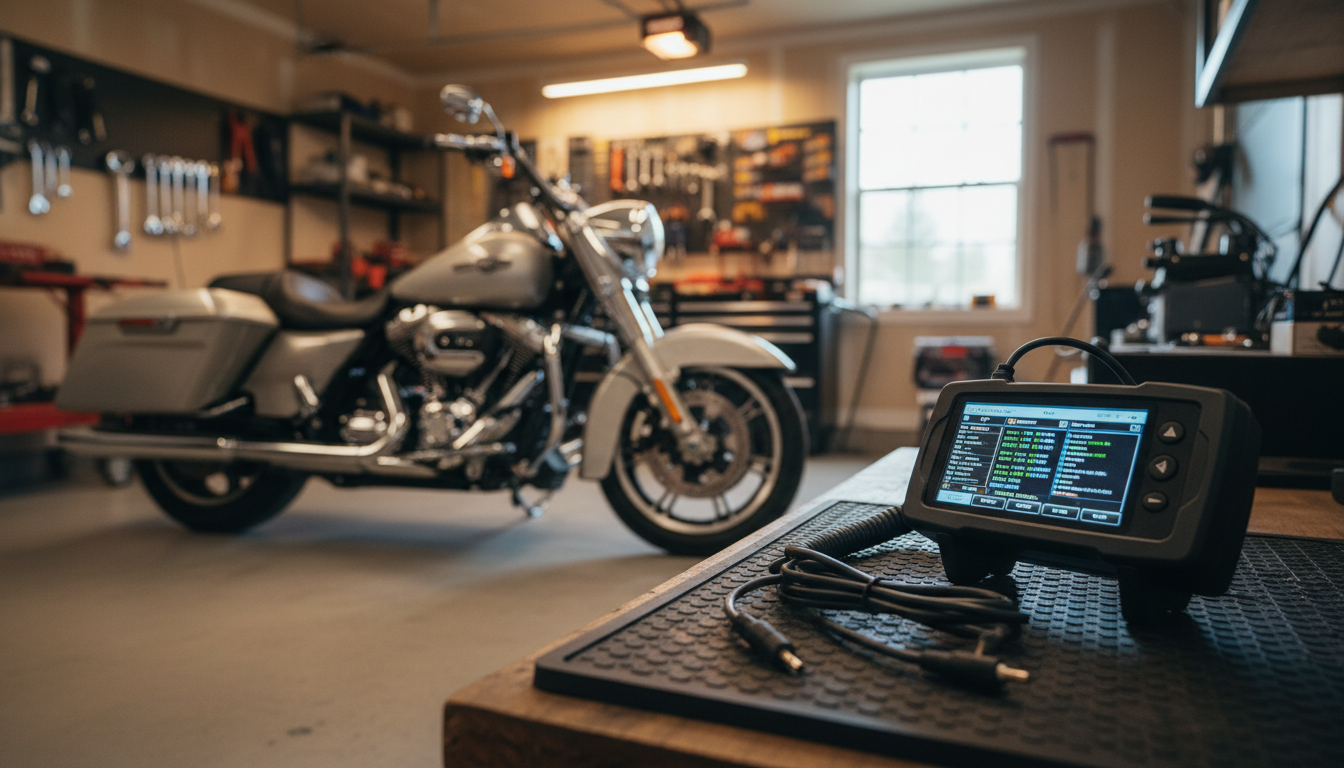
Type “best OBD2 scanner for Harley-Davidson” into a search bar and most of what comes back is written like Harley uses the same 16-pin port as a Honda Civic. It does not. Plug a car-shop code reader’s cable straight into the connector under your seat or side cover and it will not physically seat, on any model year covered by the Harley factory service manuals our research desk checked.
We spent this research pass inside the actual Harley-Davidson Electrical Diagnostics and Service Manuals, the books techs use, to document what the connector is really called, how its pin count changed across Touring, Dyna, Softail, and Sportster years, and exactly which tasks require Harley’s own DIGITAL TECHNICIAN II versus what you can check for free with your odometer’s trip-reset button. Then we lined that up against six scan tools and adapter cables sold for Harley diagnostics, from a bare cable to a shop-grade multi-brand unit.
Let’s get into it.
Key Takeaways
Short on time? Here is what our research desk found before you scroll through the rest.
- Harley’s factory service manuals call the diagnostic port a Data Link Connector (DLC), and it is a Deutsch-style connector with 4 or 6 pins depending on model and year, not the 16-pin trapezoidal port a generic car OBD2 cable is molded to fit.
- The bus protocol changed generations too: manuals document SAE J1850 on 2008 through 2011 Touring, Softail, Dyna and Sportster models, and a CAN bus architecture confirmed by the 2013 Dyna and Softail manuals and the 2019 Touring Milwaukee-8 manual.
- You can read and clear ECM, TSM/TSSM/HFSM, speedometer, tachometer, and ABS trouble codes for free, with no tool at all, using the documented odometer trip-reset button sequence, covered in full below.
- Per the manuals, only Harley’s own DIGITAL TECHNICIAN II (or a tool built to replicate its functions) can program a replacement ECM or ABS module, run the ABS bleed “ABS Service” routine, or drive actuator/output tests.
- Our six picks below run from a plain adapter cable to a shop-grade multi-brand scanner, tiered by what each is actually built to do, not by brand recognition.
Will a Regular Car OBD2 Scanner Work on My Harley-Davidson?
Short answer: the plug stops you before the software ever gets a chance to.
Every Harley service manual our research desk checked, across Touring, Dyna, Softail, and Sportster, calls the diagnostic port a Data Link Connector (DLC). It’s a Deutsch-style sealed connector, not the black 16-pin trapezoidal SAE connector bolted under the dash of nearly every car sold in the US since the mid-1990s. Depending on model and year, Harley’s DLC carries 4 pins or 6 pins. A standard car scanner’s cable was never designed to seat in either one, which is why the cheap code reader already in your toolbox for your truck cannot simply be handed to your Harley.
The “OBD” label is a trap on one platform. The 2019 Touring Milwaukee-8 manual lists a separate connector labeled “[91C] OBD” in its wiring tables. But per the manual’s own spec, it’s a 6-way Sumitomo connector, not the 16-pin SAE shape. We searched our entire manual library for “SAE J1962,” the standard defining the automotive 16-pin connector shape, and found zero hits. Even where Harley’s documentation uses the word “OBD,” it isn’t describing the industry-standard automotive plug.
Adapter cables exist that convert a car scanner’s 16-pin connector down to Harley’s 4-pin or 6-pin Deutsch shape (see our adapter pick below), so the physical mismatch is solvable. Here’s the honest limit: the manuals document the connector’s shape and the bus protocol running through it, SAE J1850 on older bikes, CAN on newer ones, but say nothing about which third-party scanner software correctly decodes that bus once the cable fits. That’s a question the scanner’s own compatibility list answers, not something Harley’s manuals settle either way. Don’t assume a cheap adapter plus your existing car scanner will read Harley codes, and don’t assume it categorically won’t either; it depends on whether that scanner’s firmware was built to speak Harley’s protocol.
Once you do get a reading, our guide to Harley check engine light and DTC codes covers what the codes actually mean, or you can run the code straight through our free Harley DTC code decoder tool.
Harley-Davidson Diagnostic Connector by Model and Year
This is the table most “best OBD2 scanner” articles skip entirely: which physical port you are actually plugging into, by model and year, straight from Harley’s own factory manuals.
| Family | Years Confirmed | DLC Type | Location (as printed in manual) |
|---|---|---|---|
| Touring | 2009, 2011, 2012, 2014, 2016 | 4-place Deutsch [91]. The 2014 and 2016 manuals also list a second 6-way DLC [91-2] | Under left side cover |
| Touring (Milwaukee-8) | 2019 | 6-way Deutsch DT Sealed [91], plus the same second 6-way DLC [91-2] | Under / behind left side cover |
| Softail | 2010 | 4-place Deutsch | Under seat |
| Softail | 2013 | 6-place Deutsch DT Sealed | Under seat |
| Softail | 2018, 2020 | 6-place Deutsch DT Sealed | Behind left side cover |
| Dyna | 2008, 2009 | 4-place Deutsch | Under electrical caddie cover |
| Dyna | 2013, 2014 | 6-place Deutsch DT Sealed | Under left side cover |
| Sportster | 2011, 2013 | 4-place Deutsch DT Sealed | Under left side cover |
Treat the years above as confirmed data points, not a complete timeline. Our manual library has gaps, so the exact 4-pin to 6-pin cutover cannot be pinned down closer than a bracket in three of the four families:
- Softail: 4-pin in 2010, 6-pin by 2013. No 2011-2012 manual in our library to narrow the gap.
- Dyna: 4-pin in 2008-2009, 6-pin by 2013-2014. No 2010-2012 manual in our library.
- Touring: the primary connector [91] is 4-place through 2016 and 6-way on the 2019 Milwaukee-8. The second 6-way DLC [91-2] is not a Milwaukee-8 addition: it is already listed in the 2014 and 2016 Twin Cam manuals. No 2017-2018 manual in our library to pin down when the primary connector changed.
- Sportster: 4-pin confirmed through 2013, the newest readable manual we have. A 2016 Sportster manual file exists but failed to OCR, so any change after 2013 is unconfirmed.
Scope limit: our library covers Milwaukee-8 through the 2018 Softail (94000529) and 2019 Touring service manuals, which is where the Milwaukee-8 rows above come from. It does not include Revolution Max models from 2021 on, so nothing here is extrapolated to those bikes. Model years we have no manual for are marked as gaps rather than filled in by assumption.
The bus protocol changed generations too. The 2008 Touring, 2008 Softail, 2009 Sportster, and 2011 Touring manuals describe an SAE J1850 bus linking the ECM, instruments, and turn signal/security module. By 2013 (Dyna, Softail) and again in 2019 (Touring M8), that architecture is a CAN bus instead, with “U0001, CAN BUS fault” in the code list by then. Sportster is the outlier: its newest readable manual, from 2013, still describes single-wire “serial data,” never titled “CAN.” No source in our library states one clean switchover year, so be skeptical of any article that gives you one.
| iCarsoft MT V6 Motorcycle Diagnostic Scan Tool for Harley-Davidson |  |
Best Overall | Reset Services: 57 (per listing) | Actuation Tests: 43 (per listing) | Dual-Use: Also a car OBD2 scanner | VIEW LATEST PRICE | Read Our Analysis |
| FXTUL M4 Motorcycle Diagnostic Tool for Harley-Davidson (4/6 Pin) |  |
Best Dedicated Harley Tool | Connector: 4-pin and 6-pin Harley DLC | Focus: Harley-Davidson specific | Design: Not a universal car scanner | VIEW LATEST PRICE | Read Our Analysis |
| TOPDON TopScan Moto Bi-Directional Motorcycle Scanner |  |
Best Budget Scan Tool | Control: Bi-directional (per listing) | Category: Motorcycle-specific | Tier: Entry-level full scanner | VIEW LATEST PRICE | Read Our Analysis |
| Autel Original Harley-Davidson OBD2 Adapter (4+6 Pin) |  |
Best Adapter Cable Only | Type: Cable, not a standalone scanner | Connector: 4-pin + 6-pin Harley DLC | Brand: Autel | VIEW LATEST PRICE | Read Our Analysis |
| OBDPROG Moto100 Full-System Motorcycle Diagnostic Scanner |  |
Best Bi-Directional / Advanced | Active Tests: Supported (per listing) | Multi-Brand: Harley, Honda, Yamaha, Kawasaki, Suzuki, BRP | Tier: Advanced / prosumer | VIEW LATEST PRICE | Read Our Analysis |
| ANCEL MT700 Full-Systems Motorcycle Diagnostic Scanner |  |
Best Shop-Grade / Multi-Brand | Display: 7-inch touchscreen | Multi-Brand: 8 brands including Harley | Reset Functions: 35+ (per listing) | VIEW LATEST PRICE | Read Our Analysis |
More Details on Our Top Picks
iCarsoft MT V6 Motorcycle Diagnostic Scan Tool for Harley-Davidson
Of the six tools here, the iCarsoft MT V6 lists the deepest test menu: 57 reset services and 43 actuation tests, per its Amazon listing, plus battery testing and live data.
The listing states it also functions as a standard car OBD2 scanner, meaning its software supports the generic automotive protocol too, a separate question from whether the unit ships with the correct 4-pin or 6-pin Harley DLC cable. iCarsoft’s title doesn’t spell out pin count the way some others here do, so confirm the included cable against our connector table above first.
Actuation tests and live data sit in the same functional territory Harley’s manuals reserve for DIGITAL TECHNICIAN II: driving an output, watching a live sensor value, running a component test. We can confirm that category of function exists and what it’s for; we can’t confirm whether this specific tool’s actuation tests replicate DT2’s exact procedures, since Harley’s documentation doesn’t discuss third-party scanner compatibility.
Best for someone who wants the widest single-tool test menu here and doesn’t mind confirming cable compatibility for their model year first.
- Brand:iCarsoft
- Reset services:57
- Actuation/active tests:43
- Battery test:Included
- Live data:Supported
- Dual-use:Also usable as a standard car OBD2 scanner
- Connector/cable:Not itemized in the listing title; confirm 4-pin/6-pin compatibility before buying
- Best for:Widest single-tool test menu in this roundup
- Tier:Mid-range, motorcycle-specific
FXTUL M4 Motorcycle Diagnostic Tool for Harley-Davidson (4/6 Pin)
Unlike the general motorcycle scanners here, FXTUL markets the M4 specifically for Harley-Davidson and states 4/6 pin compatibility directly in the title, matching exactly the two Deutsch DLC pin counts our connector table documents across Harley’s range.
That distinction isn’t marketing filler: Harley used a 4-place Deutsch DLC on older Touring, Dyna, Softail, and Sportster models, and moved to a 6-place Deutsch DLC on newer Dyna/Softail (by 2013) and the Touring Milwaukee-8 (confirmed 2019), per the manuals cited in our connector table. A tool covering both pin counts is built around Harley’s actual hardware, not a generic universal bus.
The tradeoff is depth versus focus: FXTUL’s listing doesn’t quote a reset or actuation-test count the way iCarsoft’s does. A nearly identical listing exists under the QPKING brand at the same price point; we feature only one so we’re not recommending duplicate hardware under two names.
Good fit for an owner who only ever plugs into a Harley DLC and doesn’t need the tool to double as a car scanner.
- Brand:FXTUL
- Connector:4-pin and 6-pin Harley DLC
- Focus:Harley-Davidson specific
- Diagnostic scope:Motorcycle diagnostics
- Dual-use:Not marketed as a car OBD2 scanner
- Best for:Owners who only diagnose a Harley
- Tier:Harley-specific, mid-price
- Note:A near-identical “M4” listing exists under a different brand at the same price; we feature only one
TOPDON TopScan Moto Bi-Directional Motorcycle Scanner
Of the full standalone scanners here (versus the plain adapter cable below), this is the lowest tier, and it still lists bi-directional control per its Amazon listing, a feature budget motorcycle scanners often skip in favor of read-only access.
Bi-directional control means the tool can command a component rather than only reading a sensor value back, the same territory Harley’s manuals describe under actuator/output testing. Whether TOPDON’s bi-directional functions specifically cover Harley ECM or ABS actuators isn’t something we can confirm from either the manuals or the listing.
One honest gap: TOPDON’s title doesn’t mention Harley-Davidson or a pin count at all. Confirm through listing photos or Amazon’s Q&A that it’s compatible with the 4-pin or 6-pin Deutsch DLC your model year requires, using our connector table above.
Good fit for a rider on a tighter budget who still wants real bi-directional testing, and is comfortable double-checking cable compatibility first.
- Brand:TOPDON
- Model:TopScan Moto
- Bi-directional control:Supported
- Category:Motorcycle-specific scan tool
- Harley/connector specifics:Not stated in the listing title; confirm before buying
- Dual-use:Marketed as a motorbike scanner, not a car scanner
- Best for:Budget buyers who still want bi-directional testing
- Tier:Entry-level full scanner
Autel Original Harley-Davidson OBD2 Adapter (4+6 Pin)
This is not a scan tool, it’s the cable, and it answers the “will my car scanner work” question about as directly as a listing can: Autel states 4+6 pin coverage, adapting a standard 16-pin connector down to either Deutsch pin count Harley has used, per our connector table above.
Autel is a recognized diagnostic tool manufacturer, which counts for something in a category otherwise full of unbranded cables. But the honest limit is the same one from our wedge section earlier: an adapter converts the plug shape. It doesn’t guarantee whatever scanner you plug into the other end can correctly decode Harley’s bus protocol or DTC set, that depends entirely on the scanner’s own firmware.
Pairs naturally with a scanner you already own, if its software is documented to support motorcycle or CAN-bus protocols, or as a backup cable alongside one of the dedicated tools elsewhere in this roundup.
Best for owners who already have a capable scanner and just need the adapter, or want the lowest-cost entry point and accept the compatibility uncertainty above.
- Brand:Autel
- Type:Adapter cable only, not a standalone scan tool
- Connector:4-pin and 6-pin Harley DLC support
- Other end:Standard 16-pin car OBD2 connector (adapter function)
- Diagnostic capability:None on its own; depends on the paired scanner
- Best for:Owners who already own a compatible scanner
- Tier:Lowest-cost entry point in this roundup
OBDPROG Moto100 Full-System Motorcycle Diagnostic Scanner
OBDPROG steps up from the budget and mid tiers with active tests, bi-directional control, and service reset called out explicitly in the listing, plus multi-brand coverage across Harley, Honda, Yamaha, Kawasaki, Suzuki, and BRP.
The listing’s wording, “selected ECU functions,” suggests feature availability is brand and model dependent rather than identical across all six brands, a common pattern in multi-brand scanners. Worth confirming Harley-specific coverage against OBDPROG’s current supported-vehicle list before assuming every function works on every model.
Active tests and bi-directional control sit in the same category Harley’s manuals reserve for DIGITAL TECHNICIAN II: actuator/output commands and service resets after a part swap. Whether this tool replicates that job fully on a specific Harley model is a scanner-software question our source manuals don’t address.
Good fit for DIY owners doing their own part swaps who want reset and active-test capability without dealer-tool pricing, and who work across more than one powersport brand.
- Brand:OBDPROG
- Model:Moto100
- Active tests:Supported
- Bi-directional control:Supported
- Service reset:Supported
- Multi-brand:Harley, Honda, Yamaha, Kawasaki, Suzuki, BRP
- ECU function coverage:“Selected” per brand/model, per listing; confirm Harley coverage first
- Best for:Multi-bike garages, DIY service resets after part replacement
- Tier:Advanced / prosumer
ANCEL MT700 Full-Systems Motorcycle Diagnostic Scanner
Top of this roundup by stated capability: ANCEL’s listing covers full-system diagnostics, including ABS, engine, instrument cluster (“meter”), and TPMS, across eight listed brands including Harley-Davidson, on a 7-inch touchscreen with 16GB of storage.
The listing also states 35+ reset functions and an “AutoVIN” feature that reads the VIN automatically instead of requiring manual entry. If you want to cross-reference that VIN against recall data yourself, our own Harley VIN decoder tool pulls from the same kind of public vehicle data.
ABS access deserves a specific caution. Harley’s manuals gate the ABS bleed procedure, called “ABS Service,” and ABS module programming exclusively behind DIGITAL TECHNICIAN II, confirmed across the 2009 Touring, 2013 Dyna, and 2020 Softail manuals. A scanner claiming ABS access on Harley platforms is stepping into territory the manuals treat as DT2’s job; we can’t confirm ANCEL’s ABS functions include that specific bleed routine, so confirm it with ANCEL directly if that’s why you’re buying it.
Best for riders or small shops working across multiple brands who want the widest single-tool coverage here and are willing to pay for it.
- Brand:ANCEL
- Model:MT700
- Display:7-inch touchscreen
- Storage:16GB
- Reset functions:35+
- Systems covered:Full systems, including ABS, engine, instrument cluster, TPMS
- VIN:AutoVIN automatic VIN read
- Multi-brand:Harley-Davidson, Indian, Yamaha, Polaris, Piaggio, Ducati, Honda, BMW
- Best for:Multi-brand shops or collectors; widest feature set in this roundup
- Tier:Shop-grade / professional
How to Read Harley Diagnostic Codes Without a Scan Tool
Here is the part almost nobody selling a scanner wants you to know first: your Harley can already tell you a lot for free.
Harley’s manuals describe two diagnostic tiers. The first is DIGITAL TECHNICIAN II (Part No. HD-48650), the dealer-level tool. The second, built into every bike with a digital odometer, is the trip odometer’s self-diagnostic mode: it displays and clears stored codes from the ECM, TSM/TSSM/HFSM, speedometer, tachometer, and ABS module (where equipped), using only the trip-reset button. We found identical or near-identical wording for this procedure across the 2011 Touring, 2013 Dyna, 2013 Softail, and 2013 Sportster manuals, so it’s not a one-model quirk.
Here is the documented sequence:
- Press and hold the trip odometer reset switch while turning the ignition ON.
- Release the switch. “diag” appears on the odometer display.
- Press and release the switch once. “PSSPtb” appears on the display, listing the modules that can show codes.
- Quickly press and release the switch to cycle through the letters. Hold the switch when the letter for the module you want is flashing.
- If no codes are stored, “none” appears. If codes are stored, they appear one at a time; press and release the switch to cycle through them.
- Once every code has cycled, the display shows “end.”
- To clear all codes in that module, press and hold the switch. To leave them, press and release quickly. Turn the ignition OFF to exit.
The letters in “PSSPtb” pick a module, not the code prefix itself: P is ECM, S is TSM/TSSM/HFSM, SP is speedometer, t is tachometer, and b is ABS. Cross-referencing this menu against the separate DTC prefix table in the same manuals (our own cross-reference, not one sentence stated this way in the source): the ECM screen shows codes starting with P, the TSM/TSSM/HFSM screen shows B, and the ABS screen shows C. Bus-communication faults show a U prefix regardless of screen.
| Prefix | Module | Example | Manual-Stated Meaning |
|---|---|---|---|
| P | ECM | P0603 | ECM EEPROM error |
| B | TSM/TSSM/HFSM | B1121 | Left turn output fault |
| C | ABS module | C1017 | Pump motor power circuit open fault |
| U | Serial data bus | U0001 | CAN BUS fault |
One failure mode worth knowing before you rely on it. The 2013 Dyna Electrical Diagnosis manual carries a dedicated section titled “Odometer Self-Diagnostic Inoperative: DTC U0001, U0011, B2274” (section 2.3). Those are CAN bus and constant-battery-line faults, so the free method can stop working in exactly the situation where a communication fault is what you were trying to diagnose. If the sequence gives you nothing, that silence is itself information, and it is the point where a scan tool starts earning its price.
Three honest gaps. Radio/infotainment codes are excluded from both DT2 and the odometer method; radio DTCs are read through the radio’s own display instead. We couldn’t confirm whether the odometer literally displays the alphanumeric code (“P0603”) or a different internal number, though repair procedures are indexed by that same code, suggesting it does. And the manuals never directly state the odometer method can’t show live data or run actuator tests; those procedures are just filed exclusively under DIGITAL TECHNICIAN II or bench-test sections elsewhere, never under odometer self-diagnostics. That last point is our own structural reading, not a direct quote, and we want to be upfront it’s an inference.
A common myth, checked against the manuals: does disconnecting the battery clear Harley trouble codes? We found no manual statement that it does. The manuals document historic DTCs clearing themselves after 50 ignition cycles with no new fault, and the odometer method above clearing codes on command. Battery-service warnings we found are about shock and explosion risk, not code erasure. Don’t count on pulling a terminal to reset a check-engine light; use the odometer clear step instead.
What Actually Requires a Scan Tool
The odometer trick covers a lot of ground for free. Here is exactly where the manuals say it stops.
Module programming after a replacement. When an ECM or ABS ECU is replaced, the manuals are direct: “use DIGITAL TECHNICIAN II (Part No. HD-48650) to program the ECU.” No alternative is given anywhere we searched. On CAN-generation bikes (confirmed 2013 Dyna), a replacement speedometer locks itself to the ECM’s stored mileage over a 31.1 mile (50 km) countdown, and displays “VINERR” if that sync does not complete. Note the scope: the manuals document that countdown for speedometer replacement, and do not state an equivalent countdown for ECM replacement.
ABS bleeding. Across the 2009 Touring, 2013 Dyna, and 2020 Softail manuals, brake bleed procedures on ABS-equipped bikes all point to the same step: connect DIGITAL TECHNICIAN II and run the “ABS Service” procedure. No manual bleed alternative is offered for that portion of the job.
Actuator and output testing. The exhaust valve actuator test, for example, requires connecting a Breakout Box (Part No. HD-48637) between the ECM and its harness and forcing outputs with jumpers, a bench-test procedure the odometer mode has no equivalent for. The ABS modulator’s automatic self-test also has different run conditions once DT2 is connected, per the manual’s run-condition list.
Some historic infotainment-bus faults. Per the 2008 Touring manual, a specific range of DTCs “can only be viewed as historic codes using Digital Technician,” catchable as current codes only if they fire while already connected. Some faults on this bus are effectively invisible without a scan tool.
If a code points toward a charging or voltage issue rather than a specific module fault, that’s often worth chasing separately. Our guide to Harley charging system problems and our battery tender roundup both cover that territory in more depth than a single code will.
How to Choose an OBD2 Scanner for Your Harley-Davidson
Picking the right tool comes down to matching what you actually need to do against what each tier in this roundup is built for.
Read Codes for Free Before You Buy Anything
Start with the odometer method covered above. If all you need is to know why a warning light came on, the trip-reset sequence gets you a stored code and lets you clear it, at no cost. Only move on to a purchase if you need something it can’t do: live data, actuator tests, or module programming.
Why the Physical Connector Matters More Than the Brand Name
Before comparing feature lists, confirm the tool actually plugs into your bike. Cross-check your model and year against the connector table above: a 4-pin bike needs a 4-pin cable, a 6-pin bike needs a 6-pin cable, and the two aren’t interchangeable. An impressive feature list is useless if the cable in the box doesn’t match your bike’s DLC.
Check Which Cable Actually Ships in the Box
“For Harley” in a listing title doesn’t automatically mean a tool covers both the 4-pin and 6-pin Deutsch connectors in our table above. The FXTUL M4 and the Autel adapter both state “4/6 pin” or “4+6pin” directly in their titles, the clearest signal you’ll get from a listing alone. iCarsoft, TOPDON, OBDPROG, and ANCEL don’t spell out pin count at all. Check listing photos and Q&A for your model year before buying any of them.
Bi-Directional and Active Tests: What They Actually Buy You
Bi-directional control and active tests, features listed on the TOPDON, OBDPROG, and iCarsoft units above, let a tool command a component instead of only reading its sensor output. That overlaps with what Harley’s manuals reserve for DIGITAL TECHNICIAN II and, in some cases, a Breakout Box. None of the manuals address third-party scanner compatibility, so “bi-directional” or “active tests” on a listing isn’t the same as a manual-confirmed claim that it replicates DT2’s procedures on your model.
When You Genuinely Need Harley’s Own DIGITAL TECHNICIAN II
Three jobs have no documented alternative to DT2: programming a replacement ECM or ABS module, running the “ABS Service” bleed procedure, and Breakout Box actuator testing. None of the six tools here are a manual-confirmed substitute for those; that’s dealer or independent-shop territory with HD-48650 itself.
Harley OBD2 Scanner Comparison Table
All six picks side by side, so you can scan the tiers without scrolling back up.
| Tool | Type | Connector Coverage (per listing) | Bi-Directional / Active Tests | Multi-Brand | Best For |
|---|---|---|---|---|---|
| iCarsoft MT V6 | Full scan tool | Not stated in title | Yes (per listing) | Also functions as car scanner | Widest test menu |
| FXTUL M4 | Full scan tool | 4-pin + 6-pin (stated) | Not stated | Harley only | Dedicated Harley tool |
| TOPDON TopScan Moto | Full scan tool | Not stated in title | Yes (per listing) | Motorcycle-general | Budget bi-directional |
| Autel HD Adapter | Cable only | 4-pin + 6-pin (stated) | N/A (adapter) | Depends on paired scanner | Owners with an existing scanner |
| OBDPROG Moto100 | Full scan tool | Not stated in title | Yes (per listing) | Harley, Honda, Yamaha, Kawasaki, Suzuki, BRP | Multi-bike DIY resets |
| ANCEL MT700 | Full scan tool | Not stated in title | Full systems (per listing) | 8 brands including Harley | Multi-brand shop use |
Frequently Asked Questions
The questions our research desk sees most often around Harley OBD2 scanners and diagnostic connectors.
Will a regular car OBD2 scanner plug into my Harley-Davidson?
Not directly. Harley’s manuals describe the diagnostic port as a Data Link Connector (DLC), a Deutsch-style connector with 4 or 6 pins, not the 16-pin SAE connector a car scanner’s cable is molded to fit. An adapter cable can convert the physical connector, but whether a specific scanner’s software can then read Harley’s codes correctly isn’t something the manuals address.
What is Harley’s diagnostic connector actually called?
Harley’s own manuals call it the Data Link Connector (DLC). Pin count and location vary by family and year: a 4-place Deutsch connector on older Touring, Dyna, Softail, and Sportster models, a 6-place Deutsch connector on newer Dyna/Softail and the Touring Milwaukee-8. Our connector table above lists the years confirmed for each family.
Can I read Harley trouble codes for free, without buying a scanner?
Yes. Harley’s manuals document an odometer trip-reset button sequence that displays and clears stored ECM, TSM/TSSM/HFSM, speedometer, tachometer, and ABS codes at no cost. Live sensor data, actuator tests and module programming are documented only under DIGITAL TECHNICIAN II procedures, never under the odometer method, so plan on a tool for those.
What is DIGITAL TECHNICIAN II, and do I need it?
DIGITAL TECHNICIAN II (Part No. HD-48650) is Harley’s own diagnostic and programming tool, described in the manuals as required for module programming after a replacement, the ABS bleed “ABS Service” procedure, and Breakout Box actuator testing. None of the consumer scanners here are manual-confirmed substitutes for those three jobs.
Does disconnecting the battery clear Harley trouble codes?
We found no statement in the manuals that disconnecting the battery clears stored codes. The manuals document two ways codes clear: the odometer self-diagnostic clear step, and an automatic clear after 50 ignition cycles with no new fault. Don’t rely on pulling the battery to reset a code.
What is the difference between J1850 and CAN bus on a Harley?
Both are serial data bus protocols Harley used in different generations. The 2008 through 2011 Touring, Softail, Dyna and Sportster manuals describe an SAE J1850 bus. By 2013, the Dyna and Softail manuals describe a CAN bus instead, confirmed again in the 2019 Touring M8 manual. Sportster’s newest readable manual, from 2013, still describes single-wire serial data, not CAN.
Can these scanners also work on other motorcycle brands, or on cars?
Several can, per their own listings. The ANCEL MT700 lists Harley, Indian, Yamaha, Polaris, Piaggio, Ducati, Honda, and BMW. The OBDPROG Moto100 lists Harley, Honda, Yamaha, Kawasaki, Suzuki, and BRP. The iCarsoft MT V6 also functions as a standard car OBD2 scanner. The FXTUL M4 is marketed as Harley-specific only.
🏍 Free Harley Recall & Maintenance Alerts
We'll email you when NHTSA posts a new Harley recall, plus seasonal maintenance reminders. No spam, unsubscribe anytime.
By subscribing you agree to our Privacy Policy.
