
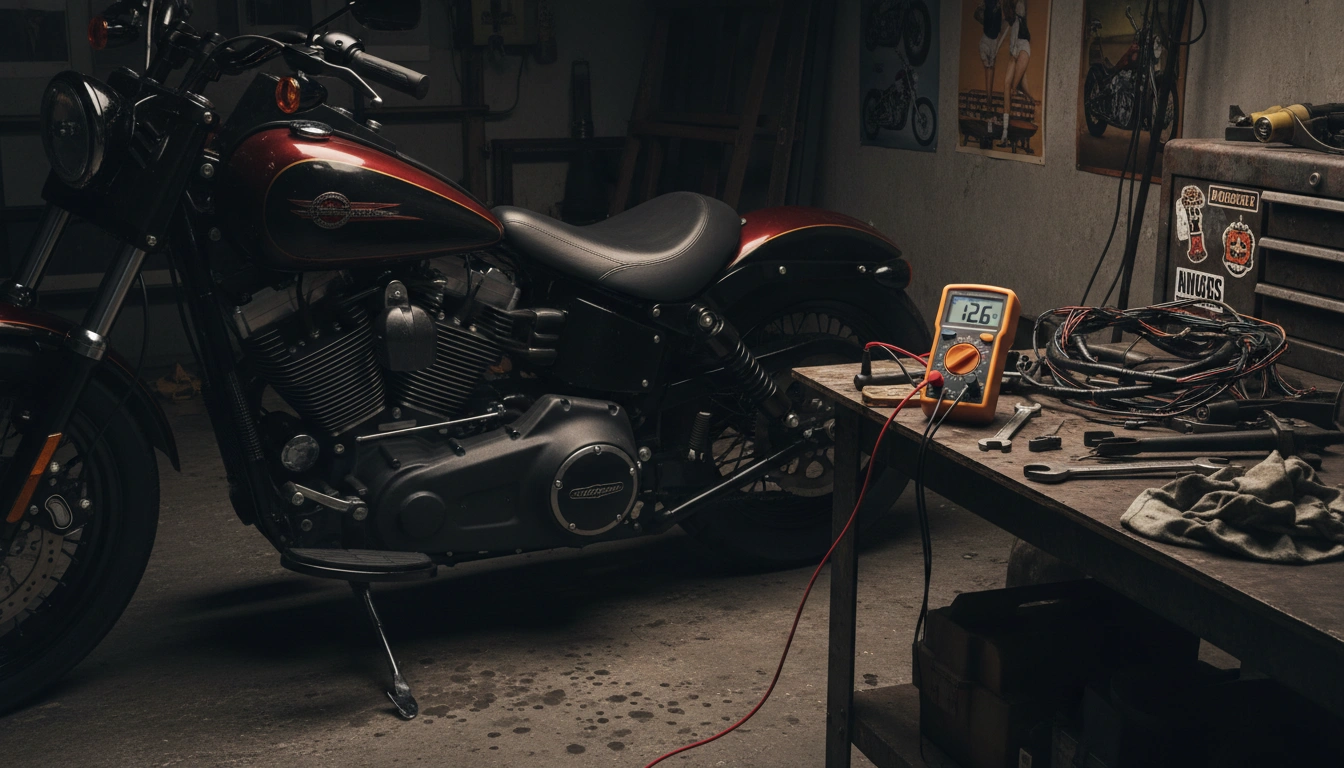
A Harley-Davidson charging system problem shows up fast: battery draining overnight, headlight dimming at idle, or a no-start after a short ride. The good news is that a $20 multimeter and the step-by-step tests below will tell you exactly which component – battery, stator, or voltage regulator/rectifier – is the culprit. Our research team analyzed hundreds of owner reports on HDForums and r/Harley, cross-referenced against official Harley-Davidson service manual test procedures, and built this guide to give you real spec values, not guesses.
The Harley charging system is a three-part circuit: a permanent-magnet alternator stator (AC generator bolted inside the primary case), a rotor (spinning magnet assembly on the sprocket shaft), and a voltage regulator/rectifier that converts stator AC to regulated 13.5–14.5 V DC for the battery. When any part fails, the whole system stops topping up your battery.
Sister posts worth bookmarking: our Harley voltage regulator symptoms deep-dive and the stator problems guide cover component-level failure modes. This post focuses on the diagnostic sequence – where to probe, what numbers to expect, and how to read the results.
What Does the Harley Charging System Actually Do?
The alternator keeps the battery charged while the engine runs and powers your ignition, fuel injection, lights, and accessories. When it under-delivers, the battery is the first casualty – it gradually discharges until there is not enough voltage to fire the starter or maintain spark. On fuel-injected Twin Cam and Milwaukee-Eight models, a sagging electrical supply can also trigger DTC codes and erratic idle behavior before you ever notice dim lights.
Harley Charging System Failure Symptoms
These are the patterns owners consistently report before a complete failure. If you see two or more of these together, start the test sequence below immediately – waiting rarely helps.
| Symptom | Most Likely Cause | Quick Check |
|---|---|---|
| Battery dead after 2–3 days sitting | Weak battery or parasitic draw | Voltage test after overnight disconnect |
| Headlight dims at idle, brightens at RPM | Low stator output or failing regulator | AC output test + voltage test at 2,000 RPM |
| Battery warning light or DTC on dash | Undercharge (below ~12.8 V at cruise) | Voltmeter at battery under load |
| Bike starts fine cold, won’t restart hot | Heat-failed regulator (common on Twin Cam) | Regulator temperature + diode test |
| Burning smell near primary cover | Shorted stator winding or burned regulator | Stator ground-fault test ASAP |
| Frequent bulb failures | Overcharging (regulator not clamping) | Voltage test at cruise – above 15 V = bad regulator |
A 2019 thread on HDForums titled “Twin Cam charging woes – tested everything” had an owner describe exactly this pattern: “Bike would run fine for 30 miles, then on the highway at 65 mph the volt gauge just started dropping slowly. By the time I got home it was at 12.1.” That is a textbook stator failure at temperature.
What You Need Before You Start Testing
You do not need dealer tools for any of these tests – a standard digital multimeter (DVOM) with AC and DC voltage modes, a resistance (ohms) scale, and a diode test function covers everything. The HD service manuals call for the HD-35500 multi-meter, but any DVOM accurate to 0.1 V will return the same readings.
A quality DVOM in the $25–$60 range is more than adequate. If you want to search by spec: look for a multimeter with true RMS AC measurement, auto-ranging, and a diode test mode.
You will also want a battery tender or smart charger on hand – if the battery is discharged below 12.6 V, charge it fully before running these tests, because a weak battery will skew every downstream reading. See our Harley battery tender guide for charger recommendations.
Step 1 – Battery Resting Voltage Test
Start with the battery because a dead cell will make the stator and regulator look bad even when they are fine. This test takes two minutes with the engine off.
1 Turn ignition OFF. Wait 2 minutes (lets surface charge dissipate).
2 Set DVOM to DC Volts. Touch red probe to positive battery terminal, black to negative.
3 Read open-circuit voltage (OCV) and compare to the table below.
| OCV Reading | State of Charge | Action |
|---|---|---|
| 12.7 V or above | 100% charged | Proceed to Step 2 |
| 12.6 V | ~75% charged | Acceptable – proceed, but plan to charge soon |
| 12.3 V | ~50% charged | Charge fully before proceeding |
| 12.0 V | ~25% charged | Charge and load test – battery may be weak |
| Below 11.8 V | Dead / bad cell | Replace battery; stop testing until replaced |
Per the HD Service Manual (2008 Sportster Electrical Diagnostics, Table 1-5): “If the open circuit (disconnected) voltage reading is below 12.6 V, charge the battery and recheck… If the voltage reading is 12.7 V or above, perform the load test.” If you need to charge the battery before retesting, our research desk compared chargers that handle AGM and lithium packs.
Step 2 – Charging Voltage at the Battery (Running Test)
With the battery confirmed good, this test tells you whether the charging system is delivering regulated DC voltage to the battery while the engine runs. A healthy system will read 13.5–14.7 V at cruise RPM; a failed regulator or stator will show battery voltage or lower – the bike is running off the battery alone.
1 Connect DVOM leads to battery terminals (engine OFF first).
2 Start engine. Bring to approximately 2,000 RPM (highway cruise equivalent).
3 Read DC voltage. Turn on headlight (high beam) to add load.
4 Rev to 3,000–3,500 RPM and read again.
| Model / Era | Expected Charging Voltage at 3,600 RPM | Source |
|---|---|---|
| All models (general spec) | 14.3–14.7 V DC @ 75°F (24°C) | HD Service Manual (2013 Dyna Electrical Diagnostics, Table 1-10) |
| Below 13.5 V at cruise | Under-charging – stator or regulator issue | |
| Above 15.0 V sustained | Regulator not clamping – replace regulator immediately | HD Service Manual (2008 Sportster, p. 1-23) |
Step 3 – Stator AC Output Test
The stator test is the most definitive check for alternator health. You are measuring raw AC voltage coming out of the stator before the regulator converts it – this eliminates the regulator as a variable. If AC output is within spec and the charging voltage at the battery is low, the regulator is the problem. If AC output is low, the stator (or rotor) is the problem.
1 Turn ignition OFF. Locate the stator connector (2-wire or 3-wire plug, typically exits the primary case and routes to the regulator near the battery area).
2 Disconnect the stator connector from the voltage regulator. Important: disconnect at the regulator side – you are testing the stator output only.
3 Set DVOM to AC Volts. Connect probes across the two stator connector sockets (for 3-wire stators, test sockets 1-2, then 2-3, then 3-1 – all three pairs should read within spec).
4 Start the engine and run at exactly 2,000 RPM. Read AC voltage.
| Engine Family | Expected AC Output at 2,000 RPM | Per 1,000 RPM Rule | Manual Source |
|---|---|---|---|
| Sportster (Evo 1200/883, TC) | 40–56 VAC | ~20–28 VAC per 1,000 RPM | HD Service Manual (2008 Sportster Electrical Diagnostics, p. 1-25) |
| Touring / Dyna Twin Cam (2007–2016) | 32–46 VAC | ~16–23 VAC per 1,000 RPM | HD Service Manual (2008 Touring Electrical Diagnostics, p. 1-25) |
| Milwaukee-8 Touring (2017+) | 40–55 VAC | ~20–27 VAC per 1,000 RPM | HD Service Manual (2019 Touring M8, Table 8-3, p. 8-5) |
| Dyna (2013, all TC) | 32–46 VAC | ~16–23 VAC per 1,000 RPM | HD Service Manual (2013 Dyna Electrical Diagnostics, Table 1-9) |
Per the HD Service Manual (2019 Touring M8, Table 8-3): “Alternator AC voltage output: 40–55 VAC at 2,000 rpm. Alternator stator coil resistance: 0.1–0.3 Ω.”
Per the HD Service Manual (2008 Touring Electrical Diagnostics, p. 1-25): “Run the engine at 2000 RPM. The AC output should be 32–46 volts AC (approximately 16–23 per 1000 RPM).”
Step 4 – Stator Resistance (Ohms) Test
This static test (engine off, stator connector still disconnected) checks for two conditions: a shorted stator winding to ground (which will cook your regulator), and an open or high-resistance winding (which reduces output). It takes about 90 seconds.
1 Set DVOM to ohms (Ω) scale. First: short the probes together and verify the meter reads 0.0 Ω – subtract any lead resistance from your readings.
2 Ground fault test: Touch one probe to a stator socket, the other to bare engine ground (not battery ground). A good stator shows NO continuity (open circuit / OL). Any continuity reading = grounded stator – replace immediately.
3 Winding resistance test: Remove the ground probe. Check resistance across the two stator sockets (on 3-wire stators: test all three socket pairs – 1-2, 2-3, 3-1).
| Engine Family | Stator Coil Resistance (All Pairs) | Ground Fault Reading | Manual Source |
|---|---|---|---|
| Sportster 2008 (Evo/TC) | 0.1–0.3 Ω | Open circuit (no continuity) | HD Service Manual (2008 Sportster Electrical Diagnostics, p. 1-24) |
| Touring / Dyna Twin Cam | 0.1–0.2 Ω | Open circuit (no continuity) | HD Service Manual (2008 Touring Electrical Diagnostics, p. 1-24) |
| Milwaukee-8 Touring 2019 | 0.1–0.3 Ω | Open circuit (no continuity) | HD Service Manual (2019 Touring M8, Table 8-3) |
| Dyna 2013 (all TC) | 0.1–0.2 Ω | Open circuit (no continuity) | HD Service Manual (2013 Dyna Electrical Diagnostics, Table 1-9) |
Per the HD Service Manual (2008 Touring Electrical Diagnostics, p. 1-24): “Resistance across all the stator sockets should be 0.1–0.2 ohms. If the resistance is higher, the stator is damaged and must be replaced. If the resistance is lower, it could indicate turn-to-turn shorts.”
Per the HD Service Manual (2008 Sportster Electrical Diagnostics, p. 1-24): “A good stator will show no continuity between either stator socket and ground. Any other reading indicates a grounded stator which must be replaced.”
Step 5 – Voltage Regulator / Rectifier Test
The regulator/rectifier on a Harley is a single unit – it both rectifies (converts AC to DC) and regulates (clamps voltage at 14.3–14.7 V). The most common failure modes are: heat-damaged diodes (especially on Twin Cam models where the regulator mounts near the exhaust), shorted diodes that let voltage spike unchecked, and open diodes that reduce current output.
A shorted or failing regulator is described repeatedly in forum threads. One r/Harley post from a 2006 Road King owner read: “Replaced battery twice in 14 months, bike running rough over 3500 RPM. Finally tested the stator output – 42 VAC, fine. Checked charging voltage – 15.8 V at idle. Regulator was cooking the battery from day one.” That is a classic regulator failure pattern: good stator, failed regulator clamp function.
1 Diode test (basic pass/fail): Set DVOM to diode test mode. Disconnect the regulator from the bike. Probe the AC input terminals (from stator) to the DC output terminal (to battery positive). A healthy diode allows current in one direction only – probe polarity and check for a reading in one direction, open circuit (OL) in the other. A reading in BOTH directions = shorted diode = replace regulator.
2 Voltage clamp test (engine running): As performed in Step 2 above – if DC charging voltage at battery exceeds 15.0 V sustained at any RPM, the regulator is not clamping. Replace it immediately to avoid boiling the battery and frying electronics.
3 Heat soak test: If symptoms only appear after 20+ minutes of riding (warm engine), run the bike until hot, then immediately test charging voltage. Regulators that fail hot often test fine cold – this is the defining characteristic of heat-death regulator failure.
For a deeper symptom map of regulator failure, see our companion post: Harley voltage regulator symptoms – how to diagnose yours.
Evo vs. Twin Cam vs. Milwaukee-8: Key Charging Differences
The fundamental test procedure is identical across all three engine families – but the spec values differ, and so do the common failure patterns. Here is what to know before you start testing.
| Engine Family | Years | Stator Output @ 2,000 RPM | Stator Resistance | Known Failure Pattern |
|---|---|---|---|---|
| Evolution (Evo) | 1984–2000 (Big Twin) 1986–2003 (Sportster) | 40–56 VAC (Sportster) ~32–46 VAC (Big Twin) | 0.1–0.3 Ω | Worn rotor magnets after high mileage; older stator connectors corrode |
| Twin Cam (TC) | 1999–2017 (Big Twin) | 32–46 VAC (Touring/Dyna) | 0.1–0.2 Ω | Regulator heat failure (especially TC88 era, 1999–2006); stator connector [46B] corrosion |
| Milwaukee-8 (M8) | 2017–present | 40–55 VAC | 0.1–0.3 Ω | Higher output system; max rated 46–50A. Less historical data but similar test procedure |
The Milwaukee-8 charging system was significantly upgraded over the Twin Cam. Per the HD Service Manual (2019 Touring M8, Table 8-3), maximum output is rated 46–50 amps – noticeably higher than the Twin Cam’s 35–50 amp spec and the Sportster’s 28–34 amp ceiling. If you are running heavy accessories (heated gear, upgraded audio, driving lights) on an older Twin Cam, you may be near the system’s capacity limit even with a healthy charging system.
What to Check If All Tests Pass But the Battery Still Dies
Sometimes the charging system tests good but the battery keeps draining. The culprit is usually a parasitic draw – something pulling current when the ignition is off. The HD service manual specifies that the voltage regulator itself draws approximately 1 mA at rest; the alarm/TSSM module draws 16–25 mA for up to 30 minutes after shutdown before going to sleep. If your total parasitic draw consistently exceeds 35–40 mA with everything asleep, something is staying on that should not be.
To check: set DVOM to DC milliamps (mA), connect in series between the negative battery terminal and the negative battery cable with ignition off. Wait 10 minutes for the alarm and TSSM to sleep. Normal draw should settle below 3–5 mA. If it stays above 40 mA, pull fuses one at a time until the draw drops – that circuit has a fault.
Separately, a battery that tests fine at 12.7 V under no load but collapses under cranking load has degraded internal capacity – a conductance tester (such as the HD-48053 analyzer or a compatible aftermarket tool) will catch this where a plain voltmeter will not. For more on battery selection and maintenance, see our Harley battery tender guide.
If you suspect the coil or ignition system is creating a secondary issue alongside charging faults, our Harley bad coil symptoms guide covers those diagnostic steps.
Quick Decision Tree: Which Component Failed?
| Charging Voltage (DC @ battery) | Stator AC Output | Stator Resistance | Verdict |
|---|---|---|---|
| Low (below 13.5 V running) | Low (below spec) | Normal (0.1–0.3 Ω, no ground fault) | Weak rotor (degaussed magnets) or stator at temperature – inspect rotor, retest hot |
| Low (below 13.5 V running) | Within spec | Normal | Voltage regulator failed – replace regulator |
| Low (below 13.5 V running) | Low | High resistance or ground fault | Stator failed – replace stator |
| High (above 15.0 V) | Within spec | Normal | Regulator not clamping – replace regulator immediately |
| Normal (13.5–14.7 V running) | Within spec | Normal | Charging system OK – check parasitic draw and battery condition |
Frequently Asked Questions
What voltage should a Harley charge at?
A healthy Harley charging system delivers 14.3–14.7 V DC at the battery terminals at operating temperature and around 3,600 RPM under normal electrical load. Per the HD Service Manual (2013 Dyna Electrical Diagnostics, Table 1-10), the regulator spec is “14.3–14.7V @ 75°F (24°C).” Below 13.5 V indicates undercharging; above 15.0 V indicates a failed regulator clamp.
How do I test a Harley stator with a multimeter?
Disconnect the stator from the regulator. With engine off, set DVOM to ohms and check resistance across the stator socket pair(s) – spec varies by model: Twin Cam Touring/Dyna = 0.1–0.2 Ω; Sportster and Milwaukee-8 = 0.1–0.3 Ω (see table above for sourced specs). Also check from each socket to engine ground – a good stator shows no continuity (open circuit). With engine running at 2,000 RPM, switch to AC volts and check output: Touring/Dyna Twin Cam should read 32–46 VAC; Sportster and Milwaukee-8 should read 40–55 VAC.
What are common signs of a bad Harley voltage regulator?
The most common signs are a battery that repeatedly goes flat, headlights that dim at idle and brighten at higher RPM, charging voltage above 15 V (overcharging), and symptoms that only appear after the bike warms up – the last pattern is characteristic of heat-damaged diodes inside the regulator. See our full voltage regulator symptoms post for the complete list.
Can I ride with a failing charging system?
Short distances only, and only if the battery is fully charged beforehand. On fuel-injected Harleys (fuel-injected Twin Cam and Milwaukee-Eight models), the ECM requires a minimum supply voltage to maintain injection and ignition – our research found that most riders report stalling or no-restart conditions once battery voltage drops below approximately 11.5 V under load. Do not rely on a failing charging system for any ride where a stranding would be dangerous. Carrying a portable jump starter rated for a V-twin is a reasonable stopgap for the ride home, not a substitute for fixing the underlying fault.
How much does it cost to fix a Harley charging system?
Voltage regulator replacement: $80–$220 for the part (OEM or quality aftermarket), plus 30–60 minutes of labor if you DIY. Stator replacement: $120–$350 for the part, but labor is significant – the primary case must be opened, which typically runs 2–3 shop hours. Rotor replacement adds another $80–$150 for the part. Battery replacement on top of a charging system repair: budget $90–$180 for a quality AGM replacement. Full system failure (stator + regulator + battery): $500–$900 all-in at a shop.
Does the Milwaukee-8 have different charging specs than the Twin Cam?
Yes. The Milwaukee-8 alternator is rated for 46–50 amps maximum output per the HD Service Manual (2019 Touring M8, Table 8-3), compared to the Twin Cam Touring specification of 35–50 amps (2013 Dyna, Table 1-10) and the Sportster’s 28–34 amps (2008 Sportster Diagnostics). The stator AC output spec for the M8 is 40–55 VAC at 2,000 RPM – similar to the Sportster range, higher than the older Twin Cam Touring spec of 32–46 VAC. The regulator charging voltage target (14.3–14.7 V DC) is identical across all three platforms.
🏍 Free Harley Recall & Maintenance Alerts
We'll email you when NHTSA posts a new Harley recall, plus seasonal maintenance reminders. No spam, unsubscribe anytime.
By subscribing you agree to our Privacy Policy.
