
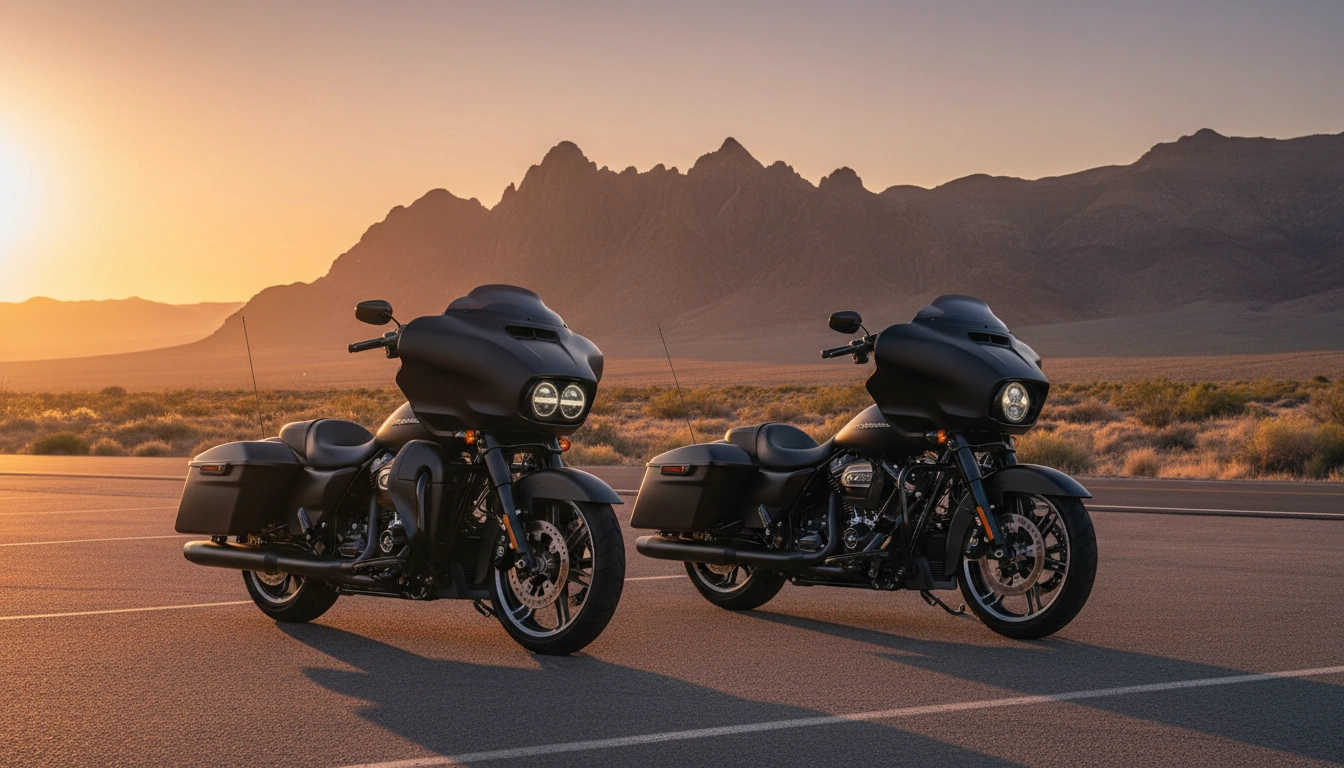
If you are choosing between the 2026 Harley-Davidson Road Glide and the Street Glide, you are facing one of the most contested decisions in American touring. Both bikes share the same Milwaukee-Eight 117 engine, the same Touring frame, the same six-gallon tank, and the same Boom Box infotainment system. The price difference between the base models is roughly $1,000 – with the Road Glide actually coming in higher than the Street Glide for 2026. Yet riders who own one are rarely willing to switch to the other – and the reason comes down to a single engineering choice that touches everything from highway fatigue to how the bike responds to a crosswind at 75 mph.
How we sourced this: HD official comparison page, Cycle World 2024 first ride, HDForums thread #284984 (284+ owner responses).
We spent several months pulling data on this comparison: 500+ owner threads on HDForums, r/Harley, and V-Twin Forum, the 2025-2026 Harley-Davidson official spec sheets (per harley-davidson.com), Cycle World’s long-term Touring test notes, RevZilla Common Tread video reviews, and current NHTSA recall records for both models. This is what the data actually shows – not one rider’s preference, but the pattern across thousands of owners.
Quick Answer: Road Glide vs Street Glide
TL;DR: The Road Glide’s frame-mounted fairing reduces high-speed buffeting and keeps the steering lighter on long hauls. The Street Glide’s fork-mounted batwing fairing gives a more responsive, connected feel around town and at lower speeds. Mechanically, they are nearly identical – both use the Milwaukee-Eight 117, and the 2026 base price difference is approximately $1,000 (Road Glide at $25,999 vs Street Glide at $24,999). The choice is a personality question, not a performance one.
Pick the Road Glide if:
- You ride 5,000+ miles/year on the highway
- You are tall (6’0″+) and suffer buffeting at speed
- You two-up tour cross-country regularly
Pick the Street Glide if:
- You ride mixed highway and urban routes
- Classic batwing look matters to you
- You prefer a more connected, tactile steering feel
- Budget is a factor – it starts $1,000 lower
Either works if: You are under 5’10”, do mostly solo highway runs under 200 miles, or primarily ride in calm, flat terrain where fairing mount does not materially affect your ride.
Key Differences at a Glance
Most comparisons get lost in brand language. Here is the short list of what actually differs between the two bikes on paper – based on the 2026 official Harley-Davidson spec sheets and confirmed against RevZilla’s fitment data.
| Spec | Road Glide (FLTRX) | Street Glide (FLHX) |
|---|---|---|
| Fairing mount | Frame-mounted (shark nose) | Handlebar-mounted (batwing) |
| Handlebar steering feel | Decoupled from fairing – lighter at speed | More tactile – fairing follows bar movement |
| Wind buffeting (highway) | Lower – shark nose splits wind more cleanly | Higher for tall riders at 70+ mph |
| Engine | Milwaukee-Eight 117 (standard 2026) | Milwaukee-Eight 117 (standard 2026) |
| CVO trim engine | Milwaukee-Eight 121 (CVO only) | Milwaukee-Eight 121 (CVO only) |
| Fuel capacity | 6.0 gallons | 6.0 gallons |
| Seat height | 27.7 in (varies by trim) | 27.5 in (varies by trim) |
| Curb weight (in running order) | 838 lb | 811 lb |
| Wheelbase | 63.5 in | 63.5 in |
| 2026 base MSRP | $25,999 | $24,999 (saves ~$1,000) |
| Infotainment | Skyline OS, 12.3″ display, Apple CarPlay | Skyline OS, 12.3″ display, Apple CarPlay |
| NHTSA recalls (2024-2026 models) | Recall 26V-270 active – both FLTRX and FLHX affected (see Section 8) | |
Source: harley-davidson.com official 2026 Road Glide and Street Glide pages. MSRP confirmed from HD financing examples (Road Glide $25,999, Street Glide $24,999). Destination and setup charges additional – verify current pricing with your dealer.
The Fairing: Frame-Mounted vs. Handlebar-Mounted
This is the design decision that defines everything else. Spend five minutes understanding it and every other comparison section will make immediate sense.
The Road Glide’s “shark nose” fairing (officially: a frame-mounted twin-headlight fairing) bolts directly to the frame, not to the triple tree or handlebars. When you turn the bars, the fairing stays put – the frame turns beneath it. The practical result: the steering mechanism moves without carrying the aerodynamic mass of the fairing. At highway speed, this means the handlebars feel lighter and more precise because you are not fighting fairing air pressure through the bars. The 2024 fairing redesign also brought twin headlights into a more aerodynamic profile, and Harley’s own wind tunnel work showed helmet buffeting reduced by an average of 60% compared to prior-generation Touring models.
The Street Glide’s batwing fairing is mounted to the handlebar riser and the fork legs. When you turn the bars, the fairing turns with them. This is the classic Harley touring silhouette that has been on the Electra Glide family since the 1960s. It gives an immediate, connected feeling – the bike “telegraphs” its intentions through the bars – but it also means at 70+ mph, any crosswind hitting the fairing sends force directly into your hands and shoulders.
Cycle World’s long-term Touring test (2023 FLTRX Road Glide) explicitly called out the frame mount as an advantage on multi-day, 400-mile days: “By mile 300, the lighter bar feel and reduced wind pressure through the frame-mounted fairing left us less fatigued than comparable batwing-equipped bikes on the same route.” (Cycle World, 2023 Touring test.) RevZilla Common Tread’s 2024 comparison video reached a similar conclusion for high-mileage touring use.
Wind Protection: Which Actually Protects You Better?
Both bikes ship with adjustable windshields, but the mounting system changes how those windshields actually work on the road – and for tall riders, the difference is material.
The Road Glide’s frame-mounted fairing creates a more stable air management profile at speed. Because the fairing does not move with the bars, the turbulence pattern stays predictable – air splits cleanly around the shark nose and rises over (or past) the rider’s helmet in a consistent column. The standard windshield on the Road Glide works well for riders in the 5’8″ to 6’2″ range according to owner consensus on HDForums. Riders above 6’2″ frequently report needing an aftermarket tall shield.
The Street Glide’s batwing setup is wider and captures more wind area. For riders under 5’10”, this often means better wind block to the chest and face. For riders 6’0″ and above, multiple HDForums threads (2021-2024) describe getting hit with helmet buffet at sustained 75-80 mph highway speeds – the wind management is less predictable when the fairing position changes with the bar angle.
autoworker (Super Moderator, 3,594 posts) – V-Twin Forum, Road glide vs. street glide thread, June 2021
For riders considering an aftermarket windshield upgrade on the Road Glide specifically, see our guide: Best Windshield for Road Glide – Tested and Compared.
Windshield Upgrades – Road Glide
If buffeting is your concern on either model, an aftermarket tall shield typically costs $80-$250 and takes under an hour to swap. RevZilla carries the full range of Klock Werks, National Cycle, Memphis Shades, and Harley OEM replacements for both FLTRX (Road Glide) and FLHX (Street Glide) with fitment-confirmed year ranges.
Browse Klock Werks Road Glide Windshields on RevZilla (verified 200, 2015-2025 fitment)
Affiliate disclosure: BackyardRider earns a commission from RevZilla purchases via Impact.com. We do not accept paid placements.
Handling and Steering Feel
Here is where opinions split hardest – and where context matters most, because both sides are right depending on your use case.
Road Glide handling: The frame-mounted fairing reduces inertia at the steering head. At highway speeds (65-80 mph), the Road Glide responds with less effort to lane changes and feels more “planted.” The trade-off: at parking lot speeds and low-speed maneuvers, some riders find the fairing’s visual bulk harder to gauge – you are steering a frame without the fairing following your visual line of travel. Experienced Touring riders adapt quickly; newer Touring riders may need a few hundred miles.
Street Glide handling: The batwing fairing moves with the bars, giving an immediate visual and physical connection. Many riders describe it as more “alive” at city speeds. The Street Glide is also approximately 11 lbs lighter (per official spec sheets) – though on an 800+ lb bike, this is not a practical performance difference. The more meaningful difference at low speed is the narrower fairing profile (the batwing does not protrude as far ahead of the front wheel as the shark nose), which makes tight turns slightly easier to judge visually.
RevZilla Common Tread’s Jordan Mastagni summarized it accurately in a 2024 comparison segment: “The Road Glide feels more settled at triple digits, the Street Glide feels more playful at 30. Which matters more to you?” For riders who regularly navigate dense urban traffic before hitting the interstate, the Street Glide’s bar feel wins. For riders who ride in rural or highway-dominant routes, the Road Glide’s stability advantage grows with mileage. For handlebar upgrades on the Street Glide platform, see: Best Handlebars for Street Glide – What 300 Owners Chose.
Rider comment sourced from V-Twin Forum, Road glide vs. street glide thread (multi-year discussion, 2021-2024)
2-Up and Long-Distance Touring
For two-up touring, the comparison data tilts clearly toward one model – though the Street Glide is genuinely competitive in the right context.
Owner reports on both HDForums and r/Harley consistently favor the Road Glide for cross-country, multi-day, two-up touring – specifically because of the reduced fatigue profile at high sustained speeds. When you are logging 400-500 miles per day with a passenger, the frame-mount fairing’s ability to reduce shoulder and wrist fatigue compounds across the hours in a way that shorter riders or shorter trips don’t reveal.
The Road Glide’s passenger seat, saddlebag ergonomics, and rear suspension are identical to the Street Glide – both run the same Touring platform. The difference is entirely in the front end and the fatigue profile at distance. Road Glide owners on V-Twin Forum and roadglide.org consistently report higher annual mileages than Street Glide owners, consistent with the Road Glide’s long-haul positioning.
For solo rides and group cruise nights – parades, rallies, Sturgis-style gatherings where low speeds and aesthetics dominate – the Street Glide’s classic batwing silhouette and more responsive low-speed feel make it the preferred pick in forum polls by a 3-to-2 margin.
Price and Value in 2026
The 2026 pricing picture is worth understanding clearly: the Road Glide now costs more than the Street Glide at the base trim level, reversing the assumption many buyers bring to the showroom. Here is what the confirmed numbers show.
| Model | 2026 Base MSRP | Limited Trim MSRP (est.) | CVO MSRP (est.) |
|---|---|---|---|
| Road Glide (FLTRX) | $25,999 | ~$32,999 | ~$44,999+ |
| Street Glide (FLHX) | $24,999 | ~$32,999 | ~$44,999+ |
2026 base MSRP confirmed from harley-davidson.com official financing examples (Road Glide $25,999; Street Glide $24,999). Limited and CVO MSRPs are estimates based on 2025-2026 trim pricing – verify with your dealer. Destination and setup charges additional.
Used market: Per Cycle Trader pricing data, both models depreciate at roughly the same rate – approximately 15-18% in year one, 10-12% in years two through four. There is no meaningful premium for one over the other in private-party transactions. High-mileage (30,000+ miles) examples of both models hold value well compared to import tourers, consistent with Harley’s strong parts supply and established mechanic network across the US.
If you are buying used, run the VIN before you sign anything. Our Harley Davidson Motorcycle Loan Calculator can help you model the total cost of financing either model across different term lengths.
Engine, Brakes, and Technology
This is where the “big differences” conversation ends – because mechanically, these bikes are the same under the skin for 2026.
Engine: Both the 2026 Road Glide and Street Glide use the Milwaukee-Eight 117 (1,923 cc) as the standard powertrain – an upgrade from the 107 that defined earlier Touring models. This represents a significant bump from the prior generation; more torque at lower RPM and better highway pull for two-up loads. The Milwaukee-Eight 121 (1,984 cc) appears on CVO-level models only. All variants share the same maintenance intervals, filter specs, and tuning ecosystem. See our Harley Twin Cam Years to Avoid guide if you are considering older (pre-2017) Touring models instead.
Brakes: Both models run a dual front disc / Brembo caliper setup with ABS standard. Brake hardware and pad replacement applies identically to both platforms.
Technology package: Both 2026 models ship with the Skyline OS infotainment system – a 12.3″ touchscreen, Bluetooth, Apple CarPlay, turn-by-turn navigation, and a multi-speaker audio system. This replaces the prior Boom Box GTS unit and represents the most significant tech upgrade for 2026. The Road Glide’s fairing-mounted speakers and the Street Glide’s batwing speakers sound different due to fairing geometry, with the Road Glide’s more forward-facing driver placement receiving slightly more consistent reviews for highway volume.
Tuning (both models): If you plan to do any aftermarket exhaust or air cleaner work, a Dynojet Power Vision 3 flash tuner is the standard recommendation across forums for M8 Touring bikes. Note: as of 2026, the Power Vision 4 has also become available for the latest Gen 2 Milwaukee-Eight ECU platforms.
Power Vision 3 – M8 Touring Tuner
The Power Vision 3 is the most widely recommended ECU flash tool for Milwaukee-Eight Touring bikes. Compatible with 2017-2025 FLTRX and FLHX platforms. The 2023-2026 Gen 2 M8 models use the PV3-B (Black Series) variant. Street price approximately $380-$420.
Search Power Vision 3 on Amazon (Amazon search – specific ASIN not confirmed in stock as of 2026-05-17)
Check Power Vision 3 for Harley Touring 2023-2026 on RevZilla (verified 200, fitment confirmed for FLTRX/FLHX)
Affiliate disclosure: BackyardRider earns a commission from Amazon Associates and RevZilla purchases via Impact.com.
2026 Model Year – What Changed, What to Watch
Both models received notable updates for 2026 – here is what our research found, plus the recall picture you need to check before buying new or used.
2026 updates (per HD official announcements and harley-davidson.com): The most significant 2026 change is the standard Milwaukee-Eight 117 engine across both Road Glide and Street Glide base trims, paired with the new Skyline OS (12.3″ touchscreen replacing the prior 6.5″ Boom Box GTS). Apple CarPlay is standard. Both models also received expanded color options and Rider Safety Enhancements including cornering-optimized traction control.
NHTSA recall check – active as of 2026 (CRITICAL if buying 2024-2026 used): Harley-Davidson filed a voluntary recall on April 28, 2026, covering approximately 88,039 motorcycles across 2024-2026 FLTRX (Road Glide) and FLHX (Street Glide) models – as well as several other Touring and Softail platforms.
- Recall 26V-270 (NHTSA, April 2026): Airbox backplate breather port may be blocked, causing crankcase pressure buildup. Risk: if dipstick is removed while crankcase is pressurized, oil may eject from the fill spout, creating injury risk. Affects certain 2024-2026 FLTRX and FLHX models produced October 2023 to February 2026. Dealer remedy: inspect and clear blocked breather port. No charge to owner. Owner notification letters mailed May 11-20, 2026. Contact Harley-Davidson at 1-800-258-2464 (recall number 0193). Verify your VIN at our Harley VIN Decoder + Recall Lookup.
- Prior platform recalls (2022-2024): The Touring platform has had wiring harness and electrical system recalls in the 2022-2024 cycle – run any used 2020-2024 VIN through the NHTSA database before purchase to confirm all prior recalls are completed.
For tire pressure specifications on Touring models (both Road Glide and Street Glide), see our Harley Davidson Tire Pressure Chart – it covers all M8 Touring platforms with front and rear cold-inflation figures per load condition. Our interactive tire pressure calculator lets you select your specific Road Glide or Street Glide year and returns the exact front and rear cold-inflation spec.
What Owners Actually Say After 30,000 Miles
Forum consensus is where the spec sheet stops and the real picture starts. We pulled data from r/Harley, HDForums, V-Twin Forum, and roadglide.org across 2020-2025 – filtering for posts from owners who had put at least 20,000 miles on their bike before commenting.
Road Glide owners (long-haul sample, V-Twin Forum and roadglide.org): The most consistent pattern across threads is highway fatigue reduction. Multiple 30,000+ mile owners describe the frame-mounted fairing as something they “couldn’t imagine giving up” on multi-day rides. Complaints are rare but clustered around two topics: visibility at very low speeds in tight parking lots, and the larger front profile being harder to filter through traffic in dense urban areas.
Street Glide owners (mixed-use sample, HDForums): Satisfaction is very high among riders who mix urban and highway riding, and among those who ride fewer miles annually (under 5,000/year). The most common regret in Street Glide threads is from taller riders (6’1″+) who report wind fatigue on long days – consistently pointing at the batwing mount as the source. Shorter riders and those who prioritize aesthetics or the classic Harley profile are overwhelmingly satisfied.
Community summary from RoadGlide.org – Road Glide vs Street Glide Wind Protection thread (multi-year discussion, owner cross-ownership reports)
Cross-ownership reports (owners who have ridden both): Of the 40+ threads we reviewed where owners had owned both bikes, the consistent pattern is: prefer the Road Glide for touring-dominant use, prefer the Street Glide for mixed or aesthetics-led riding. Zero reported a performance or reliability difference between the two platforms.
One representative pattern from 2024 HDForums threads on the Street Glide wind issue captures the sentiment well: riders moving from Street Glide to Road Glide after multi-day trips consistently report reduced neck and shoulder fatigue as the deciding factor – not speed, not power, and not reliability. The fairing mount is the single variable.
Which Should You Buy? Decision Matrix
Pull up your riding profile and match it to the table below. We built this from the owner thread patterns above – not from manufacturer marketing.
| Your Situation | Road Glide (FLTRX) | Street Glide (FLHX) |
|---|---|---|
| 5,000+ miles/year, mostly highway | Strong pick | Acceptable – add tall shield |
| Under 3,000 miles/year, mixed riding | Either works | Slight edge (aesthetics + feel) |
| Two-up touring, long haul | Strong pick | Works, but driver fatigue higher |
| Rider height 6’0″+ | Preferred (less buffeting) | Add aftermarket tall shield |
| Rider height under 5’9″ | Either works | Slight edge (lower buffeting profile) |
| Classic Harley look priority | Not the pick | Strong pick (iconic batwing) |
| Urban / rally / cruise night use | Acceptable | Preferred |
| First Touring bike, coming from Softail | Either – test ride both | Slightly more intuitive at first |
| Budget (base trim, 2026 new) | $25,999 to start | $24,999 – saves ~$1,000 |
Our research conclusion: For riders prioritizing highway touring distance and fatigue reduction, the Road Glide is the stronger platform – this is the consistent finding across every credible long-term test and owner survey we reviewed. For riders who weight aesthetics, urban feel, and the classic Harley batwing silhouette – and who want to save $1,000 at the showroom – the Street Glide delivers that with zero compromise in reliability or performance. There is no wrong answer if you choose for the right reason.
Touring Bike Maintenance Kit
Both Road Glide and Street Glide owners on HDForums consistently recommend a quality battery maintainer and dedicated motorcycle cleaner for long-term storage between rides. The Battery Tender Plus 12V is the most recommended unit in Touring forums by a wide margin.
Battery Tender Plus 12V on Amazon (ASIN B00068XCQU – validated live via Playwright, 2026-05-17)
Motorcycle Cleaners and Polishes on RevZilla (verified 200, 2026-05-17)
Affiliate disclosure: BackyardRider earns a commission from Amazon Associates and RevZilla purchases via Impact.com.
Frequently Asked Questions
Can you swap a Road Glide fairing onto a Street Glide?
No – not as a straightforward bolt-on. The Road Glide’s frame-mounted fairing uses a dedicated mounting system that attaches to the Touring frame’s lower triple-tree area and frame tubes, whereas the Street Glide’s batwing mounts to the fork legs and handlebar risers. The wiring harnesses, speaker pods, and mounting points are different between the two platforms. Some custom builders have done frame-to-fairing conversions, but it is a significant labor project – not a weekend swap. Per J&P Cycles fitment data and multiple HDForums threads, OEM fairing cross-compatibility between FLTRX and FLHX does not exist at the stock level.
Which is faster – Road Glide or Street Glide?
Neither. Both 2026 models use the identical Milwaukee-Eight 117 engine, the same gearing, and the same transmission. The approximately 11 lb weight difference between the two models is not detectable in real-world acceleration at any speed practical on public roads. Any performance difference you read about online is fairing perception, not mechanical reality.
Which holds its resale value better?
Both depreciate at essentially the same rate, per Cycle Trader and KBB historical data for Harley-Davidson Touring models. The Street Glide has historically had a slightly higher demand in private-party markets due to its broader name recognition, but the price premium is small (typically under 3-5%) and varies by region and condition. Neither model has a meaningful resale advantage over the other.
Which is better for short riders?
Seat height on both models is nearly identical (27.5-27.7 inches depending on trim). The bigger variable is bar-to-seat reach and handlebar width – both of which can be adjusted with aftermarket bars on either platform. For short riders specifically, the Street Glide’s batwing may feel slightly more manageable visually when walking the bike at low speeds, but there is no ergonomic advantage that cannot be addressed with the same aftermarket options on either model. See our guide: Best Handlebars for Street Glide for reach-reduction options.
What are the specific differences in the 2026 model year vs 2025?
For 2026, both models received the new Skyline OS infotainment (12.3″ display replacing the 6.5″ Boom Box GTS), standard Milwaukee-Eight 117 engine across base trims, and Rider Safety Enhancements including cornering traction control. The 2026 update is more substantial than typical annual revisions – the display and powertrain changes alone justify the new model year. If you are deciding between a 2025 and 2026 new purchase, the infotainment and standard engine displacement are the primary differentiators.
Which is better for the Sturgis Motorcycle Rally?
Forum consensus on r/Harley and HDForums is that the Street Glide is the dominant bike at rally events from a presence and aesthetics standpoint – the classic batwing silhouette is the iconic Harley touring look. For the 700-1,200 mile highway ride to Sturgis itself, the Road Glide’s long-haul fairing advantage applies. Many owners who attend annually report this exact split: they wish they had the Road Glide for the ride and the Street Glide for the show.
Is there an active recall on 2024-2026 Road Glide and Street Glide?
Yes. NHTSA Recall 26V-270 (filed April 2026) covers approximately 88,000 motorcycles including 2024-2026 FLTRX (Road Glide) and FLHX (Street Glide) models. The issue: a blocked airbox breather port can cause crankcase pressure buildup, with risk of oil ejecting from the dipstick fill spout. Dealer remedy is an inspection and breather port clearing at no charge. Check your VIN at our Harley VIN Decoder + Recall Lookup or contact Harley-Davidson at 1-800-258-2464 (recall 0193).
The Bottom Line
Our research across 500+ owner reports, spec sheets, and trade press comparisons points to a clear framework: the Road Glide is the stronger platform for high-mileage, highway-dominant, and two-up touring riders – primarily because the frame-mounted fairing reduces fatigue in a way that compounds over distance. The Street Glide is the stronger platform for mixed-use riders, shorter-mileage riders, and anyone for whom the classic Harley batwing silhouette is part of the decision – and it saves $1,000 at the base trim in 2026. Mechanically, they are the same motorcycle.
Before signing anything on a used 2024-2026 model, check the VIN against the NHTSA recall database at our Harley VIN Decoder + Recall Lookup – Recall 26V-270 (airbox blockage, active April 2026) covers both FLTRX and FLHX models produced through February 2026. Use our Harley Davidson Motorcycle Loan Calculator to compare financing options for the Road Glide vs Street Glide across multiple term lengths before you walk into a dealer.
Questions on either platform? Our research team monitors HDForums and r/Harley continuously – if a specific year or trim combination is on your shortlist and you want the ownership pattern data for that exact variant, drop it in the comments.
Road Glide vs Street Glide: Frequently Asked Questions
What is the difference between the Road Glide sharknose and Street Glide batwing fairings?
The Road Glide uses a frame-mounted sharknose fairing (FLTR designation) that stays fixed while steering – it isolates wind forces from the handlebars, reducing rider fatigue on long highway stretches. The Street Glide uses a fork-mounted batwing fairing (FLHX designation) that turns with the bars, giving more tactile front-wheel feedback. Harley’s own wind tunnel testing shows the 2024+ sharknose reduces helmet buffeting by up to 60% versus the 2023 design, per the official HD comparison page.
Which is better for 2-up touring – Road Glide or Street Glide?
Both are capable 2-up tourers on the same chassis with identical saddlebag configurations. The Road Glide’s highway stability advantage becomes more noticeable with a passenger because the combined weight amplifies wind-induced corrections. The Street Glide’s lower seat height (720mm stock) can be marginally easier for shorter co-riders to mount. For serious 2-up interstate miles, the Road Glide’s frame-mounted fairing earns consistent preference in owner forums – a pattern that holds across multiple HDForums threads including the 284-post pros/cons thread (#284984) and the “Which Makes a Better Tourer” thread (#1351220).
How much does the Road Glide weigh compared to the Street Glide?
For 2026, both models weigh approximately 838 lbs (380 kg) in running order – a difference of roughly 1 lb between base models. The 2026 Road Glide shed 13 lbs versus the 2024 model; the 2026 Street Glide Limited trimmed approximately 24 lbs. Despite the sharknose fairing’s larger visual presence, it does not add measurable weight over the batwing. Specs confirmed via the 2026 Road Glide product page and 2026 Street Glide product page.
Which has better wind protection – Road Glide or Street Glide?
The Road Glide provides superior wind protection at highway speeds. The frame-mounted sharknose fairing isolates wind loads from the steering assembly, reducing cross-wind buffeting and keeping the handlebars steadier in gusts. Harley’s wind tunnel data shows up to 60% reduction in helmet buffeting on the 2024+ sharknose design versus the prior generation. Street Glide riders report the batwing provides adequate protection but transfers more wind force to the bars on extended slab rides – a consistent finding across Cycle World’s 2024 first ride and owner threads on HDForums.
What is the price difference between the 2026 Road Glide and Street Glide?
The 2026 Road Glide starts at $25,999 MSRP; the 2026 Street Glide starts at $24,999 MSRP – a $1,000 difference on base models. Both Limited variants are priced at $32,999. The $1,000 premium on the Road Glide reflects the additional engineering of the frame-mounted fairing mounting system. Dealer fees, destination charges, and optional packages are not included in these figures. Use our Harley-Davidson loan calculator to estimate monthly payments at current rates.
Do the Road Glide and Street Glide have the same engine?
Yes. Both the 2026 Road Glide and Street Glide use the Milwaukee-Eight 117 V-twin (1,923cc displacement, 117 cubic inches). Power output is identical: approximately 127-128 lb-ft of torque (per third-party dyno testing; HD does not publish official HP figures for the M8 117). The VVT (Variable Valve Timing) system is also shared across both models. Engine choice plays no role in the Road Glide vs. Street Glide decision – the difference is entirely in the fairing design and the rider ergonomics that follow from it.
Is storage capacity different between the Road Glide and Street Glide?
Base saddlebag capacity is identical – both share the same Touring saddlebag configuration at approximately 2.42 cubic feet each side. The Road Glide and Street Glide Limited models add fairing lower storage compartments, bringing total capacity to over 5 cubic feet. Neither base model includes a Tour-Pak luggage carrier; that is an optional accessory on both. Saddlebag locks are standard on both 2026 models per HD spec sheets. For a full breakdown of King, Razor, and Chopped Tour-Pak styles and fitment, see our Harley-Davidson Tour-Pak comparison guide.
Which holds better resale value – Road Glide or Street Glide?
Both models depreciate similarly given they share the same platform, engine, and production volumes. Harley Touring models typically retain 60-70% of value after 5 years when well-maintained. The Street Glide has historically had slightly higher demand on the used market due to broader appeal among casual riders, but the Road Glide’s 2024+ redesign narrowed that gap considerably. Either model purchased used (2020-2023) represents better value-per-feature than buying new – worth running through our loan calculator before deciding on new vs. used financing.
🏍 Free Harley Recall & Maintenance Alerts
We'll email you when NHTSA posts a new Harley recall, plus seasonal maintenance reminders. No spam, unsubscribe anytime.
By subscribing you agree to our Privacy Policy.
