
Harley torque specs are scattered across a dozen chapters of a service manual that most owners do not have, and the numbers change more between engine families than people expect. A rear axle nut on a Twin Cam is 95-105 ft-lb. On a 1989-1998 Evolution Big Twin it is 60 ft-lb. Using the wrong one is not a rounding error.
Our research desk pulled the tables below directly out of the service manuals in our library and listed the source for every engine family, including the two families where the only manual we hold is a Clymer rather than a Harley-Davidson factory book. Where a manual prints no number, we say so instead of filling the gap with something plausible.
Key takeaways
- Inch-pounds are where the damage happens. Milwaukee-8 spark plugs are 89-133 in-lb, a Twin Cam transmission dipstick is 25-75 in-lb, and an FLSB derby cover is 25-35 in-lb. A ft-lb wrench cannot measure those.
- Rear axle nut nearly doubled between the Evolution era (around 60 ft-lb) and the Twin Cam / Milwaukee-8 era (95-105 ft-lb).
- The Milwaukee-8 Softail has no front axle nut. It uses a fixed axle with pinch bolts, torqued in N·m.
- Oil filters are not torqued. Every family specifies turns after gasket contact, and the V-Rod is the odd one out at 2/3 to 1 full turn instead of 1/2 to 3/4.
- The compensator nut is two-stage on a Twin Cam: 100 ft-lb initial, then 140 ft-lb final.
Which engine family do you have?
Every number below is keyed to an engine family, not a model name. Get this wrong and the rest of the page is wrong too.
| Engine family | Years | Typical models |
|---|---|---|
| Evolution Big Twin (1340cc) | 1984-1999 | FLH, FLT, FXR, Softail, Dyna |
| Evolution Sportster | 1986-2003 | XL / XLH 883, 1100, 1200 |
| Twin Cam 88 / 96 / 103 | 1999-2017 | Dyna, Softail, Touring |
| Revolution (V-Rod) | 2002-2017 | VRSC family |
| Milwaukee-8 107 / 114 / 117 | 2017-present | Touring, Softail |
| Revolution Max 975 / 1250 | 2021-present | Pan America, Sportster S, Nightster |
If you are not certain, our Harley engine size chart maps displacement and model year to engine family, and the VIN decoder will confirm the exact model and year from your frame number.
The specs owners actually look up, side by side
These are the fasteners you touch during routine service. Reading them across families is the fastest way to see why a number you memorised on one bike does not transfer to another.
| Service fastener | Milwaukee-8 2018 Softail | Twin Cam 2013 Dyna | Evo Big Twin 1984-98 | Evo Sportster 1986-2003 | V-Rod 2003 VRSCA |
|---|---|---|---|---|---|
| Engine oil drain plug | 14-21 ft-lb | 14-21 ft-lb | not printed | no plug (hose drain) | 25 ft-lb (35 N·m) |
| Oil filter | 1/2 to 3/4 turn | 1/2 to 3/4 turn | 1/2 to 3/4 turn | 1/2 to 3/4 turn | 2/3 to 1 full turn |
| Primary chaincase drain plug | 14-21 ft-lb | 14-21 ft-lb | not printed | 14-21 ft-lb* | n/a |
| Transmission drain plug | 14-21 ft-lb | 14-21 ft-lb | 12-15 ft-lb 4-speed, 1985-86 | 14-21 ft-lb* | shared sump |
| Derby / clutch inspection cover | 84-108 in-lb FLSB: 25-35 in-lb | 84-108 in-lb | not printed | 84-108 in-lb | 72-95 in-lb |
| Spark plug | 89-133 in-lb 10-15 N·m | 12-18 ft-lb | see conflict below | 11-18 ft-lb | 17 ft-lb (23 N·m) |
| Front axle | pinch bolts only 15-20 & 28-34 N·m | 62-67 ft-lb | 50-55 ft-lb | 50-55 ft-lb 1988-2003 | 50-55 ft-lb |
| Rear axle nut | 95-105 ft-lb | 95-105 ft-lb | 1984-88: 60-65 ft-lb 1989-98: 60 ft-lb | 60-65 ft-lb | 95-105 ft-lb |
| Battery terminal | 72-96 in-lb positive cable screw | 60-70 in-lb | not printed | not printed | 60-96 in-lb |
* On the Evolution Sportster the manual prints one combined figure covering both the transmission and primary chaincase drain plugs.
Milwaukee-8 torque specs (2017 and newer)
From the 2018 Softail factory manual. The headline change from the Twin Cam era is how much of this engine is specified in inch-pounds and N·m rather than ft-lb.
| Fastener | Torque | Notes |
|---|---|---|
| Engine oil drain plug | 14-21 ft-lb (19-28.5 N·m) | |
| Oil filter | 1/2 to 3/4 turn after gasket contact | Manual says do not use a filter wrench to install |
| Primary chaincase drain plug | 14-21 ft-lb (19-28.5 N·m) | |
| Transmission drain plug | 14-21 ft-lb (19-28.5 N·m) | |
| Clutch inspection (derby) cover screws | 84-108 in-lb (9.5-12.2 N·m) FLSB: 25-35 in-lb (2.8-3.9 N·m) | Follow the cover sequence in the manual figure |
| Spark plug | 89-133 in-lb (10-15 N·m) | Inch-pounds. Much lower than Twin Cam |
| Rear axle nut | 95-105 ft-lb (128.8-142.4 N·m) | |
| Front axle pinch bolts | Bottom mount 15-20 N·m Side mount 28-34 N·m | Fixed-axle design, there is no front axle nut |
| Battery, positive cable screw | 72-96 in-lb (8.1-10.8 N·m) | |
| Front brake caliper bridge bolt | 14-18 ft-lb (19.6-24.5 N·m) | |
| Rear caliper sleeve / slider bolt | 19.6-24.5 N·m | |
| Handlebar clamp fasteners | 12-16 ft-lb (16.3-21.7 N·m) | Gap-limiting and open-gap clamps |
| Shock pinch bolt | 12-15 ft-lb (16.26-20.33 N·m) | |
| Fork stem screw | First 160-168 in-lb, then final 62-67 in-lb | Two-stage, and the final figure is lower |
| Clutch hub jamnut | 72-120 in-lb (8.1-13.6 N·m) |
Milwaukee-8 service intervals and what each one covers are laid out in our Milwaukee-8 maintenance schedule.
Twin Cam torque specs (1999-2017)
From the 2013 Dyna factory manual. This is the most complete factory table in our library, and it is also the family where naming trips people up.
| Fastener | Torque | Notes |
|---|---|---|
| Engine oil drain plug | 14-21 ft-lb (19.0-28.5 N·m) | |
| Oil filter | 1/2 to 3/4 turn after gasket contact | No numeric spec given |
| Primary chaincase drain plug | 14-21 ft-lb (19.0-28.5 N·m) | |
| Transmission drain plug | 14-21 ft-lb (19.0-28.5 N·m) | |
| Transmission dipstick / filler plug | 25-75 in-lb (2.8-8.5 N·m) | Very low. Easy to crush |
| Clutch (derby) inspection cover screw | 84-108 in-lb (9.5-12.2 N·m) | Torque sequence specified |
| Primary cover fasteners (outer) | 12-13 ft-lb (16.0-17.6 N·m) | |
| Spark plug | 12-18 ft-lb (16.3-24.4 N·m) | |
| Front axle nut | 62-67 ft-lb (84.1-90.9 N·m) | |
| Front axle pinch bolt | 18-22 ft-lb (24.4-29.9 N·m) | FLD Switchback only |
| Rear axle nut | 95-105 ft-lb (128.8-142.4 N·m) | Manual warns: do not exceed, bearings can seize |
| Front caliper mounting bolt | 28-38 ft-lb (38.0-51.5 N·m) | Upper and lower |
| Rear caliper mounting bolt | 120-168 in-lb (13.6-18.9 N·m) | Caliper installation, section 2.13 |
| Rear caliper fasteners (pad service) | 16-20 ft-lb (21.7-27.1 N·m) | Brake pad and disc procedure, section 1.16 |
| Rear caliper banjo bolt | 17-22 ft-lb (23.1-29.9 N·m) | Hydraulic fitting, not a mount |
| Brake disc screws, front | 16-24 ft-lb (21.7-32.5 N·m) | |
| Brake disc screws, rear | 30-45 ft-lb (40.7-61.0 N·m) | |
| Handlebar riser fastener | 30-40 ft-lb (40.7-54.2 N·m) | |
| Rear shock, upper and lower | 30-40 ft-lb (40.7-54.2 N·m) | Apply Loctite 243 |
| Rear shock mounting stud nut, inner | 75-85 ft-lb (101.7-115.2 N·m) | |
| Battery terminal screw | 60-70 in-lb (6.8-7.9 N·m) | |
| Compensator / sprocket shaft nut | Initial 100 ft-lb, then final 140 ft-lb | Two-stage |
| Rocker arm support plate bolts | 18-22 ft-lb (24.4-29.8 N·m) | Cross pattern per manual figure |
| Rocker housing bolts | 120-168 in-lb (13.6-19.0 N·m) | |
| Rocker cover screws | 15-18 ft-lb (20.3-24.4 N·m) |
The two-stage compensator nut in that table is worth reading alongside our write-up on Harley compensator problems, since an under-torqued compensator is one of the causes of the startup noise owners describe.
Evolution Big Twin torque specs (1984-1999)
These come from a Clymer manual, not a Harley-Davidson factory book, and we would rather say that plainly than dress it up. The numbers are real and printed, but the source tier is lower.
| Fastener | Torque | Notes |
|---|---|---|
| Spark plug | 18-22 ft-lb (25-30 N·m) | Conflicts with the same manual’s tune-up table. See below |
| Engine oil drain plug | not printed | Procedure says “tighten securely” only |
| Oil filter | 1/2 to 3/4 turn after gasket contact | |
| Oil filter mount screws | 13-17 ft-lb (18-23 N·m) | 1992-1998 |
| Primary chaincase drain plug | not printed | Procedure text only |
| Primary chaincase cover bolts (outer) | 80-106 in-lb (9-12 N·m) | 1984-1997 |
| Primary cover screws | 80-106 in-lb (9-12 N·m) | 1998-1999 |
| Transmission drain screw (4-speed) | 12-15 ft-lb (16-20 N·m) | 1985-86 FXWG / FXSB / FXEF |
| Front axle nut | FLH/FLT 50-55 ft-lb FXR 1984-92: 50 ft-lb FXR 1993-98: 50-55 ft-lb | Split by model and year |
| Rear axle nut | 1984-88: 60-65 ft-lb 1989-98: 60 ft-lb | |
| Front brake caliper mounting bolts | 25-30 ft-lb (34-41 N·m) | |
| Rear brake caliper mounting bolts | FXR 15-20 ft-lb FLH/FLT 1984-85: 142-177 in-lb FLH/FLT 1986-98: 15-20 ft-lb | |
| Brake disc bolts, front | 1984-90: 16-18 ft-lb 1991-98: 16-24 ft-lb | |
| Brake disc bolts, rear | FXR 1984-90: 23-27 ft-lb FLH/FLT 1984-90: 24-30 ft-lb All 1991-98: 30-45 ft-lb | |
| Rear shock bolts / nuts | FXR upper and lower 33-35 ft-lb FLH/FLT upper (to early 1988) 35-40 ft-lb FLH/FLT lower 35-40 ft-lb | FXR / FLH / FLT only, not Softail |
| Compensating sprocket nut | 1984-89: 90-100 ft-lb 1990-99: 150-165 ft-lb | |
| Rocker cover bolts | 1/4 in. bolts 124-159 in-lb 5/16 in. lower cover bolts 15-18 ft-lb | |
| Handlebar clamp screws | not printed | “Securely tighten” only |
| Battery terminal bolts | not printed | No figure printed anywhere in the manual |
Evolution Sportster torque specs (1986-2003)
Also Clymer-sourced. The Sportster shares a single drain-plug spec across the transmission and primary, which is a genuine difference from the Big Twin, not an omission.
| Fastener | Torque | Notes |
|---|---|---|
| Spark plug | 11-18 ft-lb (15-24 N·m) | Same figure in two separate tables |
| Oil tank drain | no torqued plug | Drains through a hose, not a threaded plug |
| Oil filter | 1/2 to 3/4 turn after gasket contact | |
| Transmission / primary chaincase drain plug | 14-21 ft-lb (19-28 N·m) | One combined spec for both |
| Primary drive inspection cover screws | 84-108 in-lb (10-12 N·m) | |
| Front axle nut | 1986-87: 50 ft-lb 1988-2003: 50-55 ft-lb | |
| Front axle pinch bolt | 21-27 ft-lb (28-37 N·m) | 1988-2003 |
| Rear axle nut | 60-65 ft-lb (81-88 N·m) | |
| Front brake caliper mounting | 1986-99: 25-30 ft-lb 2000-03: 28-38 ft-lb | |
| Rear brake caliper mounting | Late 1987-99: 15-20 ft-lb 2000-03: 28-38 ft-lb | |
| Brake disc bolts, rear | 1986-91: 23-27 ft-lb 1992-2003: 30-45 ft-lb | |
| Handlebar clamp bolts | 144-180 in-lb (16-20 N·m) | |
| Rear shock, upper | 1986-92: 21-27 ft-lb 1993-2003: 21-35 ft-lb | Threadlocker specified |
| Rear shock, lower | 1986-92: 50-55 ft-lb 1993-2003: 30-50 ft-lb | Threadlocker specified |
| Engine (compensating) sprocket nut | 1986-98: 150-160 ft-lb 1999-2003: 190-210 ft-lb | |
| Rocker cover bolts | 120-156 in-lb (14-18 N·m) | |
| Lower rocker cover bolts | 5/16 in.: 15-18 ft-lb 1/4 in.: 120-156 in-lb | |
| Battery terminal bolts | not printed | Not printed in the manual |
V-Rod / VRSC torque specs
From the 2003 VRSCA factory manual. The Revolution engine is liquid-cooled with a shared engine and transmission sump, so several familiar line items simply do not exist here.
| Fastener | Torque | Notes |
|---|---|---|
| Engine oil drain plug | 35 N·m (25 ft-lb) | Shared engine and transmission sump |
| Oil filter | 2/3 to 1 full turn after gasket contact | Different from every air-cooled family |
| Derby cover fastener | 72-95 in-lb (8.2-10.7 N·m) | |
| Spark plugs | 23 N·m (17 ft-lb) | |
| Compensator bowl screws | 45-55 ft-lb (61-75 N·m) | |
| Front axle nut | 50-55 ft-lb (68-75 N·m) | |
| Front axle holder pinch bolts | 11 ft-lb (16 N·m) | |
| Rear axle nut | 95-105 ft-lb (129-142 N·m) | |
| Front caliper top mounting bolt | 28-38 ft-lb (38-52 N·m) | |
| Caliper bridge bolts, front | 28-38 ft-lb (38-52 N·m) | |
| Brake disc bolts, front | 16-23 ft-lb (21-31 N·m) | |
| Brake disc bolts, rear | 30-38 ft-lb (41-53 N·m) | |
| Handlebar clamp screws | 71-80 in-lb (8-9 N·m) | |
| Handlebar bolts | 31-35 ft-lb (41-47 N·m) | |
| Shock mount bolts | 31-50 ft-lb (41-68 N·m) | |
| Swingarm pivot shaft nut | 45-55 ft-lb (61-75 N·m) | |
| Clutch hub nut | 162 ft-lb (220 N·m) | |
| Battery terminal bolt | 60-96 in-lb (6.8-10.8 N·m) | Manual warns against overtightening |
Cylinder head bolts: the sequences that are not a single number
Head bolts are staged and angle-tightened on every family below. A single torque figure for a head bolt is a red flag that whoever published it was summarising rather than reading.
Evolution Big Twin (1984-1998)
- Long bolts in the centre holes, short bolts outboard next to the plug hole. Finger-tight.
- In the manual’s numbered sequence, tighten each to 80-106 in-lb (9-12 N·m).
- Same sequence again, to 142-168 in-lb (16-19 N·m).
- Mark each bolt head and the cylinder head with a vertical line.
- Same sequence, turn each bolt an additional 1/4 turn (90°) using the marks.
Evolution Sportster (1986-2003)
- Finger-tight, long bolts centre and short bolts outboard.
- Bolt 1 to 84-108 in-lb (9-12 N·m), then 2, 3, 4 in sequence.
- Bolt 1 to 144-168 in-lb (16-19 N·m), then 2, 3, 4 in the same order.
- 1998-2003 only: loosen all bolts and repeat the two steps above.
- Mark the bolts, then turn each an additional 1/4 turn (90°) in sequence.
Twin Cam (2013 Dyna)
- Finger-tight, following the manual’s sequence figure.
- Same sequence to 120-144 in-lb (13.6-16.3 N·m).
- Same sequence to 15-17 ft-lb (20.3-23.0 N·m).
- Final 90° turn in the same sequence. Mark the bolt and head first as your guide.
V-Rod (2003 VRSCA)
- Lubricate the four main head bolt threads and bolt-head undersides with 20W50.
- In sequence, tighten to 35 N·m (25.8 ft-lb).
- Loosen each bolt one full turn (360°).
- Tighten to 20 N·m (14.8 ft-lb).
- Additional 90° in the same sequence.
- Fit the four 5 mm secondary head bolts at 9.7 N·m (85 in-lb).
You need two torque wrenches, not one
This is the single most common reason a correctly-looked-up spec still ends in a stripped thread. Look back at the tables: the numbers span 25 in-lb to 162 ft-lb, a range no single wrench covers with usable accuracy.
Click wrenches are least reliable at the very bottom of their range, which is why makers commonly specify accuracy only from around 20 percent of full scale upward. Set a 10-80 ft-lb wrench to its bottom stop for a 25 in-lb dipstick plug and you are not measuring anything. Two wrenches, one in each unit, cover everything on this page.
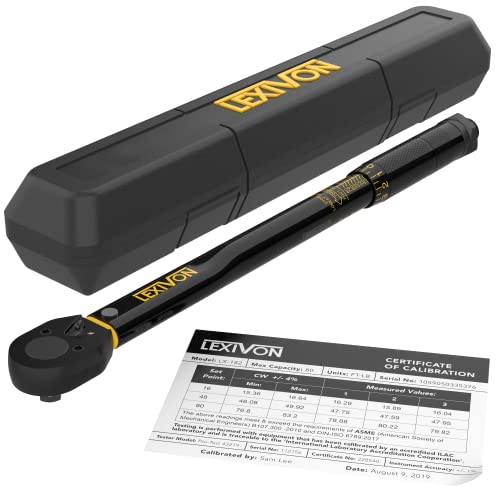
LEXIVON 3/8 in. Drive Click Torque Wrench, 10-80 ft-lb
Covers the bulk of the chassis and drivetrain numbers on this page: axle nuts, caliper mounts, riser bolts, drain plugs, rocker covers. A 3/8 in. drive is the sweet spot for a Harley, since a 1/2 in. wrench is usually too coarse at the bottom of its range for a 14 ft-lb drain plug.
Check price on Amazon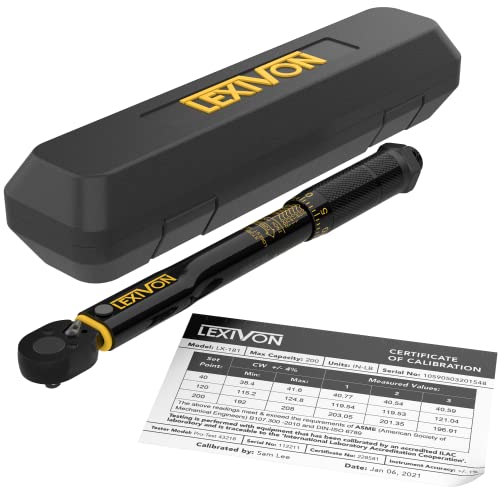
LEXIVON 1/4 in. Drive Inch-Pound Torque Wrench, 20-200 in-lb
This is the one most owners skip, and it is the reason derby covers crack and battery terminals strip. A large share of the specs in the tables above are printed in inch-pounds: 25-75 in-lb for a Twin Cam transmission dipstick, 25-35 in-lb for an FLSB derby cover, 89-133 in-lb for a Milwaukee-8 spark plug. A ft-lb wrench cannot resolve those accurately.
Check price on AmazonIf you are assembling a service kit rather than buying tools one at a time, our Harley oil change kit guide covers the consumables that go with these jobs, and the oil and fluid capacity lookup gives you the volumes for your exact model.
Four mistakes that ruin threads
None of these are about the number itself. They are about what happens around it.
Leaving the wrench wound up. Storing a click wrench at its top setting keeps the spring compressed and drifts calibration. Wind it back to the bottom of its range before it goes in the box.
Torquing dirty or dry threads when the manual assumed otherwise. A torque figure describes a specific friction condition. The V-Rod head bolt procedure explicitly calls for oiled threads, and several rear shock and axle fasteners call for threadlocker. If the manual specifies a condition, the number only means what it says under that condition. Which threadlocker matters too, and the difference is oil tolerance, covered in our Loctite 242 vs 243 breakdown.
Counting the click as a target rather than a stop. The click is the end of the job. Pulling again after it has clicked stacks torque on top of the spec.
Treating one family’s number as universal. The cross-family table above exists because a 60 ft-lb rear axle habit from an Evo carried onto a Twin Cam leaves that nut roughly 35 ft-lb light. Bad-year drivetrain context for the Twin Cam era is in our Twin Cam years to avoid write-up.
Where these numbers came from
We think you should be able to check our work, so here is the exact source behind each family rather than a general claim about service manuals.
| Engine family | Manual the numbers come from | Type |
|---|---|---|
| Milwaukee-8 (2017+) | 2018 Softail Service Manual, P/N 94000529 | Harley-Davidson factory |
| Twin Cam 88/96/103 | 2013 Harley-Davidson Dyna Service Manual | Harley-Davidson factory |
| V-Rod / VRSC | 2003 VRSCA Service Manual, P/N 99501-03 | Harley-Davidson factory |
| Evolution Big Twin (1984-99) | Clymer 1984-1998 Touring / FXR service manual | Clymer (aftermarket) |
| Evolution Sportster (1986-2003) | Clymer 1986-2003 XL/XLH Sportster service manual | Clymer (aftermarket) |
| Revolution Max (2021+) | no service manual available to us | gap, see below |
What this means in practice. The Milwaukee-8, Twin Cam and V-Rod tables are Harley-Davidson factory figures. The two Evolution tables are Clymer figures, which are professionally produced but are not Harley-Davidson documents, and the spark plug conflict flagged above is exactly the kind of thing that distinction exists to warn you about.
Scope limits we are not hiding. Each table reflects the model and year of the manual named above. The Twin Cam figures come from a 2013 Dyna, and while Softail and Touring Twin Cams are close, we have not independently confirmed every figure on those chassis. We dropped several rows that appeared in our extraction with values we could not verify as printed rather than as scanning errors. Revolution Max (2021 and newer) is a genuine gap: those service manuals are dealer-gated and we hold only an owner’s manual, so we have published nothing for that family rather than guessing.
Always defer to the factory service manual for your exact model and year. This page is a reference, not a substitute for it.
Frequently asked questions
What torque should a Harley oil drain plug be?
On Twin Cam and Milwaukee-8 engines the engine, primary and transmission drain plugs are all 14-21 ft-lb (19-28.5 N·m). On a 2003 V-Rod the engine drain plug is 25 ft-lb (35 N·m). The Clymer Evolution Big Twin manual prints no numeric figure for the drain plug at all, only an instruction to tighten it securely.
What is the rear axle nut torque on a Harley?
Twin Cam, Milwaukee-8 and V-Rod are all 95-105 ft-lb (128.8-142.4 N·m). The Evolution Sportster is 60-65 ft-lb (81-88 N·m). The Evolution Big Twin splits by year: 60-65 ft-lb for 1984-1988 and a flat 60 ft-lb for 1989-1998. The 2013 Dyna manual warns specifically against exceeding the figure, because over-torquing can cause the wheel bearings to seize.
What is the spark plug torque for a Milwaukee-8?
89-133 in-lb (10-15 N·m) on the 2018 Softail manual. That is inch-pounds, roughly 7.5 to 11 ft-lb, which is meaningfully lower than the 12-18 ft-lb specified for a Twin Cam. It is one of the easiest specs on the bike to over-torque with a ft-lb wrench.
Do I torque a Harley oil filter?
No. Every family in our library specifies turns after the gasket contacts the mounting surface, not a torque figure. Evolution, Twin Cam and Milwaukee-8 all call for 1/2 to 3/4 turn. The V-Rod calls for 2/3 to a full turn. The Milwaukee-8 manual adds that you should not use a filter wrench to install.
Why does my manual list two different rear caliper torques?
Because they are different fasteners. On the 2013 Dyna, the caliper mounting bolt is 120-168 in-lb (section 2.13, caliper installation), the caliper fasteners disturbed during brake pad service are 16-20 ft-lb (section 1.16), and the hydraulic banjo bolt is 17-22 ft-lb. Match the number to the procedure you are following.
Are Revolution Max torque specs on this page?
No. Harley-Davidson keeps Revolution Max service manuals behind dealer access, and we hold only an owner’s manual for that family, which contains no torque tables. Rather than publish numbers we cannot source, we have left it out. If you own a Pan America, Sportster S or Nightster, the figures on this page do not apply to your engine.
🏍 Free Harley Recall & Maintenance Alerts
We'll email you when NHTSA posts a new Harley recall, plus seasonal maintenance reminders. No spam, unsubscribe anytime.
By subscribing you agree to our Privacy Policy.
