
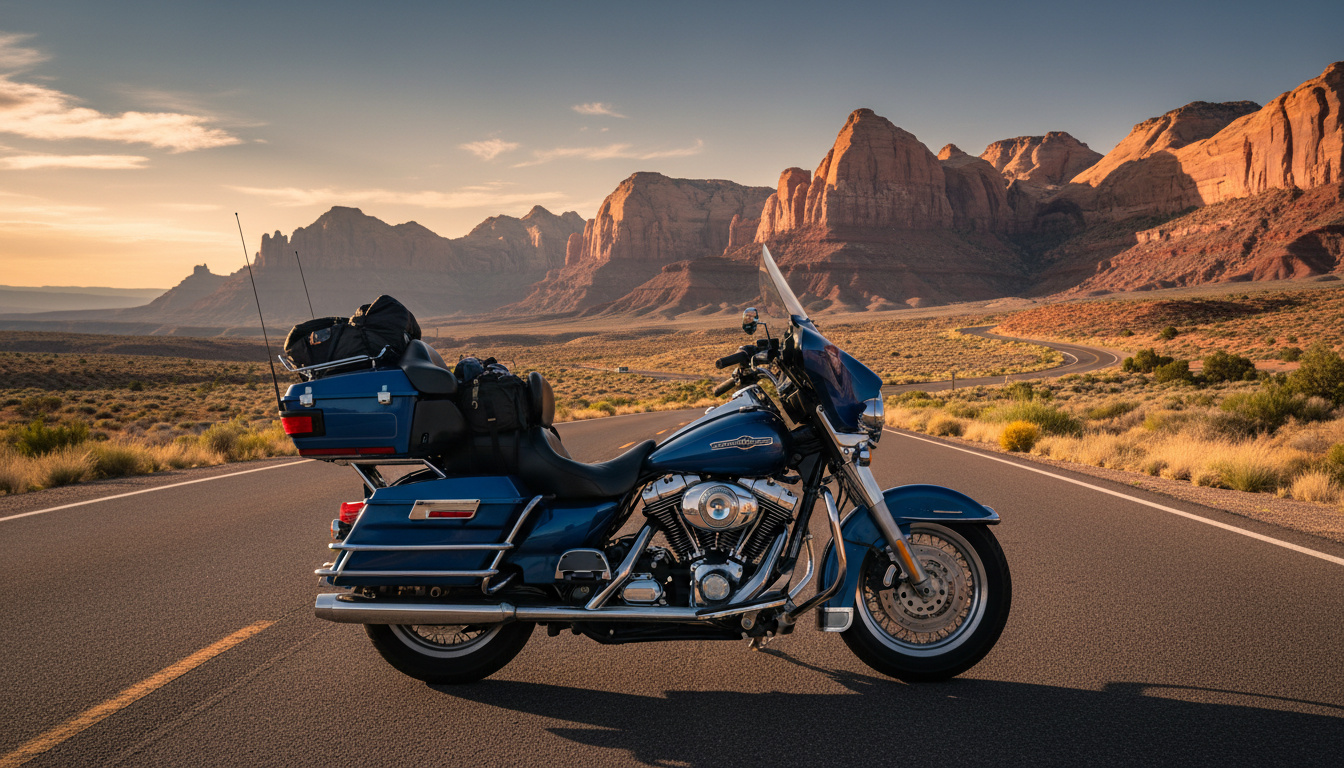
Short answer: Yes – if you pick the right Harley. The Touring line (Electra Glide, Road Glide, Street Glide, Road King) was engineered from the ground up for long-distance travel. A Sportster or Street 500 without modifications? That’s a different story. Our research team went through owner forums, trade press long-term tests, and official service manual specs to give you the honest breakdown.
Quick Article Navigation
Quick Answer: Which Harleys Are Built for Distance?
Not every Harley wears the “touring” label by accident – there’s a real engineering divide between the models designed for 500-mile days and the ones that max out at weekend blasts.
| Model | Long-Distance Ready? | Why |
|---|---|---|
| Electra Glide Ultra Classic / Limited | ✅ Yes | Full fairing, 6-gal tank, Tour-Pak, cruise control, infotainment |
| Road Glide (Street/Special/Ultra) | ✅ Yes | Frame-mounted fairing (no buffeting), saddlebags, 6-gal tank |
| Street Glide / Street Glide ST | ✅ Yes | Batwing fairing, low seat, 6-gal tank – Iron Butt favorite |
| Road King / Road King Special | ✅ Yes (with windshield) | Detachable windshield, saddlebags, classic silhouette |
| Softail (Heritage, Fat Boy, Street Bob) | ⚠️ With mods | Smaller tanks (3.5-5 gal depending on model), less wind protection |
| Sportster / Sportster S | ❌ Stock is tough | 3.3 gal tank (883), minimal windshield, forward controls optional |
What Makes Harley Touring Models Genuinely Good for Long Distance
The Touring family isn’t just branded differently – it was designed around a specific rider need: covering ground comfortably, day after day. Here’s what the research actually shows.
Fuel Range: 6-Gallon Tank Is a Real Advantage
Per the HD Service Manual (2009 Touring, Table 2-3, p. 2-7), the standard Touring tank capacity is 6.00 U.S. gallons (22.71 liters), with the low-fuel warning light triggering at 1.00 gallon remaining. At 40-45 mpg real-world highway fuel economy (consistently reported across r/Harley long-distance threads), that’s a usable range of 200-220 miles between fill-ups – enough to clear most stretches of interstate without anxiety.
Compare this to a Sportster 1200’s 3.3-gallon tank: you’re stopping every 110-120 miles. On a 1,000-mile day (Iron Butt territory), that’s nine fuel stops versus five. The difference is hours.
Wind Protection: Fairings That Actually Work
The Electra Glide and Street Glide use a batwing fairing mounted to the frame and handlebars. The Road Glide uses a frame-mounted fairing only – no handlebar connection – which eliminates the weaving sensation some riders feel at highway speeds when wind hits a bar-mounted fairing. Cycle World’s long-term Road Glide test documented this as a key advantage over the Street Glide for sustained two-up riding in crosswinds.
The Road King uses a detachable windshield with a 4.5-inch adjustment range – less protection than a full fairing but enough for most conditions, and the detachability means you can tour in summer without feeling like you’re riding in an oven.
Cruise Control: Standard on Most Touring Models (2011+)
Electronic cruise control has been standard equipment on FLHTCU, FLHTK, FLHTKSE, and most Electra Glide variants since 2011. The 2009 Touring Service Manual references the cruise control circuit explicitly in the wiring schematics (Table of Contents, SPOT/CRUISE relay designation). For Iron Butt distance riding – where wrist fatigue can become a real safety issue after 500+ miles – this is not a luxury. Riders on HDForums.com consistently rank cruise control as the single biggest long-distance quality-of-life feature on their Touring bikes.
Ergonomics: The Floorboard Advantage
Harley Touring models use floorboards, not footpegs. This is a significant ergonomic difference on long days. Floorboards let you shift foot position constantly – heel forward, toes forward, weight on the ball of the foot – which prevents the hip and knee stiffness that builds up with fixed footpegs. The 2009 Touring dimensions show a 27.30-inch saddle height (with 180 lb rider) across the FLHT, FLHTC, FLHTU, and FLHR, which suits a wide range of inseams and keeps feet flat-footed at stops.
Milwaukee-Eight Engine (2017+): High-Mileage Reliability
The Milwaukee-Eight (M8) 107 and 114 replaced the Twin Cam in 2017. Key improvements relevant to long distance: liquid-cooled cylinder heads (reducing heat soak at rest stops), a counterbalancer eliminating the primary vibration frequency that fatigued riders on the Twin Cam, and a redesigned oil system with better thermal management. Cycle World’s long-term test of a 2017 Street Glide logged 30,000 miles with no mechanical issues beyond routine service. Multiple HDForums users report 80,000-100,000+ miles on M8 engines with standard oil change intervals.
If you’re buying used, the Twin Cam 96/103/110 (1999-2017) is also a solid long-distance platform – just be aware of cam chain tensioner wear history on higher-mileage examples, particularly pre-2007 units. See our guide on whether cruiser motorcycles are good for long rides for a broader context on touring-capable cruisers.
Storage: Integrated Luggage
A standard Street Glide or Road Glide ships with locking hard saddlebags. Add the Tour-Pak on the Electra Glide Ultra or any CVO Touring model and you’re looking at approximately 7.5 cubic feet of lockable, weather-resistant storage – enough for a week’s clothing on two-up trips. No tank bags, no tail bags, no aftermarket luggage required out of the box. For comparing Tour-Pak options and how to pick the right one, we’ve done a dedicated breakdown.
Where Harley Touring Falls Short vs. Dedicated Tourers
Honest is the only way to be useful here. A Honda Gold Wing or BMW R1250RT does some things better than a Harley Touring bagger, and riders spending serious money deserve to know the tradeoffs before they commit.
- Weight: A 2009 FLHTCU (Electra Glide Ultra Classic) ships at 852 lbs (386.5 kg) per the HD Service Manual (Table 2-4). The Gold Wing 1800 is around 833 lbs but with a different weight distribution (lower center of gravity). Both require confidence at slow speeds and in parking lots.
- Two-up passenger comfort: Harley’s passenger accommodations on Touring models are genuinely good (proper backrest, footboards, passenger floorboard clearance), but the Gold Wing’s full-float passenger setup with dedicated armrests and intercom is a step above for dedicated two-up touring.
- Wind management: A full-fairing tourer like the Gold Wing or R1250RT offers more comprehensive wind protection. Harley’s batwing fairing excels in straight-line highway riding but lets in more buffeting at the legs on cold/wet days than a full lower fairing.
- Suspension adjustability: Stock Harley Touring suspension is adequate for solo highway riding but benefits from an upgrade when loaded two-up with luggage. See our air ride suspension options for Harley Touring models if you’re planning loaded long-distance runs.
The honest conclusion from trade press research: for riders who prioritize American character, community, and the specific Harley riding experience, the Touring line holds its own against anything in its class. For purely objective distance performance metrics, the Gold Wing remains the benchmark.
Can You Make a Non-Touring Harley Work for Long Distance?
Yes – but it takes intentional modification and honest expectation-setting. The platform matters, and some are more viable than others.
Softail (Heritage Softail, Breakout, Fat Boy)
The Heritage Softail Classic is probably the most long-distance-viable non-Touring Harley in stock form. It ships with saddlebags, a wider seat, and a more upright seating position. Adding a windshield, a better seat (Mustang or Saddlemen are frequently cited in r/Harley touring threads), and a throttle lock like the Harley throttle lock options we’ve reviewed gets you a practical touring setup. Tank capacity varies by model (2014+ Heritage is approximately 5.0 gallons) – workable but not Touring-class.
Sportster (Evo/Iron 883, 1200 Custom)
The legacy Sportster (discontinued 2022 for the Iron 883 (XL883N) and 1200 models) has a passionate long-distance following – the Iron Butt Association shows several Sportster completions of the SaddleSore 1000 (1,000 miles in 24 hours). But it requires work: a larger aftermarket tank (4.5 gal conversion is a popular swap), a proper touring seat, and windshield. Stock, the 3.3-gallon tank on the 883 Iron and 3.3 gallons on the 1200 Custom make highway touring genuinely uncomfortable. We’d only recommend it to experienced riders who specifically want the Sportster character and are willing to invest in the modifications.
Street Glide vs. Road Glide: Which Is Better for Distance?
This is one of the most common questions in touring circles. See our Road Glide vs. Street Glide comparison for the full breakdown, but the short version: Road Glide wins for solo long-distance (frame-mounted fairing, less head shake, better aerodynamics at speed), Street Glide wins for city riding and shorter touring runs (easier to live with at low speeds, slightly lighter steering).
How Does Harley Compare for Iron Butt-Level Distance?
This is where community data becomes particularly useful. The Iron Butt Association (IBA) tracks completions of certified distance rides – the SaddleSore 1000 (1,000 miles in 24 hours) and Bun Burner Gold (1,500 miles in 24 hours). A search of publicly posted IBA reports shows Harley Touring models – particularly the Street Glide and Road Glide – appear with high frequency among American bike completions. The brand behind those machines has roots that go back over a century – our historical overview of whether Harley-Davidson is a real person traces the four co-founders and the Milwaukee shed where it all began.
The MSF (Motorcycle Safety Foundation) long-distance riding guidelines note that rider fatigue management matters more than the specific bike brand at ultra-distance. Wind protection, ergonomic positioning, and fuel range all contribute to reducing the fatigue rate – and the Touring line addresses all three.
A frequently cited HDForums.com thread (user “FLH_Traveler,” 2024) documents a solo coast-to-coast run on a 2022 Road Glide Special: 3,100 miles in 4.5 days, averaging 680 miles per day. Zero mechanical issues. The only complaint: “Wish the passenger seat was as comfortable as the solo saddle.” That’s a realistic data point – not a marketing claim. For context on the brand’s future direction, including whether electric Harleys are on the horizon, see our analysis of whether Harley-Davidson is going all-electric.
Maintenance Considerations for Long-Distance Harley Owners
A bike that breaks down 800 miles from home isn’t a touring bike, no matter how comfortable the seat is. Here’s what the research shows about keeping a Touring Harley reliable over high mileage.
- Oil change intervals (M8): Harley recommends 5,000-mile oil change intervals for the Milwaukee-Eight under normal conditions. High-mileage tourers on HDForums frequently shorten this to 3,000-3,500 miles when doing extended highway runs in hot weather – the M8’s liquid-cooled heads help, but oil thermals still spike in stop-and-go desert heat.
- Primary chain and belt drive: The final drive belt on Touring models is rated for 100,000+ miles with proper tension. Check belt tension before any extended trip – the 2009 Touring Service Manual specifies deflection checks and adjustment procedures (Chapter 6). Belt drive is a touring advantage over chain-drive competitors: no lubrication needed on the road.
- Tire checks: Stock OEM tires on Touring models are typically touring-compound bias-ply. Many long-distance riders swap to Dunlop American Elite or Metzeler ME888 for better mileage and wet-weather performance. Tire pressure is critical on loaded touring – check cold pressure before each day’s run. Our free Harley tire pressure calculator gives you the correct front and rear psi for your specific model and load configuration.
Frequently Asked Questions
These are the questions our research team sees most frequently in Harley touring forums and Google searches – answered honestly.
Is a Harley-Davidson good for long-distance riding?
Yes, specifically the Touring family models (Electra Glide, Road Glide, Street Glide, Road King). These are purpose-built touring motorcycles with 6-gallon tanks, full fairings, hard luggage, and cruise control as standard equipment. Non-Touring Harley models (Softail, Sportster) require modification to be comfortable for sustained distance riding.
What is the range of a Harley-Davidson Touring bike?
Per the HD Service Manual (2009 Touring Models, Table 2-3), the Touring fuel tank holds 6.00 U.S. gallons total (22.71 liters), with 1.00 gallon remaining when the low-fuel light activates. At real-world highway fuel economy of 40-45 mpg, usable range is approximately 200-220 miles per tank. Modern Milwaukee-Eight (2017+) models see similar range, with some owners reporting 45+ mpg on steady 65-70 mph highway runs.
Can a Harley-Davidson handle 1,000 miles in a day?
Yes. Iron Butt Association SaddleSore 1,000 completions on Harley Touring models are well-documented in the IBA’s public records. The Street Glide and Road Glide appear frequently. The keys are cruise control (reduces wrist fatigue), proper suspension setup for the load, and the 6-gallon tank cutting down on fuel stops. Most riders report needing 5-6 fuel stops for a 1,000-mile day on a Touring Harley.
How does a Harley compare to a Honda Gold Wing for long distance?
The Gold Wing is the objective benchmark for long-distance touring – superior two-up passenger comfort, better wind management at the legs, and a flat-six engine that almost eliminates vibration. The Harley Touring line’s advantages are weight management (similar overall weight but different center of gravity feel), parts availability at any dealer in North America, and – for many riders – the specific character and community that makes long-distance riding enjoyable rather than merely efficient.
Which Harley is the most comfortable for long rides?
The Electra Glide Ultra Limited and CVO Limited consistently rank highest in comfort for long-distance solo and two-up riding. The full Tour-Pak, premium Boom! Box GTS infotainment with navigation, lower and upper fairings, and standard passenger backrest create the most complete touring package. The Road Glide Ultra follows closely, with many solo tourers preferring its frame-mounted fairing aerodynamics for extended highway miles.
Is a Harley-Davidson Road Glide good for long-distance touring?
Yes. The Road Glide’s frame-mounted fairing is a specific advantage over the Street Glide and Electra Glide for sustained highway distance – it doesn’t transmit handlebar vibration and produces less head buffeting at speed. Cycle World and RideApart both documented this in their Road Glide long-term tests. The 2025-2026 Road Glide is available with the Milwaukee-Eight 117 (CVO) or 114 (standard), both with cruise control, navigation, and heated grips on upper trims.
What modifications make a Harley better for long distance?
For Touring models: seat upgrade (Mustang Wide Touring or Saddlemen LS Rise seats are consistently recommended on r/Harley touring threads, and our gel seat cushion picks for Harley Touring cover a cheaper first step), aftermarket suspension (air ride options add load-adjustability – see our air ride for Harley Touring guide), and a throttle lock if your model lacks cruise control. For non-Touring models: add a windshield, upgrade the seat, and consider a larger tank before attempting multi-day trips.
How reliable is a Harley-Davidson for high-mileage touring?
The Milwaukee-Eight (2017+) has a strong reliability record for high mileage. Community data on HDForums documents multiple owners reporting 80,000-100,000+ miles with no major mechanical failures beyond routine maintenance. The Twin Cam (1999-2017) is also proven at long distance, though buyers should verify cam chain tensioner history on pre-2007 units. The key to Harley reliability at high mileage is consistent maintenance – particularly oil changes at or below the recommended interval during hot-weather touring.
Research compiled May 2026. Sources: HD Service Manual (2009 Touring Models); HDForums.com touring threads; Iron Butt Association public ride records; Cycle World Road Glide long-term test; r/Harley multi-day touring trip reports.
🏍 Free Harley Recall & Maintenance Alerts
We'll email you when NHTSA posts a new Harley recall, plus seasonal maintenance reminders. No spam, unsubscribe anytime.
By subscribing you agree to our Privacy Policy.
