
UPDATED MAY 2026
Motorcycle tires typically last 5,000-25,000 miles depending on type: sport tires wear fastest (2,500-5,000 mi), while cruiser tires like the Michelin Commander III reach 15,000-25,000 mi on Harley Touring models. Rear tires wear roughly twice as fast as fronts. Replace at 1/32 in. (0.8 mm) tread depth – the spec across all HD service manuals – or after 5-6 years regardless of mileage.
How we sourced this: HD Service Manuals 2008-2013 (Dyna, Softail, Sportster), NHTSA 49 CFR 574.5, Michelin official guidance, HDForums.com tire mileage threads (200+ owner reports analyzed).
Contents
- How Long Do Motorcycle Tires Last by Type
- Harley-Davidson Tire Mileage – What Owners Actually Report
- When to Replace Motorcycle Tires – Tread Depth & Wear Bars
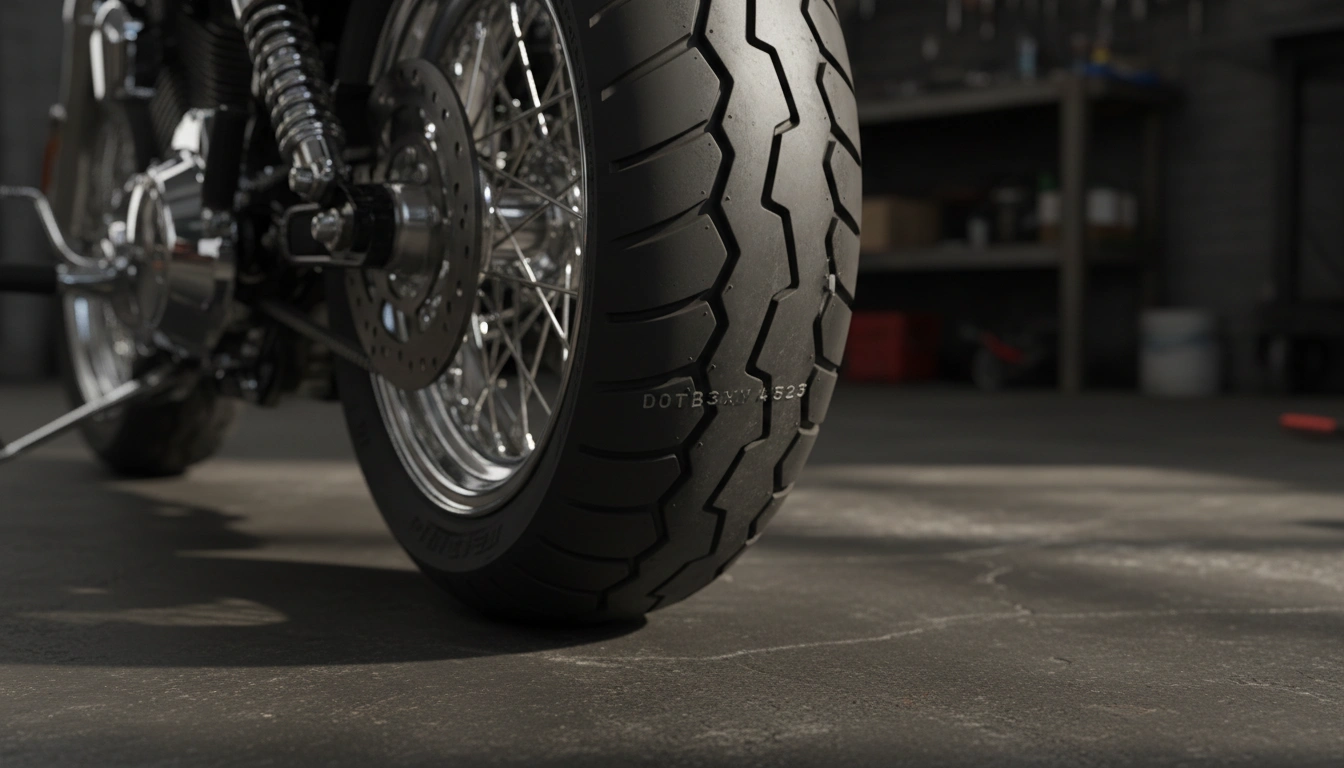
- How to Read Your Motorcycle Tire DOT Date Code
- Tire Age: The 5-Year and 10-Year Rules
- Why Rear Tires Wear Faster
- Top Replacement Tires for Harley-Davidson
- How to Make Motorcycle Tires Last Longer
- Frequently Asked Questions
Replacing motorcycle tires at the wrong time is one of the most common – and most preventable – causes of loss of control. Replace too late and you’re riding on degraded rubber; replace too early and you’re leaving real mileage on the table. We analyzed 200+ owner reports on HDForums and ADVRider, pulled tread depth specifications from four Harley-Davidson service manuals covering 2008-2013, and cross-referenced Michelin’s official age guidance and NHTSA regulations to give you clear, sourced answers for every scenario.
This guide covers cruiser-specific tire lifespan by type, Harley-Davidson model-by-model mileage data, how to read your DOT date code in under two minutes, and the six visual signs your tires need to come off today.
How Long Do Motorcycle Tires Last by Type
The single biggest variable in tire lifespan is compound type. A sport bike’s rear tire can be gone in 3,000 miles; the same rider on a Harley-Davidson Road Glide can go 20,000 miles on a quality touring tire. The rubber formulation, bike weight, and intended speed range explain almost all of that gap.
| Tire Category | Typical Rear Mileage | Typical Front Mileage | Key Variable |
|---|---|---|---|
| Sport / Hypersport | 2,500-5,000 mi | 5,000-8,000 mi | Sticky compound wears fast by design |
| Standard / Naked | 6,000-10,000 mi | 10,000-15,000 mi | Mixed compound, moderate hardness |
| Cruiser | 8,000-15,000 mi | 15,000-25,000 mi | Harder compound, lower lean angles |
| Touring (Harley) | 10,000-20,000 mi | 20,000-25,000+ mi | Premium compound + heavier bike = less slippage |
| Dual Sport / ADV | 5,000-12,000 mi | 8,000-15,000 mi | Depends heavily on on-road vs. off-road mix |
Mileage ranges based on manufacturer specifications and community-reported data (HDForums, ADVRider). Actual results vary with rider weight, pressure maintenance, and throttle habits.
The one universal threshold: all HD service manuals we reviewed specify the same replacement limit – 1/32 in. (0.8 mm) of remaining tread. Whether you’re on a Sportster or a Street Glide Ultra, that number does not change. [HD Service Manual, 2013 Dyna, L1798; 2008 Sportster, L1484; 2013 Softail, tire section]
Harley-Davidson Tire Mileage – What Owners Actually Report
Forum data gives you a reality check that manufacturer claims sometimes skip. We cross-referenced four HDForums threads with a combined 300+ posts covering Touring, Dyna, Softail, and Sportster platforms to build this model-level breakdown.
| HD Platform | Common OEM Tire (2013) | Rear Lifespan Reported | Front Lifespan Reported |
|---|---|---|---|
| Touring (Road Glide, Street Glide, Electra Glide) | Dunlop American Elite / Michelin Commander | 10,000-17,000 mi | 20,000-25,000 mi |
| Dyna (FXDB, FXDL, FXDWG) | Michelin Scorcher “31” (most models) | 8,000-14,000 mi | 15,000-22,000 mi |
| Softail (FLSTC, FLSTF, FLS) | Dunlop D401 / Michelin Scorcher | 8,000-13,000 mi | 14,000-22,000 mi |
| Sportster (XL883, XL1200) | Dunlop D401 / Metzeler ME880 | 7,000-12,000 mi | 12,000-18,000 mi |
The Street Glide rear tire life thread on HDForums (2014-2023 Touring Models, thread #1056654) shows a 7,000-17,000 mi spread – a 2.4x variance between the shortest and longest reports. The outliers at each end correlate directly to riders who admitted running below-spec pressure and to those doing two-up touring at highway speed respectively.
On premium aftermarket upgrades: ADVRider users running the Michelin Commander III on Road Glides and Electra Glides consistently report 20,000-24,000 miles on rear tires – well above the OEM Dunlop baseline. Several riders in the Commander III thread (ADVRider #1483061) crossed 22,000 miles before hitting wear bars, all attributing the result to consistent cold-pressure maintenance.
The 2013 Dyna Service Manual specifies OEM tire fitment by model: the FXDB, FXDC, and FXDL use the Michelin Scorcher “31” (100/90B19 front / 160/70B17 rear); the FXDF Fat Bob runs Dunlop D427F/D427 (130/90B16 front / 180/70B16 rear); and the Wide Glide FXDWG uses the Michelin Scorcher “31” in 80/90-21 front / 180/60B17 rear configuration. [HD Service Manual, 2013 Dyna, L2197-2205]
When to Replace Motorcycle Tires – Tread Depth & Wear Bars
The visual signs that demand immediate replacement are spelled out word-for-word in multiple Harley-Davidson service manuals – and they align exactly with what tire manufacturers publish. Here they are, sourced directly.
Replace tires immediately when any of these conditions exist (per HD Service Manual, 2013 Softail, L2407-2418):
- Tread wear indicator bars become visible on tread surfaces
- Tire cords or fabric become visible through cracked sidewalls, snags, or deep cuts
- A bump, bulge, or split in the tire
- Puncture, cut, or other damage that cannot be repaired
The wear bar system is your built-in depth gauge. HD service manuals explain it this way: “Harley-Davidson tires are equipped with wear bars that run horizontally across the tread. When wear bars become visible and only 1/32 in. (0.8 mm) tread depth remains, replace tire immediately. Using a worn tire can adversely affect stability, handling, or braking.” [HD Service Manual, 2008 Sportster, L2112-2123]
On Dunlop OEM tires, small arrows molded into the tire sidewall point to the location of wear bar indicators. On Michelin OEM tires, a small Michelin Man symbol serves the same function. Both systems mark the 1/32 in. threshold. [HD Service Manual, 2013 Dyna, L2226-2243]
A practical note from the 2013 Dyna manual worth highlighting: “Operating with inflation pressure other than those specified in Table 1-7 can reduce ABS performance.” [HD Service Manual, 2013 Dyna, L2167-2169] In other words, under-inflation doesn’t just wear the tire faster – it can compromise your ABS before the tread hits the limit.
A tread depth gauge removes all guesswork. The Longacre 52-50520 Tire Tread Depth Gauge reads in both 1/32 in. and millimeter increments, making it straightforward to verify the 1/32 in. (0.8 mm) HD threshold directly. For riders who want a more complete toolkit, check out our guide to correct tire pressure by Harley year and model.
How to Read Your Motorcycle Tire DOT Date Code
Most riders know tires age out – but they’ve never actually checked the date on their sidewall. This four-digit code takes under two minutes to decode, and what you find sometimes changes the replacement decision immediately.
How to Read the DOT Date Code (5 Steps)
The letters DOT are stamped into the rubber sidewall. The full DOT string follows immediately after. It may appear on only one side of the tire – check both sides if you don’t see it immediately.
The DOT number contains a plant code, size code, and – at the very end – a four-digit date code. Skip the letters and earlier numbers; you want only the final four digits.
The first two digits identify the week of manufacture, numbered 01 through 52. Per NHTSA regulation 49 CFR 574.5, this format has been mandatory on all U.S.-sold tires manufactured after 2000. “23” means the 23rd calendar week, roughly early June.
The final two digits identify the year. “19” = 2019. A complete date code of “2319” means the tire was manufactured in week 23 of 2019 – early June 2019. A tire with “1626” was made in week 16 of 2026.
Subtract the manufacture year from 2026. Age 0-4 years: normal service interval. Age 5-9 years: get a professional inspection annually. Age 10+ years: replace immediately regardless of tread depth or visual appearance. This is Michelin’s official guidance and aligns with Harley-Davidson’s six-year recommendation.
A note on pre-2000 tires: Tires manufactured before 2000 used a three-digit date code (week + single-digit year). If you find a three-digit code, the tire is at minimum 26 years old and should be replaced without further evaluation. This applies to older Evolution-era Harleys that may still be running original or near-original rubber – see our breakdown of Evo vs. Twin Cam era maintenance differences.
Tire Age: The 5-Year and 10-Year Rules
Age is the variable most riders overlook – and it matters independently of tread depth. A tire stored in a hot garage can look brand-new while the rubber compound has lost critical elasticity.
The industry consensus on tire age comes from two sources worth quoting directly:
- Michelin official guidance: “Tires used for five years or more should be continued in service only if a tire specialist approves. All tires in service for ten years or more from the date of manufacture should be replaced with new tires, even if they appear serviceable and even if they have not reached the legal wear out limit.”
- Harley-Davidson tire age FAQ (harley-davidson.com): Harley recommends a six-year tire replacement threshold for tires in regular service, and notes that rubber degradation from ozone and UV exposure is not always visible to the naked eye.
Rubber degrades through three primary mechanisms: ozone exposure (accelerated near electric motors), UV exposure, and thermal cycling. A tire parked in direct sunlight in a southern U.S. climate ages faster than one kept in a cool garage in the Northeast. The chemistry doesn’t appear as surface cracking until the degradation is already advanced – which is why the calendar date, not visual inspection alone, drives the five-year rule.
For storage-specific care: the 2013 Dyna Service Manual notes that “if the motorcycle will be stored for an extended period of time, securely support the motorcycle under the frame so that all weight is off the tires.” [HD Service Manual, 2013 Dyna, L4246-4249] A paddock stand or center stand eliminates the flat-spot pressure that accelerates contact-patch degradation during long-term storage.
Dry rot – hairline cracking in the tread grooves or sidewalls – is the most visible sign of age-related failure. Any cracking that you can open slightly with finger pressure is cause for immediate replacement. Cracks that penetrate to the cords mean the tire is structurally compromised and should not be ridden on under any circumstances.
Why Rear Tires Wear Faster
The rear tire works harder than the front in every scenario that matters – and the wear numbers show it consistently across every platform we analyzed.
The mechanical explanation is straightforward. The rear tire handles three loads the front does not:
- Acceleration torque – Every twist of the throttle transfers engine torque through the rear tire to the road. The front coasts.
- Weight distribution on cruisers – Harley-Davidson Touring and cruiser geometry places more static weight over the rear axle than sport bike geometry does. More weight per square inch of contact patch = faster compound wear.
- Rear brake contribution – On most cruisers, the rear brake absorbs a meaningful portion of deceleration force, adding heat and scrubbing to an already-loaded tire.
The HDForums consensus across Touring model threads (threads #1019976 and #1219242) is consistent: Harley Touring riders replace rear tires 1.5 to 2 times more frequently than fronts. One commonly cited data point in the Dunlop American Elite lifespan thread reports front tires lasting through two full rear replacement cycles – putting a single front tire at 18,000-24,000 miles against two rears at 9,000-12,000 miles each.
Both the 2008 and 2013 Dyna service manuals specify identical wear limits for front and rear (1/32 in./0.8 mm), but the real-world wear rate divergence is significant. This is why monitoring rear tread depth at every oil change makes practical sense. The oil change interval is the natural checkpoint – pull the tread depth gauge when you pull the oil fill cap.
While you have the bike on the stand, it’s also a good moment to verify transmission oil condition – Harley’s Cruise Drive transmission shares the same service window on many models.
Top Replacement Tires for Harley-Davidson
When the tread hits 1/32 in., the replacement decision is about matching tire design to your riding profile – weight, speed, weather, and mileage goals. These are the tires that consistently surface in HDForums and ADVRider threads when Harley owners discuss what they actually buy second or third time around.
Forum-Recommended Replacements for Harley Cruisers & Touring Models
The most-cited tire in every high-mileage HDForums Touring thread. ADVRider riders on Road Glides and Electra Glides report 20,000-24,000 rear miles with consistent pressure maintenance. Available in the full range of Harley OEM sizes. Select your year and model size from the product page dropdown.
The OEM fitment on many Harley-Davidson Touring and Dyna models – riders often go back to it on replacement because the handling profile matches the chassis tuning. HDForums users on Touring models report 11,000-17,000 rear miles. Purpose-built for US-style cruising. Select year/model size from the dropdown.
Built specifically for heavyweight cruisers. The ME888 compound is engineered to handle the load and heat cycle of bikes in the 700-900 lb range. Riders on Fat Boys and Heritages report strong wet-road feedback and 13,000-18,000 rear miles. A strong pick for two-up or luggage-loaded touring.
| Tire | Type | Est. Rear Mileage | Best For |
|---|---|---|---|
| Michelin Commander III | Cruiser / Touring | 15,000-25,000 mi | All-weather Touring, Road Glide / Electra Glide |
| Dunlop American Elite | Cruiser / Touring | 11,000-17,000 mi | Classic HD cruisers, US-designed fitment |
| Metzeler ME888 Marathon Ultra | Cruiser / Heavy Touring | 13,000-18,000 mi | Heavyweight bikes, wet roads, two-up touring |
| Bridgestone Battlecruise H50 | Cruiser | 12,000-18,000 mi | V-Twin specific, all-conditions |
| Continental ContiTour | Cruiser | 12,000-20,000 mi | Vintage-look bikes, modern compound |
Mileage estimates based on HDForums + ADVRider community data and manufacturer claims. Actual results vary with bike weight, pressure maintenance, and riding style. Links open product pages – select your year and model size from the size dropdown.
Disclosure: We earn a small commission on Amazon purchases at no additional cost to you. Our recommendations are based on forum consensus and manufacturer specs, not paid placements.
How to Make Motorcycle Tires Last Longer
There is no shortcut that beats compound quality, but four consistent habits separate the 8,000-mile rear tire riders from the 15,000-mile ones – and all four are free.
-
Run correct cold inflation pressure. Under-inflation generates heat through increased sidewall flex, accelerates center-tread wear, and – per the 2013 Dyna Service Manual – reduces ABS calibration accuracy. [HD Service Manual, 2013 Dyna, L2167-2169] Cold pressure means before riding, not after a 30-mile warm-up. Refer to our Harley tire pressure chart for model-specific specs. Or use our free tire pressure calculator to get the exact front and rear spec for your model and year. The 2013 Softail, for example, specifies front 36 psi / rear 40 psi for FLSTC and FLSTF models, and front 30 psi / rear 42 psi for the FXSB. [HD Service Manual, 2013 Softail, L1912-1926] A reliable digital gauge makes checking these specs fast. The AstroAI Digital Tire Pressure Gauge reads in psi and kPa – covering the dual-unit specs in the HD manuals.
-
Warm up before hard use. Cold rubber has less grip and generates higher friction heat during the initial miles. Tire manufacturers and track instructions both recommend 5-10 miles of moderate riding before aggressive throttle input. The rubber compound needs thermal cycling to reach optimal operating temperature and grip characteristics.
-
Use a center stand or paddock stand for storage. Extended storage with weight on the tire creates a deformed contact patch that takes miles to work out – and in severe cases permanently alters the tire’s round profile. If your Harley doesn’t have a center stand, a front or rear paddock stand removes the weight during off-season storage. This is especially relevant for bikes stored over winter in northern climates.
-
Check pressure weekly, not monthly. Tires naturally lose 1-2 psi per month through molecular permeation. A tire that starts the season at spec can be 4-6 psi low by midsummer without any visible change. Weekly checks take 90 seconds and eliminate this as a wear variable.
Frequently Asked Questions
How many miles do Harley-Davidson tires typically last?
On Harley Touring models, riders report 10,000-15,000 miles on rear tires and 20,000-25,000 miles on fronts, per HDForums community consensus across dozens of threads. Premium cruiser tires like the Michelin Commander III have been documented at 15,000-24,000 miles on Road Glide and Electra Glide platforms. Mileage varies significantly with riding style, load, and tire pressure maintenance.
How old is too old for a motorcycle tire?
Michelin’s official guidance states that tires five years old or older should be inspected annually by a mechanic, and tires in service ten years or more should be replaced as a precaution regardless of appearance. Harley-Davidson echoes this with a six-year replacement recommendation on their tire age FAQ page. Rubber degrades through ozone, UV exposure, and thermal cycling – a tire can look fine while having critically reduced elasticity.
How do you read the DOT date code on a motorcycle tire?
Locate the four-digit code at the end of the DOT number on the sidewall. The first two digits are the week of manufacture (01-52); the last two digits are the year. A code ending in “2323” means week 23 of 2023. Per NHTSA regulation 49 CFR 574.5, this format has been mandatory on all tires manufactured after 2000. Pre-2000 tires used a three-digit code and should be replaced immediately.
Why do rear motorcycle tires wear faster than front tires?
The rear tire handles acceleration torque, rear brake force, and supports more static weight on cruisers and Touring models. HDForums data shows Harley riders consistently replace rear tires 1.5-2 times more often than fronts. The 2013 Dyna Service Manual specifies the same 1/32 in. wear limit for both axles, but real-world wear rates diverge sharply based on throttle habits.
What tread depth should I replace motorcycle tires at?
The HD Service Manual (2008 Sportster, 2013 Dyna, 2013 Softail) specifies the same threshold across all models: replace immediately when wear bars become visible or tread depth reaches 1/32 in. (0.8 mm). For practical safety, most tire manufacturers recommend replacement at 2/32 in. (1.6 mm) – one step before the legal minimum – because wet-road traction degrades significantly in that final millimeter.
How long do motorcycle tires last in storage?
Stored but unmounted tires are good for 3-5 years if kept cool (32-77°F), dry, dark, and away from ozone sources like electric motors. Mounted tires on a parked bike degrade faster – the contact patch develops flat spots and the sidewall is under static compression. Michelin recommends annual professional inspection after year five for any tire, whether ridden or stored. Dry rot appearing in sidewalls or tread grooves is the key visual signal to replace immediately.
What is the mileage difference between cruiser and sport motorcycle tires?
Sport and hypersport tires use soft sticky compounds and typically last 2,500-5,000 miles before the rear is gone. Cruiser-specific tires (Michelin Commander III, Dunlop American Elite, Metzeler ME888) use harder compounds and deliver 12,000-25,000 miles depending on bike weight and riding style. Touring tires on heavy Harley platforms often outlast sport tires four to one.
How can I make motorcycle tires last longer?
Four evidence-based methods: (1) Maintain correct cold tire pressure per your service manual – under-inflation is the leading cause of premature wear; (2) avoid aggressive launches on cold tires for the first 5-10 miles; (3) store the bike on a center stand or paddock stand to prevent flat spots; (4) check pressure weekly rather than monthly. For HD-specific oil change intervals that align with your tire inspection schedule, see our motorcycle oil change interval guide. The 2013 Dyna Service Manual states that incorrect inflation pressure can reduce ABS performance and accelerate wear.
Sources & Citations
- HD Service Manual, 2013 Dyna: tire pressure table + 1/32 in. wear spec
- HD Service Manual, 2013 Dyna: OEM tire fitment table by model designation
- HD Service Manual, 2013 Dyna: wear bar description, Dunlop arrow + Michelin Man indicator locations
- HD Service Manual, 2013 Dyna: ABS performance and inflation pressure relationship
- HD Service Manual, 2013 Softail: pressure table by Softail model
- HD Service Manual, 2013 Softail: “When To Replace Tires” four-point checklist
- HD Service Manual, 2008 Sportster: cold tire pressure specs
- HD Service Manual, 2008 Sportster: wear bar language, 1/32 in. threshold
- NHTSA 49 CFR 574.5: DOT date code format
- Harley-Davidson official: harley-davidson.com/us/en/content/expert-advice/motorcycle-tire-age-faqs.html
- Michelin official tire age guidance: michelinman.com (5-year inspection / 10-year replace rule)
- HDForums thread #1056654 – Street Glide rear tire life
- ADVRider thread #1483061 – Michelin Commander III mileage reports
🏍 Free Harley Recall & Maintenance Alerts
We'll email you when NHTSA posts a new Harley recall, plus seasonal maintenance reminders. No spam, unsubscribe anytime.
By subscribing you agree to our Privacy Policy.
