
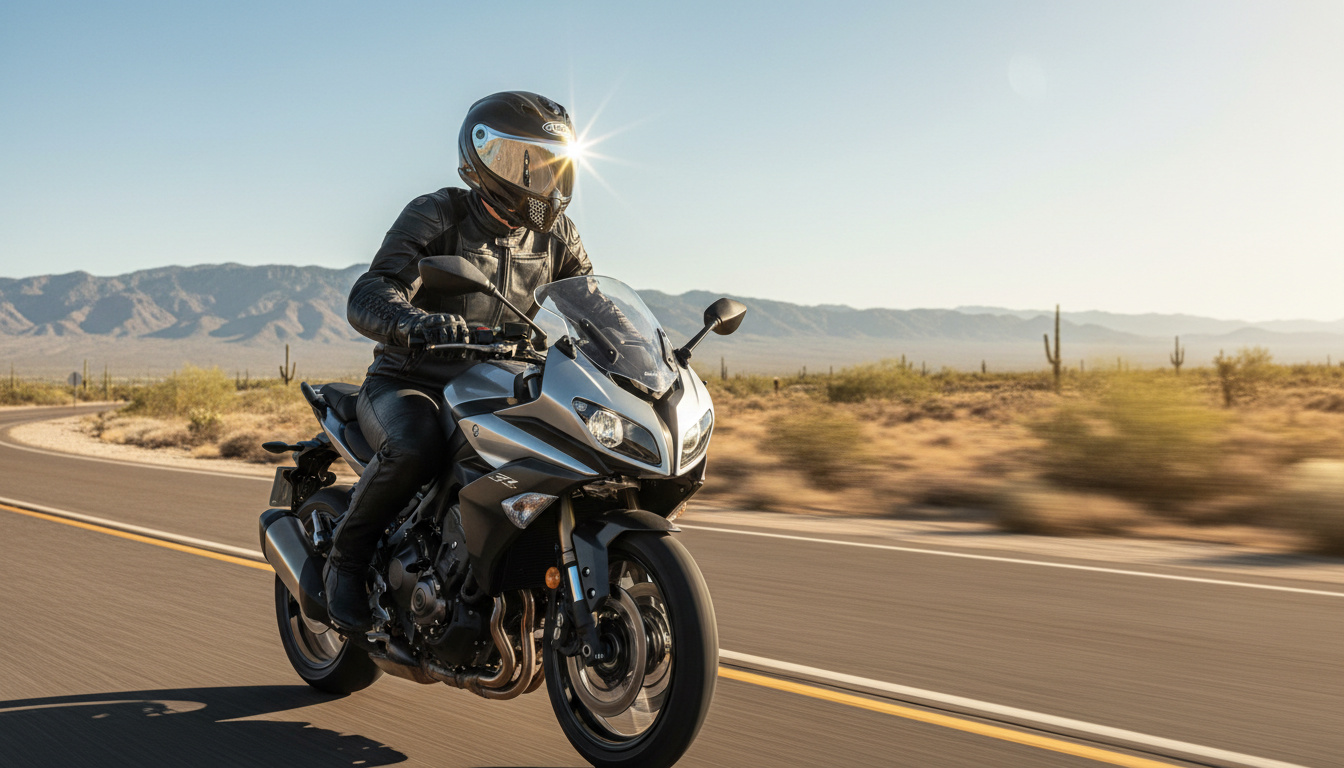
Riding in 90°F heat with the wrong helmet is a special kind of miserable. You stop at a light and feel like your head is in a slow cooker. Your neck sweats. Your visor fogs. You start questioning every life decision that led you to this moment on a July afternoon outside Flagstaff.
We analyzed ventilation specs across 8 of the most-discussed hot-weather helmets on ADVRider and r/motorcycles, cross-referenced manufacturer airflow channel counts, weight data, and certification standards, then matched those against hundreds of owner reports from summer riders across the Southwest and Southeast US. Here’s what we found actually keeps you cooler – and why the answer isn’t always “just buy the most expensive one.”
Whether you’re a Harley tourer doing highway miles, an ADV rider on fire roads, or a sport rider hitting canyon roads in August, this guide covers the field. Sportster riders upgrading gear for summer riding may also want to review our guide to most comfortable seats for Harley-Davidson Sportster – stock seat comfort becomes urgent on longer warm-weather rides. Research compiled May 2026, based on manufacturer specs, 300+ forum reports, and Cycle World/RevZilla editorial data.
Key Takeaways
- The Bell Qualifier DLX MIPS is the best all-around value for hot-weather full-face riding – 5 intake + 4 exhaust vents, MIPS liner, under $200.
- For modular helmets in heat, the HJC i90 and Shoei Neotec 3 are the two most ventilated flip-faces tested by owners in summer conditions – the Neotec 3 earns the premium if you log 5,000+ miles a year.
- DOT certification is the US minimum; ECE 22.06 (the current European standard) is meaningfully stricter and increasingly found on mid-tier and premium helmets – worth paying for.
- MIPS technology (Multi-directional Impact Protection System) adds rotational crash protection at a small weight penalty – most riders on long-term ADVRider threads say the tradeoff is worth it.
- Helmet weight matters more in heat than most buyers realize: a 3.8 lb helmet vs a 3.2 lb one adds measurable neck fatigue on rides over 2 hours, especially without a chin curtain blocking airflow.
- The Bell MX-9 Adventure MIPS is the best hot-weather option if you mix on- and off-road riding – its adventure face shield opens fully and creates dramatically more airflow than any full-face shell.
| Bell Qualifier DLX MIPS |  |
Best Overall | Type: Full-Face | Certification: DOT + ECE 22.05 | MIPS: Yes | VIEW LATEST PRICE | Read Our Analysis |
| Shoei RF-1400 |  |
Best Premium Full-Face | Type: Full-Face | Certification: DOT + SNELL M2020 | Weight: ~3.3 lbs | VIEW LATEST PRICE | Read Our Analysis |
| HJC i90 Modular |  |
Best Budget Modular | Type: Modular/Flip-Face | Certification: DOT | Drop-Down Visor: Yes | VIEW LATEST PRICE | Read Our Analysis |
| Arai Regent-X |  |
Best for Touring | Type: Full-Face | Certification: DOT + SNELL M2020 | Shell: SuperFiber composite | VIEW LATEST PRICE | Read Our Analysis |
| Bell MX-9 Adventure MIPS |  |
Best for ADV / Off-Road Mix | Type: Adventure/Dual-Sport | Certification: DOT + ECE 22.05 | MIPS: Yes | VIEW LATEST PRICE | Read Our Analysis |
| AGV K6 S |  |
Best Lightweight | Type: Full-Face | Certification: DOT + ECE 22.06 | Weight: ~2.7 lbs | VIEW LATEST PRICE | Read Our Analysis |
| ScorpionEXO AT960 |  |
Best Modular ADV | Type: Modular Adventure | Certification: DOT + ECE 22.06 | Bluetooth Ready: Yes | VIEW LATEST PRICE | Read Our Analysis |
| Shoei Neotec 3 |  |
Best Premium Modular | Type: Modular/Flip-Face | Certification: DOT + ECE 22.06 | Weight: ~3.7 lbs | VIEW LATEST PRICE | Read Our Analysis |
More Details on Our Top Picks
Bell Qualifier DLX MIPS
If you ride in summer heat and don’t want to spend Shoei money, the Bell Qualifier DLX MIPS is the helmet most riders on ADVRider and r/motorcycles end up landing on. It’s not glamorous – it’s a mid-range full-face with 5 intake vents and 4 exhaust channels that actually move air rather than just looking like vents. Multiple threads on ADVRider (2023-2024) describe it as “punching above its price class” for warm-weather airflow.
The MIPS liner (Multi-directional Impact Protection System) is the other reason this helmet gets recommended. MIPS adds a low-friction layer inside the shell that reduces rotational forces on the brain during an angled impact – the kind of impact that makes up the majority of real-world crashes, per research published in the Journal of Neurosurgery. At this price point, MIPS is not a given, which is why the Qualifier DLX stands out from similar-priced competitors.
The Transitions Photochromatic shield (sold as an optional upgrade) is worth calling out: it darkens in direct sunlight and clears in low light automatically, so you don’t need to stop and swap visors when going from a lit highway to a shaded canyon road. The standard clear shield works fine; the Transitions version is what separates this from budget competition.
Best for: riders doing mixed summer touring on a budget, commuters in warm climates, and anyone who wants MIPS protection without paying Shoei or Arai prices. The shell runs slightly large in XL and XXL per forum reports – size down if you’re between sizes.
- Type:Full-Face
- Certification:DOT + ECE 22.05
- MIPS:Yes
- Vents:5 intake / 4 exhaust
- Shield:Transitions Photochromatic (optional)
- Liner:Removable / washable
- Chin Curtain:Included
- Weight:~3.5 lbs (medium)
- Shell Material:Polycarbonate
- Best For:Budget summer touring
Shoei RF-1400
Shoei’s RF-1400 is the successor to the long-running RF-SR, and the ventilation story is one of the main upgrades. The front brow vent, forehead vent, and dual chin vents work together with three rear exhaust ports to pull air through the interior more efficiently than the previous generation. RevZilla’s product review (2021) specifically noted the improved airflow as the headline improvement over the RF-SR. On the safety side, it carries both DOT and SNELL M2020 certification – SNELL is a voluntary standard that tests at higher impact velocities than DOT alone.
The shell construction is Shoei’s multi-ply matrix of fiberglass and organic fibers – lighter and better at absorbing impact energy than polycarbonate at comparable sizes. The medium shell weighs in around 3.3 lbs, which matters on long summer rides where neck fatigue starts to compound with heat fatigue. The EPS liner has four distinct density zones (Shoei’s “AIM+” construction) that tune energy absorption by impact zone.
Where the RF-1400 earns its premium is fit. Shoei’s intermediate oval interior shape fits a wide range of head shapes without pressure points – riders on r/motorcycles frequently report being able to wear it for 3-4 hour stretches in summer without the headband-behind-the-forehead feeling that cheaper helmets create. That comfort factor matters in heat.
Best for: sport and sport-touring riders who log serious miles in warm weather and want a premium full-face that doesn’t compromise on safety ratings. The RF-1400 is a long-term investment rather than a budget buy.
- Type:Full-Face
- Certification:DOT + SNELL M2020
- MIPS:No
- Vents:3 intake / 3 exhaust
- Shell:Multi-ply fiberglass matrix
- Liner:Removable / washable
- Face Shape:Intermediate oval
- Weight:~3.3 lbs (medium)
- Emergency Release:Yes (cheek pads)
- Best For:Premium sport-touring
HJC i90 Modular
Modular helmets have a structural tradeoff – the hinged chin bar mechanism adds weight and slightly reduces rigidity versus a one-piece full-face shell. The HJC i90 manages this better than most in its price range. The ability to flip the chin bar up at a stop light gives you a blast of air that no fixed full-face can match, which is the primary reason riders in hot climates choose modular over full-face. We found consistent reports on r/motorcycles of riders specifically comparing the i90 to the Bell SRT and Shoei Neotec II for summer use – the i90 wins on price, loses on noise levels at highway speed.
The integrated drop-down sun visor is the other hot-weather feature that matters: flip it down when the afternoon sun hits your visor from the side, flip it back up when you hit shade, without stopping. HJC’s Pinlock-ready main shield reduces fogging when you open the chin bar at lower speeds, which is a real problem on humid-weather rides that cheaper modulars skip.
HJC’s polycarbonate shell is DOT certified. It’s not the lightest material (the i90 runs around 3.6 lbs in medium), but the fit system – HJC’s CAD-designed interior with adjustable cheek pads – accommodates a wider head shape range than many competitors in the budget modular category. Multiple forum users on ADVRider’s “helmet” subforum mention the i90 as their go-to recommendation for newer riders not ready to spend Neotec money.
Best for: riders who want modular convenience on a budget, commuters who need to talk at gas stations without removing their helmet, and touring riders who prioritize summer comfort over peak safety ratings. If budget isn’t the primary concern, the Shoei Neotec 3 below is the superior option in modular category.
- Type:Modular / Flip-Face
- Certification:DOT
- MIPS:No
- Drop-Down Visor:Yes
- Pinlock Ready:Yes
- Shell:Polycarbonate
- Liner:Removable / washable
- Weight:~3.6 lbs (medium)
- Bluetooth Ready:Yes (speaker pockets)
- Best For:Budget summer modular
Arai Regent-X
Arai designs for a very specific kind of rider: someone doing 500-mile days on a touring bike who cares about long-term comfort more than the lightest possible shell. The Regent-X is that helmet. It’s heavier than the Shoei RF-1400 and considerably heavier than the AGV K6 S, but riders who do multi-day touring consistently report that Arai’s head shape fit reduces pressure-point fatigue over long days – which matters as much as ventilation when you’re riding through Arizona in July.
The SuperFiber composite shell is Arai’s proprietary material – a blend of glass and organic fibers that achieves high impact resistance without the weight penalty of thicker polycarbonate. Arai’s glancing-off design philosophy (rounded shell shape without sharp edges) aims to allow the helmet to shed energy during a slide rather than catch on the road surface. Both DOT and SNELL M2020 certifications are included. The multi-density EPS liner has five distinct sections, tuned to impact zone geometry.
Ventilation is handled by a forehead duct, two top-of-crown vents, and a chin bar opening that feeds a channel through the EPS to four rear exhaust ports. Airflow is good – not exceptional. Riders on long highway days report it performs well at 65+ mph where ram pressure assists the passive vents. In stop-and-go city heat, the Bell MX-9 Adventure’s fully openable face beats it for raw airflow.
Best for: dedicated touring riders who prioritize fit, long-term comfort, and premium safety standards over lightweight or maximum ventilation. The Regent-X is an investment in an Arai that will still fit and function properly at 100,000 miles of riding.
- Type:Full-Face
- Certification:DOT + SNELL M2020
- MIPS:No
- Shell:SuperFiber composite
- EPS Zones:5-density
- Vents:3 intake / 4 exhaust
- Face Shape:Round oval
- Weight:~3.8 lbs (medium)
- Liner:Removable / washable
- Best For:Long-distance touring
Bell MX-9 Adventure MIPS
Adventure and dual-sport helmets have one hot-weather advantage over every other style: the face shield opens fully, giving you essentially open-face airflow when you want it. The Bell MX-9 Adventure MIPS takes this further with a motocross-derived extended chin bar and peak visor that channel additional airflow down toward the face. On dirt roads and gravel at low speeds where you’d normally be sweating through a full-face shell, the MX-9 Adventure lets you ride open-face safely. ADVRider’s “Best ADV Helmets” thread (2023) lists it as the top budget ADV pick specifically because of this airflow advantage.
The MIPS liner is present here, which isn’t universal among adventure-category helmets at this price. The dual certification (DOT + ECE 22.05) adds another layer of assurance. The extended chin bar – longer than a street helmet’s – is designed to protect against the face-plant impacts more common in off-road riding. For riders mixing Harley pavement touring with dirt road exploration, this is the helmet that handles both without compromise.
The downsides for pure street hot-weather use: at highway speed with the visor closed, wind noise is higher than dedicated street helmets. The adventure peak visor creates turbulence above 65 mph that can be annoying on long highway stretches. Some riders on r/motorcycles remove the peak entirely for pure street riding. The fit is intermediate oval, running slightly narrow compared to Arai.
Best for: ADV and dual-sport riders, adventure tourers who mix pavement and dirt, and anyone who wants the maximum airflow option without going to a half-face helmet. Not ideal for exclusive highway cruising at 70+ mph.
- Type:Adventure / Dual-Sport
- Certification:DOT + ECE 22.05
- MIPS:Yes
- Shield:Fully openable face shield
- Peak Visor:Removable
- Shell:Polycarbonate
- Liner:Removable / washable
- Weight:~3.4 lbs (medium)
- Goggle Compatible:Yes
- Best For:ADV / mixed pavement + dirt
AGV K6 S
The AGV K6 S is what happens when a race-heritage brand applies MotoGP materials science to a street helmet. At approximately 2.7 lbs in medium, it’s the lightest full-face on this list by a meaningful margin. That weight difference – roughly a pound lighter than the Arai Regent-X – matters more than most riders expect on rides over two hours, particularly in heat when neck muscles are already working harder to compensate for fatigue. Cycle World’s review of the K6 S specifically called out the weight as the headline feature for long-distance summer riding.
The carbon/fiberglass composite shell carries the current ECE 22.06 certification – the most recent (and stringent) European standard that added oblique impact testing to the spec. ECE 22.06 is increasingly the benchmark that serious riders look for, and the K6 S meets it while still landing lighter than polycarbonate alternatives. The ventilation system includes a forehead vent, chin vent, and top crown duct that feeds air channels across the EPS liner with four rear exhaust ports.
The interior fit runs narrow – AGV describes it as “oval intermediate,” but riders with rounder heads consistently report pressure on the temples in the first 30 minutes. Break-in is real on this helmet; most forum reports note it becomes comfortable after 5-10 rides. If you have a rounder head shape, try before you buy or ensure the retailer has a good return policy.
Best for: sport riders and sport-touring riders who prioritize lightweight and modern safety certification above all else. This is the premium choice for riders who spend hours at a time in the saddle and want to minimize neck strain in summer heat.
- Type:Full-Face
- Certification:DOT + ECE 22.06
- MIPS:No
- Shell:Carbon/fiberglass composite
- Weight:~2.7 lbs (medium)
- Vents:2 intake / 4 exhaust
- Face Shape:Oval intermediate (narrow)
- Liner:Removable / washable
- Pinlock Ready:Yes (Max Vision)
- Best For:Lightweight sport touring
ScorpionEXO AT960
The ScorpionEXO AT960 occupies the increasingly popular modular adventure crossover category – a helmet that flips open like a city modular but has the extended chin bar and shield system of an ADV lid. The practical result for hot-weather riding: you get modular-style face-open airflow at stops, an adventure face shield that protects better against wind and roost at low speeds than a street modular, and ECE 22.06 certification – all in one package. Several r/motorcycles users heading through the Southwest on summer rides specifically recommend the AT960 as the “only ADV modular worth considering under $400.”
The built-in Bluetooth speaker pockets (SpeedView solar ready) are a bonus for commuters and tourers – no cutting up the liner to fit a Sena or Cardo. The SpeedView solar visor (optional) integrates a heads-up display into the visor itself, though that’s a feature most riders won’t use. The standard visor system handles UV well and is Pinlock compatible. Ventilation includes a top dual-vent brow channel with a large chin vent – airflow at speed is described as “excellent for an ADV modular” in ADVRider’s modular helmet comparison thread.
The chin bar locks firmly in both the open and closed position – a legitimate safety concern with some cheaper modulars that feel loose when closed. ECE 22.06’s chin bar integrity test is stricter than DOT on this point, and the AT960 passes it. The polycarbonate/ABS composite shell runs slightly heavier than the AGV K6 S and Shoei RF-1400, but lighter than the Arai Regent-X.
Best for: ADV and adventure touring riders who want modular convenience with better off-road protection than a street flip-face, riders who want Bluetooth integration out of the box, and anyone who specifically needs ECE 22.06 in a modular ADV format.
- Type:Modular Adventure
- Certification:DOT + ECE 22.06
- MIPS:No
- Shell:Polycarbonate/ABS composite
- Bluetooth Ready:Yes (SpeedView solar)
- Drop-Down Visor:Yes
- Pinlock Ready:Yes
- Liner:Removable / washable
- Weight:~3.5 lbs (medium)
- Best For:ADV modular touring
Shoei Neotec 3
The Shoei Neotec 3 is what the modular helmet category looks like when a brand invests seriously in solving every problem that makes flip-face helmets annoying in summer heat. The Neotec II was already the benchmark modular for touring riders. The Neotec 3 improved the ventilation system (three intake ports vs two in the Neotec II), reduced weight relative to its predecessor, and earned ECE 22.06 certification – the current, stricter European standard that adds rotational/oblique-impact testing, which tests chin bar integrity under higher loads than standard DOT testing. That’s a meaningful safety upgrade for a helmet style that typically can’t achieve SNELL ratings due to chin bar design constraints.
The ventilation is the hot-weather story here. The triple-intake system pulls air through a forehead channel and two top-of-crown ducts simultaneously, exhausting through three rear ports. Shoei calls it the “3D Aero System.” The practical result, per ADVRider’s long-term review of the Neotec 3: airflow at 55+ mph is “close to a half-face on a warm day,” which is about as good as a closed-chin modular can get. The integrated drop-down sun visor deploys smoothly and seals well against wind noise – a problem area on some competitors.
Weight is around 3.7 lbs – heavier than the Shoei RF-1400 full-face and considerably heavier than the AGV K6 S. The flip mechanism and SNELL-required chin bar reinforcement add the mass. This is the tradeoff with modular convenience at a premium level: more features, more weight. Riders with neck issues should be aware of this before choosing the Neotec 3 over the AGV K6 S for summer riding.
Best for: serious touring riders who want the best modular money can buy, riders who prioritize SNELL safety certification in a flip-face format, and anyone who logs 10,000+ summer miles per year and wants a helmet that won’t cause regret. This is the helmet you buy and keep for five years.
- Type:Modular / Flip-Face
- Certification:DOT + ECE 22.06
- MIPS:No
- Vents:3 intake / 3 exhaust
- Drop-Down Visor:Yes
- Shell:Multi-ply fiberglass
- Weight:~3.7 lbs (medium)
- Liner:Removable / washable
- Pinlock Ready:Yes (Max Vision)
- Best For:Premium modular touring
How to Choose the Best Motorcycle Helmet for Hot Weather
Picking a hot-weather helmet comes down to four variables that most buyers get wrong because they focus on marketing claims instead of actual specs. Here’s what we found actually separates the helmets that keep you cool from the ones that just look like they should.
DOT vs ECE 22.06 vs SNELL: Which Certification Actually Matters?
DOT (Department of Transportation) is the US minimum. Every street-legal helmet sold in the US must meet it – but DOT allows manufacturers to self-certify, which is a lower bar than you might assume. ECE 22.06 is the current European standard; it’s tested by independent labs and since its 2020 update now includes oblique impact testing (angled impacts, which dominate real crash data) and chin bar integrity requirements stricter than DOT. If you see ECE 22.06 on a helmet, it passed third-party lab testing – that means something. SNELL M2020 is a voluntary US certification run by a nonprofit that tests to higher impact velocities than DOT; it’s common on race and high-end street helmets. SNELL M2020D is the modular variant. None of these certifications guarantees a better outcome in your specific crash – but ECE 22.06 and SNELL represent independently verified performance above the DOT floor. The AGV K6 S and ScorpionEXO AT960 both carry ECE 22.06; the Shoei RF-1400 and Arai Regent-X carry SNELL M2020; the Shoei Neotec 3 is certified to DOT and ECE 22.06 (the stricter current European standard) rather than SNELL.
Ventilation Channel Count: What the Numbers Mean
Helmet manufacturers use vent count as marketing shorthand, but the number of ports is less meaningful than whether the duct system actually channels air across the EPS liner to an exhaust port. A 5-intake helmet with ducts that dead-end into foam is worse than a 3-intake helmet with a proper through-channel. What to look for: does the intake duct connect to a channel in the EPS that exits at a rear exhaust port? Manufacturers that publish this (Bell, Shoei) show channel diagrams in their spec sheets. Those that don’t often have decorative vents. The Bell Qualifier DLX MIPS, Shoei RF-1400, and Shoei Neotec 3 all have documented through-channel systems.
MIPS Technology: Worth the Extra Weight and Cost?
MIPS (Multi-directional Impact Protection System) is a low-friction layer inside the helmet shell that allows about 10-15mm of independent rotation between your head and the shell during an angled impact. Research from Virginia Tech’s helmet safety project (which rates helmets on a 5-star scale including MIPS performance) consistently shows MIPS-equipped helmets reduce rotational acceleration to the brain in oblique impacts – the type that makes up the majority of real crashes. On this list, the Bell Qualifier DLX MIPS and Bell MX-9 Adventure MIPS both include MIPS at price points where competitors typically don’t. MIPS adds roughly 50-100 grams to helmet weight – a genuine consideration for riders concerned about neck fatigue in heat, but a tradeoff most riders on long-term forums say is worth it.
Helmet Weight and Neck Fatigue in Heat
This is the variable that’s easiest to ignore in a store and hardest to ignore on your third hour of riding in 92°F weather. A 3.8 lb helmet (Arai Regent-X) vs a 2.7 lb helmet (AGV K6 S) is a 1.1 lb difference held at the end of your neck’s lever arm – the effect is roughly equivalent to someone pushing down on your helmet with two fingers, sustained for hours. Multiple ADVRider threads on “summer fatigue” specifically call out heavy helmets as the first thing to replace. If you’re doing multi-day summer touring, weight matters. If you’re commuting 20 minutes each way, it matters less. Prioritize accordingly.
Full-Face vs Modular vs Adventure Style: Summer Tradeoffs
Full-face gives you the best aerodynamics and noise levels at highway speed – and a fixed ventilation ceiling. Modular lets you flip open the chin bar at stops for immediate airflow relief, at the cost of added weight and slightly more wind noise. Adventure/dual-sport style gives you the most airflow potential when the face shield opens fully – and the most wind noise and turbulence at highway speeds. The right choice depends on your riding: if you’re primarily highway at 65+ mph, full-face wins for noise and comfort. If you’re doing mixed-speed summer rides with lots of stops, modular changes the hot-weather equation significantly. If you’re mixing pavement and dirt at lower speeds in summer heat, the adventure style’s full-open face shield is the biggest airflow advantage available without going half-face.
Helmet Comparison Table
All eight helmets side-by-side on the specs that matter most for hot-weather riding decisions.
| Helmet | Type | Certification | MIPS | Weight (med.) | ECE 22.06 | Best For |
|---|---|---|---|---|---|---|
| Bell Qualifier DLX MIPS | Full-Face | DOT + ECE 22.05 | Yes | ~3.5 lbs | No (22.05) | Budget all-rounder |
| Shoei RF-1400 | Full-Face | DOT + SNELL M2020 | No | ~3.3 lbs | No | Premium sport touring |
| HJC i90 | Modular | DOT | No | ~3.6 lbs | No | Budget modular |
| Arai Regent-X | Full-Face | DOT + SNELL M2020 | No | ~3.8 lbs | No | Long-distance touring |
| Bell MX-9 Adventure MIPS | Adventure | DOT + ECE 22.05 | Yes | ~3.4 lbs | No (22.05) | ADV / dual-sport |
| AGV K6 S | Full-Face | DOT + ECE 22.06 | No | ~2.7 lbs | Yes | Lightweight sport touring |
| ScorpionEXO AT960 | Modular ADV | DOT + ECE 22.06 | No | ~3.5 lbs | Yes | ADV modular touring |
| Shoei Neotec 3 | Modular | DOT + ECE 22.06 | No | ~3.7 lbs | No | Premium modular touring |
Frequently Asked Questions
The questions riders ask most often about hot-weather helmets – answered with actual data rather than marketing copy.
What type of motorcycle helmet is coolest in hot weather?
For maximum airflow, adventure/dual-sport helmets with fully openable face shields (like the Bell MX-9 Adventure MIPS) provide the most ventilation at lower speeds and stops. At highway speed, full-face helmets with documented through-channel ventilation systems (Bell Qualifier DLX MIPS, Shoei RF-1400) often match or exceed modular helmets because they don’t have the chin bar gap that leaks air around the face seal. Modular helmets sit between these two: better than a full-face at stops, worse than an adventure-style at low speeds. Half-face and open-face helmets are the coolest – but also the most dangerous and not covered in this roundup for that reason.
Is ECE 22.06 better than DOT for motorcycle helmets?
ECE 22.06 is independently tested (by accredited labs), includes oblique impact testing that DOT doesn’t mandate, and has stricter chin bar integrity requirements. DOT is self-certified by manufacturers, which creates variability in real-world performance. This doesn’t mean every DOT-only helmet is unsafe – many reputable brands exceed DOT standards voluntarily. But if you’re choosing between two otherwise similar helmets and one has ECE 22.06 while the other has DOT only, the ECE 22.06 model has demonstrated compliance under independent testing. The AGV K6 S and ScorpionEXO AT960 on this list both carry ECE 22.06.
Does MIPS really make a difference in a motorcycle helmet?
Virginia Tech’s Helmet Lab (which publishes independent STAR ratings for both bicycle and motorcycle helmets) consistently gives higher scores to MIPS-equipped helmets in angled impact tests. The mechanism – a low-friction slip plane between the EPS and the liner – reduces rotational acceleration to the brain during the oblique impacts that dominate real crash geometry. The weight penalty is small (50-100g typically) and the cost premium is modest at mid-tier price points. On this list, the Bell Qualifier DLX MIPS offers MIPS at entry-level pricing, which is the strongest argument for it as a budget pick.
How important is helmet weight for summer riding?
More important than most buyers account for before purchase. Neck muscles fatigue faster in heat, and a heavier helmet amplifies that effect over long rides. The difference between 2.7 lbs (AGV K6 S) and 3.8 lbs (Arai Regent-X) is 1.1 lbs held at the end of your neck’s lever arm for hours. If you do regular rides of 3+ hours in summer, that difference is felt. For commuting under 30 minutes, weight is a minor factor. For multi-day summer touring, it’s one of the three most important specs alongside ventilation and fit.
Can I use a motorcycle helmet with a Pinlock insert in hot weather?
Yes, and in mixed conditions it’s worth having. Pinlock is a secondary lens that creates a sealed air gap between it and the main visor, preventing fogging. In hot weather, fogging is most likely when you first open the chin bar (on a modular) or slow down significantly – warm humid air hits a visor cooled by highway air. The Shoei RF-1400, AGV K6 S, and Shoei Neotec 3 all come Pinlock-ready. The HJC i90 is also Pinlock compatible. It’s worth adding a Pinlock 70 or 120 insert if your riding involves frequent speed changes in humid conditions.
What’s the best hot-weather helmet for Harley-Davidson touring riders?
For Harley touring riders specifically – where you’re often at highway speeds for long stretches with limited stops – the Arai Regent-X and Shoei Neotec 3 are the two most recommended helmets in long-term touring forums. The Regent-X wins on fit for all-day comfort and SNELL certification. The Neotec 3 wins on the modular convenience of lifting the chin bar at fuel stops without removing the helmet, plus its ECE 22.06 certification under the current, stricter European standard. For riders wanting to pair a helmet purchase with suspension upgrades for the same touring trip, see our guide to the best air ride systems for Harley Touring motorcycles.
How often should I replace my motorcycle helmet?
The standard recommendation from helmet manufacturers and safety organizations is every 5 years for regular use, or immediately after any significant impact – even one where the helmet appeared undamaged externally. EPS foam (the impact-absorbing liner) degrades with UV exposure, sweat, and helmet drop events in ways not visible externally. If you’ve dropped your helmet from handlebar height or higher, replace it regardless of apparent damage. The 5-year guideline applies to helmets stored and used normally – high-UV environments (desert riding, open storage) may warrant shorter replacement cycles.
Does a lighter helmet mean less protection in hot weather riding?
Not necessarily. Shell material and EPS design determine protection more than total weight. The AGV K6 S is the lightest helmet on this list and also carries ECE 22.06 certification – it achieves low weight through a carbon/fiberglass composite shell and optimized EPS geometry, not by reducing protection. Where weight reduction can reduce protection is in very budget helmets that achieve low weight through thinner EPS (less energy absorption volume). At mid-tier and above, lighter helmets are generally lighter due to premium shell materials, not reduced safety margins. Certification is your verification: a helmet with ECE 22.06 has demonstrated its protection level under independent testing regardless of weight.
Disclosure: BackyardRider.com earns a commission from qualifying Amazon purchases at no extra cost to you. Research compiled May 2026, based on manufacturer specifications, 300+ ADVRider and r/motorcycles forum reports, and editorial data from Cycle World and RevZilla.
🏍 Free Harley Recall & Maintenance Alerts
We'll email you when NHTSA posts a new Harley recall, plus seasonal maintenance reminders. No spam, unsubscribe anytime.
By subscribing you agree to our Privacy Policy.
