
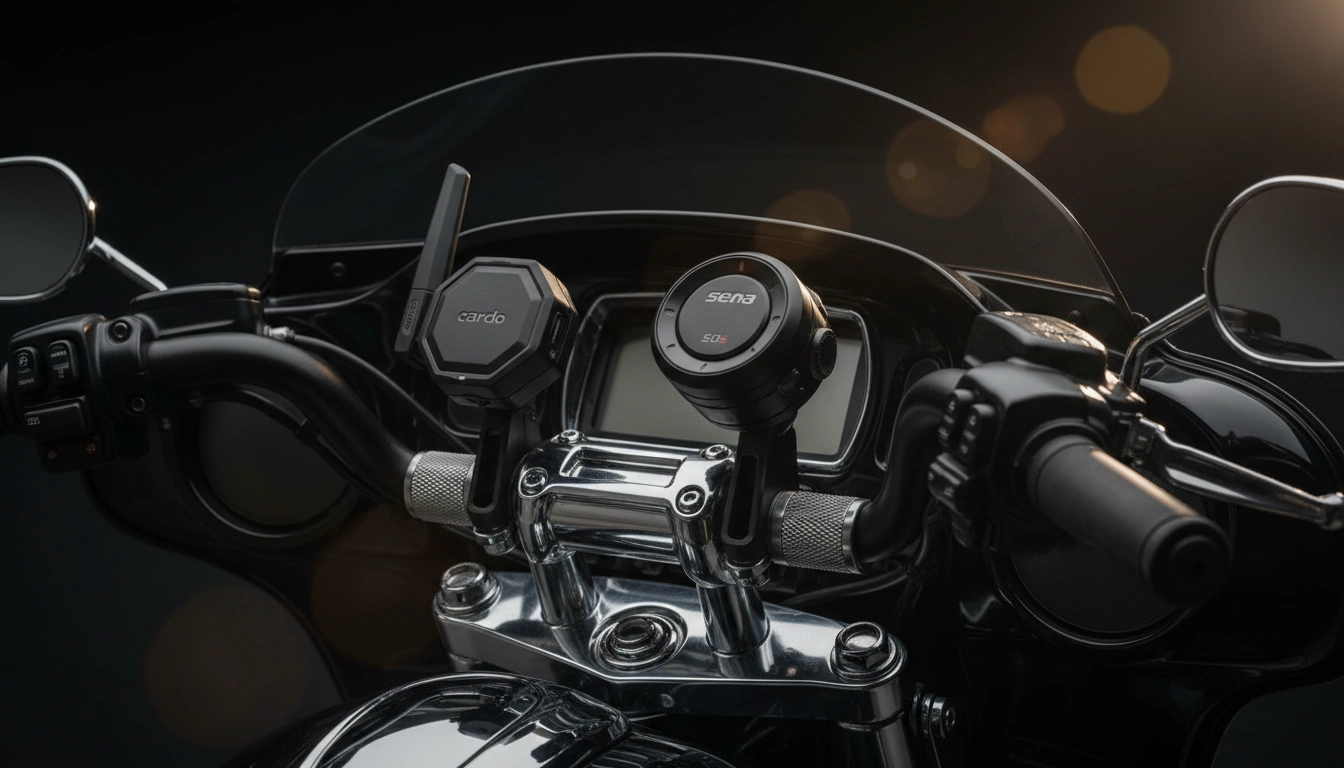
If you’ve ever tried having a conversation with your passenger at 70 mph on a Road Glide, you know the drill – you’re basically lip-reading through a windshield. A quality intercom changes everything, but figuring out whether to go Cardo or Sena for your Harley Touring rig is its own research project. Our team analyzed 200+ forum threads, owner reports from HDForums and Road Glide Org, and the current product lineup to put together this guide.
The short answer: for most Harley Touring riders, the Cardo Packtalk Edge is the best all-around pick in 2026 – superior mesh range, magnetic Air Mount that survives fairing vibration, and JBL audio that cuts through wind noise. The Sena 50S is the better choice if you’re already deep in the Sena ecosystem or want Harman Kardon audio with a jog-dial interface. For budget riders, the Cardo Spirit HD at $179 does the job without drama. Read on for the full breakdown.
One thing worth knowing upfront: Harley’s own Boom! Audio 30K and Audio 50S intercoms are manufactured by Sena under an OEM agreement (per official documentation at oem.sena.com/harley-davidson). The Boom! Audio 50S is essentially a Sena 50S with stereo integration for the Boom Box GTS audio system. If you’re buying aftermarket, you’re looking at the same brands – just without the HD badge markup. Let’s get into it.
Key Takeaways
- The Cardo Packtalk Edge ($439) is the top pick for group touring – DMC mesh connects up to 15 riders, 5-mile range, IP67 waterproof, and magnetic Air Mount holds firm on Touring fairings.
- The Sena 50S ($299-$329) is the best Sena option for Harley Touring, with Harman Kardon audio and Group Mesh for up to 24 riders – it’s also the basis for HD’s own Boom! Audio 50S OEM unit.
- Cardo’s DMC (Dynamic Mesh) and Sena’s Mesh 2.0 are incompatible networks – if you ride with a mixed group, you’ll need the Bluetooth bridge workaround (Cardo released a software update enabling cross-brand pairing in 2024).
- Battery life ranges from 7 hours (Sena 5S) to 17 hours (Sena 30K) – for Iron Butt-style touring, the 30K or Packtalk Pro’s 13-hour runtime are the realistic all-day options.
- For 2024-2026 CVO models, Harley-Davidson switched from Sena to Cardo as the factory-partnered intercom brand – a shift noted by owners in a high-traffic HDForums thread on the 2024 CVO center-cooled lineup.
| Cardo Packtalk Edge |  |
Best Overall | Technology: DMC Mesh Gen 2, 15 riders | Audio: 40mm JBL, IP67 waterproof | Range: Up to 5 miles / 8 km | VIEW LATEST PRICE | Read Our Analysis |
| Cardo Packtalk Pro |  |
Best for Long Tours | Technology: DMC Mesh, crash detection | Audio: 45mm JBL, 13-hr battery | VIEW LATEST PRICE | Read Our Analysis | |
| Sena 50S |  |
Best Sena for Touring | Technology: Mesh 2.0, up to 24 riders | Audio: Harman Kardon, 13-hr mesh | Range: Up to 5 miles open terrain | VIEW LATEST PRICE | Read Our Analysis |
| Sena 50R |  |
Best Low-Profile Sena | Technology: Mesh 2.0, 3-button control | Audio: Harman Kardon, 11-hr mesh | Profile: Thinner module, sharknose fit | VIEW LATEST PRICE | Read Our Analysis |
| Sena 30K |  |
Best Battery Life | Technology: Adaptive Mesh, dual processor | Battery: 17 hrs BT / 14 hrs Mesh | Special: HD Boom Audio 30K OEM base | VIEW LATEST PRICE | Read Our Analysis |
| Cardo Spirit HD | 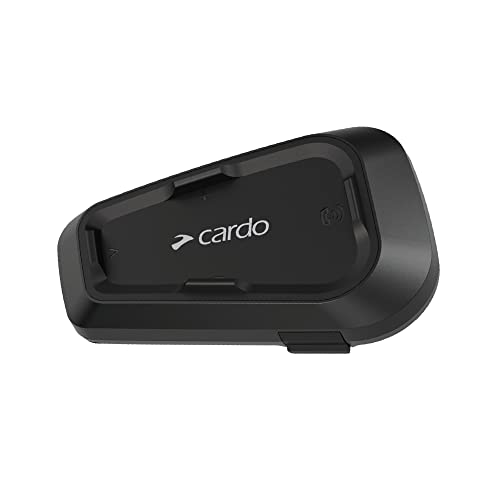 |
Best Budget Pick | Technology: Bluetooth, 2-rider intercom | Audio: 40mm HD speakers, 13-hr battery | VIEW LATEST PRICE | Read Our Analysis | |
| Sena 5S |  |
Best Entry-Level Sena | Technology: Bluetooth 5.0, 2-rider | Battery: 7 hrs talk time | Range: 700 meters open terrain | VIEW LATEST PRICE | Read Our Analysis |
| HD Boom! Audio 50S (OEM) |  |
Best OEM Integration | Technology: Sena 50S rebadge, stereo BT | Special: Boom Box GTS stereo sync | Fits: ’98-’25 FLHT/FLHTCU/FLHTK/FLTRU | VIEW LATEST PRICE | Read Our Analysis |
More Details on Our Top Picks
Cardo Packtalk Edge
The Packtalk Edge is the best motorcycle intercom for Harley Touring riders who want a set-it-and-forget-it experience. It uses Cardo’s second-generation Dynamic Mesh Communication (DMC), which means everyone in your group reconnects automatically when someone gets separated – no manual re-pairing when you split off at a gas station and rejoin 20 minutes later.
The 40mm JBL speakers and IP67 waterproof rating make it well-suited to the unpredictable weather Harley Touring riders actually encounter. The magnetic Air Mount system is particularly good on Touring helmets – the clamp stays stable on full-face and three-quarter helmets even with fairing wind buffeting at highway speeds. Bluetooth 5.2 handles phone, GPS, and music without the dropouts older hardware had on long runs.
Cardo also added cross-brand pairing with Sena devices (released via firmware update in 2024), addressing the biggest complaint from mixed-brand group riders. Our research found this was frequently discussed in the 2024 HDForums CVO thread – where owners noted HD had switched from Sena to Cardo as the preferred OEM partner for the center-cooled CVO lineup. Range on the Packtalk Edge is up to 1.6 km (1 mi) unit-to-unit, extending to 5 miles across 6+ DMC riders. That covers most realistic group ride spreads.
The main knock is price – at $439, it’s a commitment. And if your entire riding group uses Sena mesh, you’ll be bridging via Bluetooth rather than running native mesh with them. But if you’re buying fresh or converting your crew, this is the one to buy.
- Technology:DMC Mesh Gen 2
- Speakers:40mm JBL
- Range:1.6 km / 5 mi (group)
- Battery:Fast charge (20 min = 2 hrs)
- Waterproof:IP67
- Bluetooth:5.2
- Riders:Up to 15 DMC
- Mount:Magnetic Air Mount
- Voice Control:Hey Cardo
Cardo Packtalk Pro
The Packtalk Pro steps up to 45mm JBL speakers and adds the feature that puts it in a different category from the Edge: built-in crash detection. If the IMU detects an impact and you don’t respond within 30 seconds, it sends an alert with your location to pre-set emergency contacts. For solo long-distance touring on a Road King or Electra Glide, this is genuinely useful insurance.
Battery life comes in at 13 hours of continuous use, with 2-day standby – enough for a full day’s riding without a mid-trip charge if you started with a full battery. The Pro also includes an auto on/off function via IMU: it powers down when the bike sits still and powers back up when you start moving, which extends real-world battery life on stop-heavy routes. Priced at $499.95, it’s $60 more than the Edge.
The DMC mesh performance is identical to the Edge – same 15-rider capacity, same 5-mile group range, same IP67 rating, same Bluetooth 5.2. The speaker upgrade from 40mm to 45mm makes a noticeable difference at 80 mph highway speeds where wind noise is competing for headspace. Our research found multiple owners on Road Glide Org specifically mention the Pro’s audio upgrade as worth the price difference for solo riders who primarily use it for music and GPS on long interstate runs.
If you primarily ride two-up with a passenger on multi-day trips, the Packtalk Pro is the one to get. For group-focused riders who mostly care about intercom and not solo riding features, the Edge saves $60 without meaningful compromise.
- Technology:DMC Mesh Gen 2
- Speakers:45mm JBL
- Range:1.6 km / 5 mi (group)
- Battery:13 hours
- Waterproof:IP67
- Bluetooth:5.2
- Riders:Up to 15 DMC
- Crash Detection:Yes (IMU-based)
- Auto On/Off:Yes (IMU)
Sena 50S
The Sena 50S is the model that Harley-Davidson based its own Boom! Audio 50S on, and for good reason – it’s a polished, well-engineered system with Harman Kardon audio, a jog-dial control interface that’s easier to use with gloves than button systems, and Sena’s Mesh 2.0 that connects up to 24 riders in group mode. If your riding crew is already on Sena, this is your upgrade path.
The jog dial is the 50S’s most underrated feature on Harley Touring bikes. Batwing-fairing bikes generate meaningful vibration and wind load on helmet-mounted hardware – you want to be able to adjust volume or change a setting without looking or fumbling through multiple button presses. One rotation adjusts volume; tapping cycles through functions. On multi-day trips where you’re doing a lot of phone call management and music switching, this matters more than the spec sheet suggests.
Battery life is 16 hours Bluetooth / 13 hours Mesh with quick-charge delivering 2 hours of talk time after 20 minutes of charge. The 50S module sits at 102 x 56 x 27mm and weighs 64g – slightly larger than the Cardo Edge but still comfortable on most touring helmets including popular open-face models that HD Touring riders often prefer for summer touring. For Harley owners who also use the Boom Box GTS infotainment system, note that the OEM Boom Audio 50S (not this aftermarket unit) adds stereo audio integration through the WHIM module (P/N 76000768) – the aftermarket 50S does not have this.
Where the 50S falls short: it’s not fully waterproof (water-resistant, not IP67), and its module footprint is slightly bulkier than the 50R. If you ride in heavy rain on the regular, factor that in. Otherwise, it’s the most capable Sena unit for HD Touring use.
- Technology:Mesh 2.0 / Wave Intercom
- Speakers:Harman Kardon
- Range:2 km BT / 5 mi Mesh
- Battery:16 hrs BT / 13 hrs Mesh
- Bluetooth:5.0
- Riders:24 (Group Mesh)
- Weight:64g
- Control:Jog dial
- HD OEM Basis:Boom! Audio 50S
- Quick Charge:20 min = 2 hrs
Sena 50R
The Sena 50R shares the same Mesh 2.0 platform and Harman Kardon audio as the 50S but uses a three-button control layout instead of the jog dial. The result is a slightly smaller, lower-profile module (97 x 48 x 27mm vs 102 x 56 x 27mm) that fits better on road helmets where the extra height of the 50S module can catch wind. For Road Glide riders with sharknose fairings who spend a lot of time in that particular aerodynamic envelope, the lower profile is a real consideration.
Battery on the 50R comes in at 13 hours Bluetooth / 11 hours Mesh, slightly shorter than the 50S’s 16/13. The quick-charge is faster, though: 20 minutes delivers 6 hours Bluetooth or 3.5 hours Mesh, compared to the 50S’s 2 hours from the same charge time. So if you’re doing regular shorter runs and charging daily, the 50R charges more usefully. For Iron Butt territory, the 50S’s raw battery runtime wins.
Three-button operation is a preference call vs the jog dial. Some riders find buttons easier to distinguish by feel at speed; others prefer the tactile sweep of the dial. Our research found no strong consensus in touring forums – it’s genuinely personal. What the 50R also has is Wave Intercom and Open Mesh, same as the 50S, so you’re not giving up networking capability.
The 50R is the right call if you prioritize a lower-profile mount over maximum battery runtime – particularly on sharknose-fairing Road Glide models where helmet aerodynamics are tighter. Otherwise, the 50S is the better value at similar pricing.
- Technology:Mesh 2.0 / Wave Intercom
- Speakers:Harman Kardon
- Range:2 km BT / 5 mi Mesh
- Battery:13 hrs BT / 11 hrs Mesh
- Bluetooth:5.0
- Riders:24 (Group Mesh)
- Module Size:97 x 48 x 27mm
- Weight:65g
- Quick Charge:20 min = 6 hrs BT
- Control:3-button
Sena 30K
The Sena 30K is the battery marathon runner of this lineup – 17 hours Bluetooth / 14 hours Mesh in real-world use. It’s also the hardware that Harley used as the basis for the Boom! Audio 30K OEM intercom (documented at oem.sena.com/harley-davidson). The key difference between the HD-badged version and the standard 30K: the Boom Audio 30K adds stereo audio routing when connected to a Boom Box-equipped Touring bike, while the standard 30K uses mono audio mixing through the intercom system.
The 30K uses a dual-processor, dual-antenna architecture – one processor runs Bluetooth 5.0, the other runs the Adaptive Mesh network – allowing true audio multitasking. You can be in a mesh intercom group conversation with four riders while simultaneously receiving turn-by-turn GPS directions through your phone’s Bluetooth channel. This is not possible on the 50S or 50R, which mix audio through a single processor. For navigation-heavy touring, that’s a meaningful functional difference.
One area where the 30K shows its age: the module is the same footprint as the 50S (102 x 56 x 27mm, 61g) but the control interface is older-style three-button without the jog dial refinement of the 50-series. The HD speaker setup is still very good – redesigned with a beveled taper for comfort. Mesh range extends to 8 km (5 miles) in open terrain. Pricing runs $260-$300 for the single unit, making it significantly cheaper than the 50S for comparable mesh capability, with the added battery and multitasking benefits.
If you’re doing all-day rides where you don’t want to think about charging, and you need GPS audio alongside intercom without switching between modes, the 30K is the one to get. It’s a great choice for Electra Glide riders who tour solo or in small groups and use maps heavily.
- Technology:Adaptive Mesh + BT dual
- Speakers:HD speakers (beveled)
- Range:5 mi Mesh open terrain
- Battery:17 hrs BT / 14 hrs Mesh
- Bluetooth:5.0 (dual processor)
- Riders:24 Mesh / 4 BT bridge
- Audio Multitask:Yes (GPS + intercom)
- HD OEM Basis:Boom! Audio 30K
- Module Size:102 x 56 x 27mm
Cardo Spirit HD
At $179.95, the Cardo Spirit HD is the entry point for riders who want a Cardo unit without the Packtalk price tag. It handles two-rider intercom at up to 600m (0.4 miles), plays music via Bluetooth, and includes FM radio. For passenger-to-rider communication on a Harley Touring bike – which is one of the most common use cases we see in forum discussions – the Spirit HD does the job cleanly without the group-mesh complexity of the premium units.
The 40mm HD speakers are a step down from the JBL units in the Packtalk line, but they’re still solid for music and conversation. Battery comes in at 13 hours with fast charge capability (2 hours of talk time from a 20-minute charge). The Spirit HD is waterproof and pairs universally with other Cardo units as well as non-Cardo devices via standard Bluetooth. Cardo offers over-the-air software updates, which keeps the feature set current without buying new hardware.
The limitations are real: 600m intercom range is plenty for two-up riding but inadequate for group riding spread across multiple bikes on highway. There’s no mesh networking, so if your group uses Packtalk Edge units, the Spirit HD rider can join via Bluetooth – but they’re the weak link in the chain and can only manage one intercom connection at a time. It pairs with Cardo mesh units through standard Bluetooth as a bridge, not as a full DMC participant.
The Spirit HD is the right buy for Touring riders who primarily need passenger intercom and GPS audio, ride mostly solo or two-up, and don’t want to spend $400+ on features they won’t use. It carries a 2-year warranty, a year shorter than the Packtalk’s 3-year coverage.
- Technology:Bluetooth (2-rider)
- Speakers:40mm HD speakers
- Range:600m / 0.4 mi
- Battery:13 hours
- Waterproof:Yes
- FM Radio:Yes (6 presets)
- OTA Updates:Yes
- Warranty:2 years
- Riders:2-rider intercom
Sena 5S
The Sena 5S is the baseline entry point for riders who want to get into Sena’s ecosystem without the 50-series price. It uses Bluetooth 5.0 for up to 2-rider intercom, handles phone calls, music, and GPS turn-by-turn directions. The range is limited – 700 meters in open terrain – but that covers the practical distance of most two-up riding and close-formation group scenarios.
Battery comes in at 7 hours of talk time, charging fully in about 1.5 hours via USB-C. For a half-day or moderate full-day ride that’s workable, but it’s the shortest runtime on this list. The 5S uses a standard small LCD display for status indication, which is a nice touch at this price point – you can see battery level and connection status at a glance. Dimensions are 76mm x 48mm x 30mm, making it one of the more compact units here.
Where the 5S genuinely struggles relative to the Sena 50S or 30K is group riding. There’s no mesh networking – it’s pure Bluetooth intercom, meaning you need a direct pairing with each rider you want to talk to, with a hard cap of two simultaneous intercom connections. On a Harley group ride with 8 bikes, you’re outside the 5S’s capability. It’s also water-resistant rather than fully waterproof, which matters for unexpected summer storms on a multi-state trip.
The Sena 5S makes sense for the Harley Sportster-to-Touring upgrader who’s doing mostly local riding, two-up weekend runs, and isn’t planning Iron Butt events. If your riding evolves past that, you’ll want to budget for a 50S or 50R sooner than you think.
- Technology:Bluetooth 5.0
- Speakers:HD audio
- Range:700m open terrain
- Battery:7 hours talk
- Waterproof:Water-resistant
- Control:Button + LCD display
- Mesh:None
- Riders:2-rider intercom
- USB-C:Yes
- Charge Time:1.5 hours
HD Boom! Audio 50S (OEM)
The Harley-Davidson Boom! Audio 50S (Part Number 76001178A single / 76001179A dual) is a factory-badged Sena 50S manufactured under an official OEM agreement between Sena Technologies and Harley-Davidson, as documented in official service documentation at oem.sena.com/harley-davidson. This is a Tier 1 (HD official) product – not a third-party accessory – and it’s the one unit on this list designed specifically to integrate with Harley’s own infotainment system.
The key differentiator from the standard Sena 50S: when connected to a Boom Box GTS or Boom Box 6.5GT radio system via the Wireless Headset Interface Module (P/N 76000768), the Boom Audio 50S delivers stereo music and GPS directions through the intercom speakers rather than mono mixing. This matters because Harley’s Boom Box audio system is one of the better factory motorcycle infotainment setups available, and hearing it in stereo through quality Harman Kardon speakers is noticeably better than mono. Owners on Road Glide Org forums frequently mention this integration as the deciding factor for staying OEM.
The trade-offs are real. According to official HD fitment data (accessed May 2026 at harley-davidson.com), this system fits ’98-’25 FLHT, FLHTCU, FLHTCUSE, FLHTK, FLHTKSE, FLTRU, FLTRUSE, and FLHTCUTG models equipped with Boom! Box audio systems – a wide net that covers most modern Touring bikes. However, it does not fit wireless headset models or older non-Boom Box touring setups. The OEM badge also typically means a price premium versus the equivalent aftermarket Sena 50S, so compare carefully before buying dealer direct.
If you have a 2014-2025 Touring bike with the Boom Box GTS infotainment and you want seamless stereo integration with zero setup complexity, the OEM route is worth the premium. If you don’t use the Boom Box audio system heavily or have an older pre-Boom Box touring model, the standard Sena 50S or Cardo options on this list give you more features for the money.
- Manufacturer:Sena OEM for HD
- Part Number:76001178A (single)
- Technology:Mesh 2.0 / BT 5.0
- Stereo Integration:Yes (Boom Box GTS)
- Requires WHIM:P/N 76000768
- Fits:’98-’25 FLHT/FLHTCU/FLHTK
- Speakers:Harman Kardon
- Battery:Same as Sena 50S
- OEM Warranty:1-year HD limited
- Available:HD dealers + Amazon
How to Choose a Motorcycle Intercom for Harley Touring
Picking the right intercom for a Harley Touring bike isn’t just about specs. The batwing fairing on a Bagger-style Electra Glide and the sharknose fairing on a Road Glide create different wind noise profiles and helmet mounting environments – and those differences matter when you’re comparing units in a browser.
Mesh vs Bluetooth: What Matters for Harley Group Riding
Bluetooth intercom (Sena 5S, Cardo Spirit HD) pairs directly between riders in a 1-to-1 or 1-to-2 connection. Mesh intercom (Sena 50S, Cardo Packtalk Edge) creates a self-healing network where riders can join and leave without breaking the group connection. For the typical Harley group ride where bikes spread across multiple lanes and riders stop separately, mesh is dramatically less frustrating to manage. The Sena 30K’s dual-processor mesh also lets you multitask GPS directions alongside intercom conversation – useful on routes you don’t know well.
Batwing vs Sharknose Fairing: Does Mounting Change?
Both fairing types are wind-managed, which means the helmet you wear has different aerodynamic demands than an unfaired bike. Sharknose Road Glide riders tend to prefer lower-profile intercom modules (Sena 50R, Cardo Packtalk Edge with Air Mount) because the helmet sits deeper in the fairing’s aerodynamic pocket and a tall module creates more turbulence. Batwing Electra Glide and Street Glide riders have a bit more flexibility since the fairing does more wind shielding work. Our research across multiple Road Glide Org and HDForums threads confirms this is a recurring owner observation, not a theoretical concern.
Cardo DMC vs Sena Mesh 2.0: Cross-Brand Compatibility
Cardo’s Dynamic Mesh Communication and Sena’s Mesh 2.0 are incompatible networks by default – a Packtalk Edge will not join a Sena 50S mesh group natively. In 2024, Cardo released a software update enabling Bluetooth-based cross-brand pairing as a bridge – meaning a Cardo rider can participate in audio with a Sena group, but through the Bluetooth layer rather than as a full mesh participant. This works but adds pairing steps and can introduce audio quality differences. If your riding group is split brand, verify which brand the majority uses and match it. Per the 2024 CVO HDForums thread cited in our research, Harley-Davidson itself switched from Sena to Cardo as the preferred factory partner for the 2024 center-cooled CVO Touring lineup – but existing Sena users in non-CVO bikes are not affected.
Battery Life: Planning for Long-Distance Touring
A Milwaukee-8-powered Road King on a multi-day run will outlast most intercom batteries if you’re running intercom continuously. Our recommendation: target at least 10-11 hours of mesh talk time for all-day touring without mid-ride charging anxiety. The Sena 30K (14 hrs Mesh), Sena 50S (13 hrs Mesh), and Cardo Packtalk Pro (13 hrs) hit that bar. The Cardo Packtalk Edge’s fast charge (2 hrs from a 20-minute charge) is a workable backup for lunchtime top-ups. Avoid the Sena 5S’s 7-hour runtime for anything longer than a half-day ride.
HD Boom Box Integration: When OEM Actually Makes Sense
Most aftermarket intercoms play music from your phone through Bluetooth – mono, through the helmet speakers only. If you have a Boom Box GTS audio system in your Touring bike and you want the stereo integration with proper HD Boom Audio tuning, the OEM Boom! Audio 50S is the cleanest solution. It costs more and requires the Wireless Headset Interface Module, but the audio integration is qualitatively better than any aftermarket unit bridging through Bluetooth. If you’re also looking to upgrade your GPS navigation setup, see our guide on updating your Harley-Davidson GPS – keeping the maps current matters when your intercom is also routing you via your phone.
Motorcycle Intercom Comparison
| Model | Technology | Battery (Mesh) | Range (Mesh) | Speakers | Waterproof | Price |
|---|---|---|---|---|---|---|
| Cardo Packtalk Edge | DMC Mesh Gen 2 | Fast charge only | 5 miles / 8 km | 40mm JBL | IP67 | $439 |
| Cardo Packtalk Pro | DMC Mesh Gen 2 | 13 hrs | 5 miles / 8 km | 45mm JBL | IP67 | $499 |
| Sena 50S | Mesh 2.0 | 13 hrs | 5 miles / 8 km | Harman Kardon | Water-resistant | ~$300-$330 |
| Sena 50R | Mesh 2.0 | 11 hrs | 5 miles / 8 km | Harman Kardon | Water-resistant | ~$300 |
| Sena 30K | Adaptive Mesh | 14 hrs | 5 miles / 8 km | HD speakers | Yes | $260-$300 |
| Cardo Spirit HD | Bluetooth only | N/A | 0.4 miles (600m) | 40mm HD | Yes | $179 |
| Sena 5S | Bluetooth only | N/A | 700m | HD audio | Resistant | ~$100-$130 |
| HD Boom! Audio 50S | Mesh 2.0 (Sena OEM) | 13 hrs | 5 miles / 8 km | Harman Kardon | Water-resistant | Premium OEM |
Frequently Asked Questions
What is the best intercom for a Harley Touring bike in 2026?
The Cardo Packtalk Edge is the top overall pick for most Harley Touring riders in 2026. It uses second-generation Dynamic Mesh Communication, supports up to 15 riders, delivers IP67 waterproofing and 40mm JBL audio, and uses a magnetic Air Mount that handles fairing vibration well. The Sena 50S is the better choice if you’re already in the Sena ecosystem or prefer a jog-dial control interface. For budget riders who mainly need passenger-to-rider intercom, the Cardo Spirit HD at $179 is a clean, reliable entry point.
Are Cardo and Sena intercoms compatible with each other?
Cardo’s DMC mesh and Sena’s Mesh 2.0 networks are not natively compatible. They cannot join each other’s mesh groups directly. In 2024, Cardo released a software update enabling Bluetooth-based cross-brand pairing – a “bridge” mode where a Cardo rider connects to a Sena rider via standard Bluetooth while both remain in their own mesh groups. This works but requires extra setup steps and runs through the Bluetooth rather than native mesh layer. If your entire group can standardize on one brand, that’s simpler.
Is the Harley-Davidson Boom! Audio 30K or 50S worth it vs aftermarket?
The Boom! Audio 50S is a rebadged Sena 50S built under an official OEM agreement (documented at oem.sena.com/harley-davidson). Its key advantage over a standard Sena 50S is stereo audio integration with the Boom Box GTS infotainment system when paired with the Wireless Headset Interface Module (P/N 76000768). If you use your Boom Box GTS heavily and want true stereo through your helmet, the OEM unit is worth the premium. If you don’t have a Boom Box GTS or don’t use it for music, buy the aftermarket Sena 50S and save money.
Does the sharknose Road Glide fairing change which intercom to buy?
The sharknose fairing on Road Glide models creates a deeper aerodynamic pocket around the helmet than the batwing fairing on Street Glide and Electra Glide models. Road Glide riders in forum discussions frequently prefer lower-profile intercom modules to reduce wind turbulence. The Sena 50R (slightly smaller than 50S) and the Cardo Packtalk Edge with its compact Air Mount profile are both mentioned positively by Road Glide owners. The Sena 50S and 30K’s 102mm-wide modules can catch more wind in the sharknose environment but are not unusable – it’s a comfort preference, not a fitment incompatibility.
How long does a motorcycle intercom battery last on a full day’s touring ride?
A realistic all-day Harley Touring ride of 8-10 hours running intercom continuously will tax any unit under 10 hours of mesh talk time. The Sena 30K (14 hrs Mesh), Sena 50S (13 hrs Mesh), and Cardo Packtalk Pro (13 hrs) are the safe choices for all-day use without mid-ride charging. The Cardo Packtalk Edge’s quick charge (2 hrs of talk time from a 20-minute charge) makes it a viable option too, as long as you charge at lunch. Avoid the Sena 5S (7 hrs) for anything longer than a half-day ride.
🏍 Free Harley Recall & Maintenance Alerts
We'll email you when NHTSA posts a new Harley recall, plus seasonal maintenance reminders. No spam, unsubscribe anytime.
By subscribing you agree to our Privacy Policy.
