
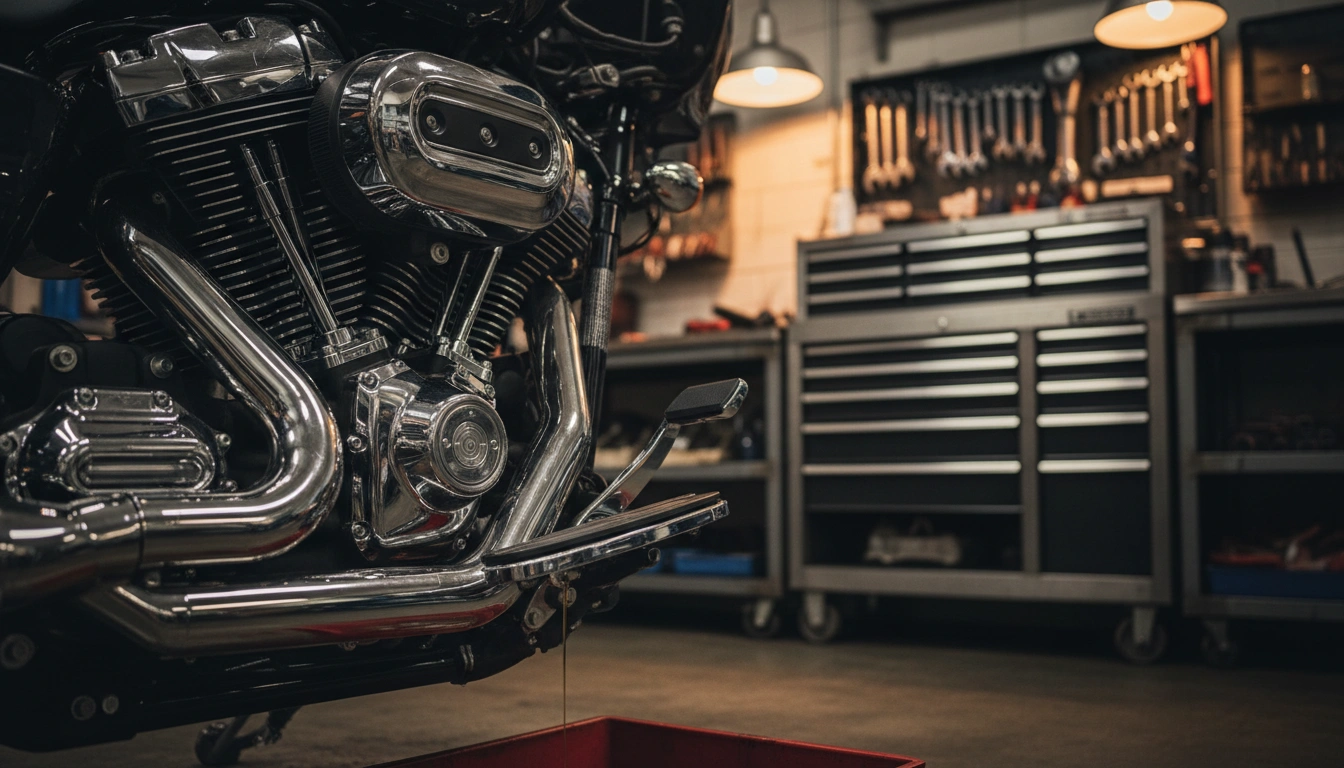
Oil sumping is one of the most documented mechanical concerns on 2017-2019 Milwaukee-Eight motorcycles. Our research team analyzed over 300 owner threads across HDForums, CVOHarley.com, and TrikeTalk, reviewed Harley-Davidson’s own service bulletins filed with NHTSA, and cross-referenced the 2019 Touring and 2018 Softail service manuals. Here is what we found: sumping is real, it is documented by HD’s own TSB M1450, and there are clear fix paths — from the factory-updated oil pump to aftermarket solutions from Feuling.
The short answer: if you own a 2017, 2018, or early-2019 M8-equipped Harley and notice oil weeping from the air cleaner or a progressive loss of power during sustained highway runs, your engine may be sumping. This guide covers the mechanism, the diagnostic test, the affected models, and every fix option from cheapest to most comprehensive.
What Is Milwaukee-8 Oil Sumping?
Sumping – formally “wet sumping” – occurs when oil accumulates in the engine crankcase instead of returning efficiently to the external oil reservoir. The Milwaukee-Eight is a dry sump engine by design: oil lives in an external tank (or the oil pan in later Softail architecture), not in the crankcase. When the scavenge side of the oil pump cannot return oil fast enough, the crankcase floods.
Per HD Technical Tip TT466 (dated 2019-08-20, filed with NHTSA), the root cause on 2017-2019 engines is the stock scavenge gerotor design. The original pump uses a 10-lobe scavenge gerotor. Harley’s engineers determined this design did not remove oil from the cam and flywheel compartments quickly enough under sustained high-rpm or heavy-load conditions. The redesigned 2020 pump uses an 8-lobe gerotor – counterintuitively, fewer lobes increase displacement per revolution, improving scavenge volume.
Per the HD Service Manual (2019 Touring M8, p. 4-6), the oil pump has two crankshaft-driven gerotor sets:
- Feed gerotor set – distributes pressurized oil to the engine (spec: 35-45 psi at 2,000 rpm normal operating temperature)
- Scavenge gerotor set – draws oil from the cam and flywheel compartments and returns it to the oil pan
Per the HD Service Manual (2019 Touring M8, p. 4-6): “Milwaukee-Eight engines are dry sump engines meaning they have external oil reservoirs.” The spec table on the same page describes the pump as “Twin gerotor, dual scavenge, crank mounted and driven, internal oil pump, dry sump.” When the flywheels spin through pooled oil, they aerate it into foam that the pump cannot scavenge effectively – oil pressure drops and the engine can suffer bearing damage if the condition is prolonged.
Which Milwaukee-8 Models and Years Are Affected?
HD’s Service Bulletin M1450 explicitly covers the following models. This is quoted directly from the TSB as filed with NHTSA:
| Model Family | Affected Years | Engine | TSB Reference |
|---|---|---|---|
| Touring (FLHR, FLHX, FLTRX, FLHT, etc.) | 2017-2019 | M8 107, M8 114 | M1450 – all markets |
| CVO Touring (FLHXSE, FLTRXSE) | 2017-2019 | M8 114, M8 117 | M1450 – all markets |
| Trike (FLHTCUTG, FLHXXX) | 2017-2019 | M8 107, M8 114 | M1450 – all markets |
| Touring Police | 2017-2019 | M8 107 | M1450 – all markets |
| Softail (FLHC, FLFB, FLSB, FXBR, etc.) | 2018-2019 | M8 107, M8 114 | M1450 – all markets |
Softail coverage starts at 2018 because that is the first model year the Milwaukee-Eight appeared in the Softail line, following the 2018 platform redesign. 2017 Softails used the Twin-Cooled Twin Cam and are not affected.
Late-production 2019 models received the updated 8-lobe pump before leaving the factory, per TT466. All 2020 and newer Milwaukee-Eight models use the improved pump as standard. The updated pump is identifiable by an identifying tang on the cover housing near the front lower bolt hole and casting number 62400244 on the cover.
Symptoms Checklist: Is Your M8 Sumping?
Sumping symptoms tend to appear progressively and are most pronounced during sustained highway riding at higher rpms. Our research found owners on HDForums and CVOHarley.com consistently describe the same progression across dozens of threads.
Milwaukee-8 Sumping Symptom Checklist
- Oil weeping from the air cleaner housing or soaked air filter element
- Oil residue or splatter on the right side of the engine during or after rides
- Progressive power loss during sustained highway riding (commonly after 30-60 minutes at speed)
- Increased engine braking sensation when closing the throttle
- Engine runs hotter than normal despite no coolant issues
- Oil tank level drops faster than expected between changes
- Lifter tick or increased valve train noise at cold startup (oil pooled in crankcase overnight, not in the tank)
- CKP (crankshaft position) sensor shows oil contamination when removed for the diagnostic check
- No oil pressure warning light triggered – the ECM does not detect sumping; the feed pump still functions
On CVOHarley.com, member Heatwave – owner of a 2017 CVO Limited who experienced two engine failures from sumping – described the danger: “There was never a drop of oil that came out of the air cleaner” before failure. Power loss was the only external signal. Member trahog reported a more severe case: “my buddy is on his 7th motor, just started to sump again – 11 ounces of oil in the crankcase sensor, 2017 CVO Stage 4 kit.”
The absence of an oil pressure warning light is particularly worth noting. Because the feed pump continues functioning normally, the ECM does not detect a low-pressure condition and does not trigger any dashboard warning. The owner receives no electronic alert while oil accumulates in the crankcase.
The Official Diagnostic Test (TSB M1450 Procedure)
HD’s Service Bulletin M1450 includes a specific field test to confirm or rule out sumping. The same procedure is referenced consistently across forum threads – owners who performed it got clear, actionable results.
- Warm the engine to operating bulk oil tank temperature: 93-121°C (200-250°F)
- With the vehicle at operating temperature, allow the engine to idle upright for 45-60 seconds
- Stop the engine. Remove the CKP (crankshaft position) sensor within one minute of shutdown
- Drain any oil from the CKP sensor opening into a measuring vessel
- Less than 177 ml (6 fl oz) collected: sumping is not the cause – explore other issues (TSB M1450, Step 10)
- 177 ml (6 fl oz) or more collected: confirmed sumping – proceed with oil pump replacement (TSB M1450, Step 11)
TSB M1450 also includes a pre-test checklist of conditions to rule out first: plugged breather bolts or hoses, a stuck oil bypass valve, a damaged O-ring at the oil pump/crankcase junction, and a blocked crankcase scavenge port. Per HD Service Manual (2019 Touring M8, p. 2-52), “Plugged crankcase scavenge port” and “O-ring damaged or missing from oil pump/crankcase junction” are both listed as diagnostic causes for excessive oil consumption and smoking.
Why the Stock Pump Sumps: The Root Cause
Two distinct mechanical contributors work together to create the sumping condition:
1. Scavenge Gerotor Design
The HD Service Manual (2018 Softail SM 94000529, p. 16-010) specifies the pump as “twin gerotor, dual scavenge, crank mounted and driven, internal oil pump, dry sump.” The scavenge gerotor draws oil from the cam and flywheel compartments and returns it to the oil pan. On 2017-early 2019 engines, the 10-lobe scavenge gerotor did not provide sufficient displacement per revolution to keep pace with oil returning from the top end during sustained high-rpm operation. Harley’s redesign – the 8-lobe gerotor introduced in late 2019/all 2020 production – increases displacement per revolution and shifts the scavenge balance between cam cover and crankcase areas to a more effective split.
2. Sump Plug Depth (Secondary Contributor)
A secondary contributor discovered by owners and the aftermarket: the stock sump plug is 0.465 inches tall. At this height, the plug can partially or fully block the internal scavenge cross port inside the crankcase, preventing the pump from drawing oil effectively. On TrikeTalk, member Jack Klarich described the mechanism clearly: “The deeper the case plug is set blocks part of the oil return to the scavenge side of the oil pump.” Member Mykneesbehurtin attributed the variability between engines to factory quality control: “Either way makes a person wonder about QC at the factory” – suggesting tap depth inconsistency explains why some owners experience sumping early and others never do on the same model year.
Fix Options: From Cheapest to Most Comprehensive
Our research identified four distinct repair paths. Which is appropriate depends on warranty status, riding style, and whether the engine has already sustained damage.
| Fix Option | Addresses Root Cause | Typical Total Cost | Best For |
|---|---|---|---|
| OEM 2020 oil pump swap (HD P/N 62400247 or 62400248) | Scavenge gerotor design | DIY: $250-$400 parts / Dealer: $500-$800 | Stock performance, out-of-warranty bikes |
| Feuling short sump plug only | Cross port blockage from plug depth | ~$25-$40 parts | Mild cases; always pair with pump service |
| Feuling HP+ oil pump + cam plate (P/N 7196) | Gerotor design + passage volume + plug depth | Parts: ~$800 / Installed: $1,100-$1,500 | Out-of-warranty, performance-oriented builds |
| Feuling Race Series pump + cam plate (P/N 7197) | Maximum scavenge + oil pressure | Parts: ~$900-$1,000 / Installed: $1,300-$1,700 | Stage 3/4 tuned engines, sustained high-rpm |
Option 1: OEM 2020 Oil Pump Replacement
The factory-spec fix confirmed by HD Technical Tip TT466. The 2020 pump (8-lobe scavenge gerotor) is retrofittable to all 2017-2019 Milwaukee-Eight models as a complete unit. Key part numbers: 62400247 (oil-cooled engines) and 62400248 (Twin-Cooled engines). The cover assembly P/N 62400245 is included with the pump assembly order per TT466 Table 1.
Critical installation note from TT466: “the new oil pumps, or their internal components, are not compatible with old oil pump versions.” The new pump must be installed as a complete unit. Do not mix old and new internal components.
In-warranty: dealers submit under TSB M1450. Out-of-warranty: expect 2-3 hours of dealer flat-rate labor on top of parts cost. Dealer estimates reported in forum threads range from $300-$700 total for out-of-warranty OEM pump replacements, depending on model and market.
Option 2: Feuling Short Sump Plug (Quick Win, Not a Standalone Fix)
Before committing to full pump replacement, Feuling recommends checking sump plug depth. Their short sump plug (0.265 inches vs. OEM 0.465 inches) ensures the internal scavenge cross port stays fully open. For mild sumping cases where the cross port blockage is the primary contributor, this may reduce or eliminate symptoms. However, it does not address the gerotor design itself – treat it as a complement to pump service, not a replacement for it.
Option 3: Feuling HP+ Oil Pump and Cam Plate Kit (P/N 7196)
Feuling’s HP+ kit (P/N 7196, fits 2017-2022 oil-cooled M8 engines) replaces both the stock pump and cam plate with billet components. Feuling’s published test data: 27% more pressure and scavenge gear volume over stock, 42% more scavenge volume through enlarged port sizing, and up to 50% reduction in measured engine sump oil level. Dyno testing showed a 2 hp and 2 ft-lb torque gain at the rear wheel, attributed to reduced parasitic drag from the flywheel no longer displacing pooled crankcase oil.
The cam plate upgrade is the differentiator versus simply swapping in the OEM 2020 pump: enlarged oil passages feed more volume to the crankshaft and rod bearings, addressing a secondary restriction the OEM 2020 pump alone does not resolve. For 2017-2019 bikes with high miles or ridden aggressively, the Feuling HP+ kit is the most frequently recommended solution in our forum research.
View Feuling Race Series oil pump and cam plate at RevZilla (fits 2017-2025 oil-cooled M8)
Option 4: Addressing the Inner Primary Oil Transfer (Separate Issue, TSB M1492)
TSB M1492 (2019-08-03) covers a separate oiling concern on 2017-2019 Touring, CVO Touring, and Trike models: oil transferring from the transmission case to the primary housing through the transmission mainshaft. Symptoms: low transmission oil and unexpectedly high primary oil level at a routine service interval. This is distinct from crankcase sumping but can co-occur on the same bikes.
The fix: inner primary vent service kit P/N 26500027. HD’s instruction per M1492: “Do not install inner primary vent as a preventative action. Dealer must verify the motorcycle is experiencing significant oil transfer prior to installation” – specifically, 150 ml (5 fl oz) or more of transfer in less than 8,000 km (5,000 mi).
DIY vs. Dealer: What the Job Actually Involves
Oil pump replacement on a Milwaukee-Eight requires cam compartment cover removal and access to the crankshaft-mounted pump. The HD Service Manual (2018 Softail SM 94000529, p. 18-966 to 19-018) describes the procedure: remove the oil pump assembly from the crankshaft, disassemble and inspect components, install new O-ring in the crankcase scavenge port (torque spec for the crankcase oil check valve: 18-22 ft-lbs / 24.4-29.8 N·m per the 2019 Touring SM fastener table), apply assembly lube to the scavenge port spigot, and slide the new housing onto the crankshaft while fitting the port into the O-ring.
This is not a quick garage job without proper service manual access and cam cover experience. TSB M1450 credits 2.1 hours of flat-rate labor for 2019 models and 1.4 hours for 2017-2018 models for the inner vent procedure; oil pump replacement labor runs separately. Dealer quotes in forum threads for out-of-warranty pump work ranged from $300-$700 total for OEM replacements, with Feuling kit installs running higher due to cam plate service time.
For routine maintenance oil during the repair service, see our guide to best 20W-50 oil for Harley-Davidson – the Milwaukee-Eight specifies 20W-50 HD SYN3 or equivalent. You can also search Amazon for HD-compatible 20W-50 oil and filter kits for the service.
Cost Summary
| Repair Scenario | Estimated Cost (2026) | Notes |
|---|---|---|
| In-warranty dealer repair | $0 to owner | Submitted under TSB M1450; labor time varies by model year |
| OEM 2020 pump (DIY) | $250-$400 parts only | HD P/N 62400247 (oil-cooled) or 62400248 (Twin-Cooled) |
| OEM 2020 pump (dealer installed) | $500-$800 total | Parts + 2-3 hrs dealer labor |
| Feuling HP+ kit P/N 7196 (DIY) | ~$800 parts | Includes cam plate; preferred for out-of-warranty performance builds |
| Feuling HP+ kit (dealer installed) | $1,100-$1,500 total | Higher labor time due to cam plate service |
| Engine rebuild after severe sumping damage | $3,500+ | Worst case: prolonged sumping causing rod bearing failure |
Is Your 2019 Already Fixed at the Factory?
Late-production 2019 models received the updated 8-lobe gerotor pump before leaving the factory. To verify: look for the identifying tang on the pump cover housing near the front lower bolt hole. The updated cover carries casting number 62400244. Without disassembly, your dealer can check via VIN and production date records.
All 2020 and newer Milwaukee-Eight models across all platforms (Touring, Softail, Trike, CVO, Police) use the updated 8-lobe pump as standard equipment and are not subject to the stock sumping condition.
Related Reading on BackyardRider
If you are evaluating a used Milwaukee-Eight bike, see our companion guide on Road King years to avoid for platform-level risk by model year. For a historical perspective on how M8 growing pains compare to earlier HD engine generations, see our Evo vs. Twin Cam reliability comparison. Owners who have addressed sumping and are now looking at exhaust upgrades can check our best exhaust for the Milwaukee-8 guide – certain pipe configurations affect backpressure and breather behavior on the M8. For broader Milwaukee-Eight engine history and common issues context, also see our guide on Harley-Davidson engine problems by generation.
Frequently Asked Questions
Is Milwaukee-8 oil sumping covered by a recall?
No. HD has not issued a safety recall for M8 sumping. The condition is addressed by Technical Service Bulletin M1450, filed with NHTSA (first issued 2017-07-05, last updated 2019-08-20). TSBs instruct dealers on diagnosis and remedy but do not require proactive owner notification or free repairs for out-of-warranty vehicles. Bikes still under warranty at time of diagnosis are covered; out-of-warranty owners bear the full repair cost.
Which Milwaukee-8 years are most affected by sumping?
Model years 2017 and 2018 Touring, CVO, and Trike models are the most consistently reported, as they had the original 10-lobe scavenge gerotor for their entire production run. 2018-2019 Softail models are also covered by TSB M1450. Early-production 2019 models are at risk; late-production 2019 models received the updated pump before shipping. All 2020 and newer models use the improved 8-lobe design.
Can you still ride a Milwaukee-8 that is sumping?
Short, low-rpm rides are lower risk, but sustained riding while sumping can cause serious engine damage. When oil pools in the crankcase, the flywheel aerates it into foam the pump cannot circulate. This creates oil starvation at rod and main bearings. Owners on CVOHarley.com report engine failures requiring complete long block replacements after ignoring progressive symptoms. Our recommendation: limit riding to what is necessary until the pump is replaced.
What is the difference between the Feuling HP+ (7196) and Race Series (7197)?
Both kits replace the stock pump and cam plate with high-flow billet units and address sumping more aggressively than the OEM 2020 pump alone. The HP+ (7196) is calibrated for street-ridden stock and mildly modified engines. The Race Series (7197) provides higher flow rates suited to stage 3/4 or high-compression builds with sustained high-rpm operation. For a stock or lightly modified 2017-2019 Touring or Softail, the HP+ resolves sumping with margin to spare.
Will the 2020 OEM pump completely fix sumping on a 2017 Milwaukee-8?
Yes, for most cases. HD Technical Tip TT466 explicitly states the 2020 pump “is retrofittable to all previous years and models that have the Milwaukee-Eight engine.” Install as a complete unit only – old and new components are not interchangeable (TT466). P/N 62400247 covers oil-cooled engines; P/N 62400248 covers Twin-Cooled. If the engine has already suffered bearing wear from prolonged sumping, the pump swap resolves the cause but does not reverse bearing damage.
Does the Milwaukee-8 107 sump more than the 114 or 117?
TSB M1450 covers all Milwaukee-Eight displacements – 107, 114, and 117. The root cause (scavenge gerotor design) is shared across all variants. Our research found no evidence that one displacement sumps more severely than another, though higher-displacement engines generate higher oil volumes that may make symptoms more pronounced under the same riding conditions.
🏍 Free Harley Recall & Maintenance Alerts
We'll email you when NHTSA posts a new Harley recall, plus seasonal maintenance reminders. No spam, unsubscribe anytime.
By subscribing you agree to our Privacy Policy.
