
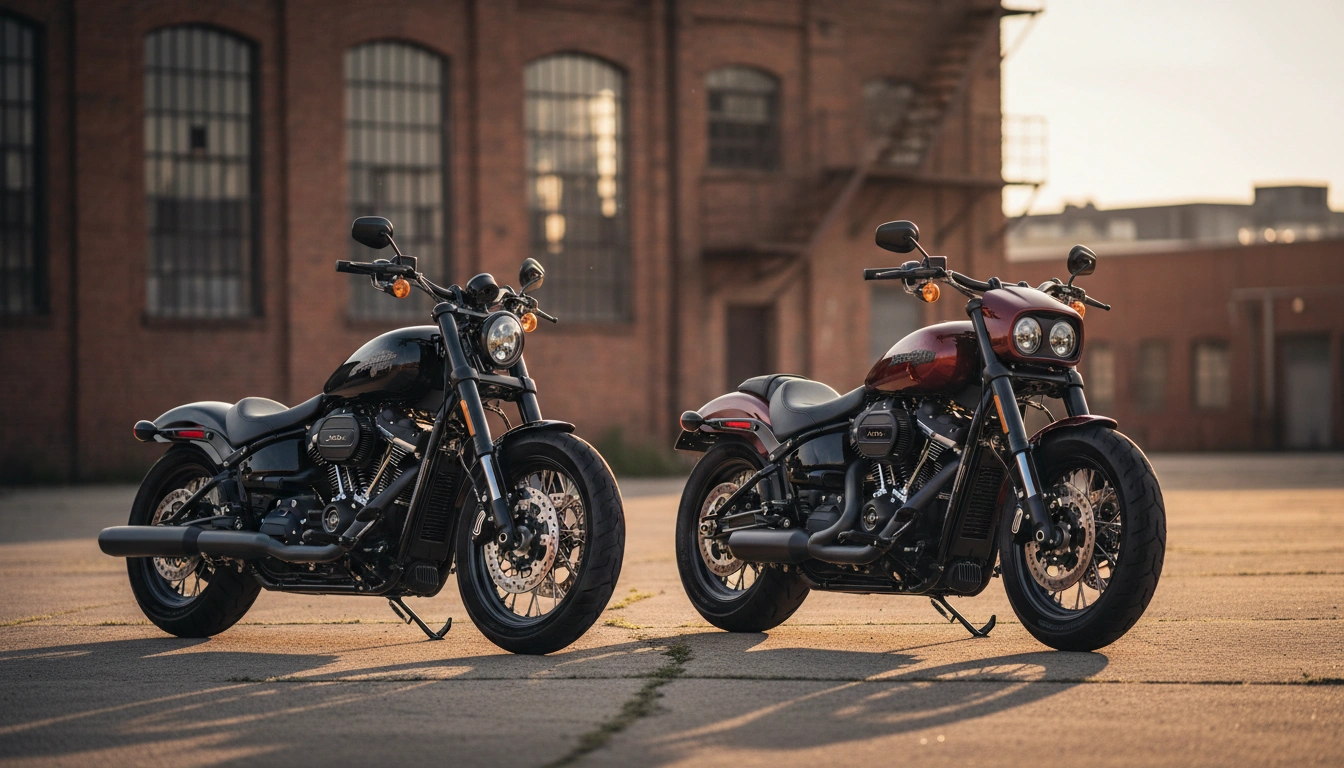
Bottom line up front: The Street Bob (FXBB) is the lighter, narrower, more flickable bike for riders who want a stripped-down city cruiser with mid controls and upright ergonomics. The Fat Bob (FXFB) is the heavier, wider, visually aggressive machine with forward controls, a 150mm front tire on a 16-inch wheel, and a noticeably lower seat. Choose the Street Bob if you value nimble handling and a classic silhouette. Choose the Fat Bob if you want a brawnier presence, fatter tire contact patch, and a laid-back forward-control riding position.
Both are Milwaukee-Eight Softails introduced in 2018 on the same frame platform—but they ride differently, look completely different, and attract different buyers. Our research covered the 2018 HD Softail Service Manual (Part No. 94000529), HD official spec sheets, and dozens of owner threads on HDForums, including the frequently-cited “Street Bob or Fat Bob?” discussion that has run across multiple model years.
What Are the Street Bob and Fat Bob?
The Milwaukee-Eight is Harley-Davidson’s eighth-generation Big Twin engine family, introduced for 2017. The Street Bob (FXBB) and Fat Bob (FXFB) are both 2018-and-later Softail platform bikes using this engine. The Softail frame—a hardtail look with a hidden rear mono-shock—unified what had previously been separate Dyna and Softail lines. Both models share the same basic architecture but diverge dramatically in front-end geometry, tire sizing, ergonomics, and character.
Engine: Milwaukee-Eight 107 vs 114
The Street Bob ships standard with the Milwaukee-Eight 107; the Fat Bob comes standard with the Milwaukee-Eight 107 on base trims and the 114 on the FXFBS. Both engines share the same basic architecture—a 45-degree V-twin, single camshaft with dual balance shafts, air-cooled—but differ in displacement, bore, and compression.
| Spec | M8 107 (FXBB Standard / FXFB Base) | M8 114 (FXFBS) |
|---|---|---|
| Displacement | 107 cu in (1,753 cc) | 114 cu in (1,868 cc) |
| Bore | 3.937 in (100 mm) | 4.016 in (102 mm) |
| Stroke | 4.375 in (111.1 mm) | 4.500 in (114.3 mm) |
| Compression Ratio | 10.0:1 | 10.5:1 |
| Engine Type | 4-cycle, 45° V-twin, air-cooled, dual balance shafts | 4-cycle, 45° V-twin, air-cooled, dual balance shafts |
| Fuel | Premium unleaded | Premium unleaded |
Source: HD Service Manual 2018 Softail Models (Part No. 94000529), Tables 1 and 2 — Milwaukee-Eight engine specifications.
In real-world use, both engines deliver the classic Harley low-RPM torque character. The 114 adds noticeably stronger mid-range pull, which owners on HDForums describe as “more grunt right off the stop light.” For most urban riding the 107 is genuinely sufficient—but if you’re regularly carrying a passenger or plan to add exhaust and tuning mods, the 114 headroom is worth having.
If you’re shopping used M8 bikes, our guide to Harley Softail years to avoid covers which model years had issues to watch for, and our Milwaukee-8 years to avoid breakdown goes deeper on engine-specific problems across the family.
Tires and Front-End: Where the Two Bikes Truly Diverge
This is the biggest mechanical difference between the Street Bob and Fat Bob—and it changes how both bikes handle. The Street Bob runs a 100/90B19 front tire on a 19-inch wheel. The Fat Bob runs a 150/80B16 front tire on a 16-inch wheel. Those numbers mean very different things at the steering head.
| Tire / Wheel | Street Bob (FXBB) | Fat Bob (FXFB/S) |
|---|---|---|
| Front tire | Dunlop D401F 100/90B19 BW | Dunlop D429F 150/80B16 BW |
| Front wheel diameter | 19 inches | 16 inches |
| Rear tire | Dunlop 150/80B16 BW | Dunlop 180/70B16 BW |
| Front pressure (cold) | 30 psi (207 kPa) | 36 psi (248 kPa) |
| Rear pressure (cold) | 40 psi (276 kPa) | 40 psi (276 kPa) |
Source: HD Service Manual 2018 Softail Models (Part No. 94000529), Tire Pressure and Specifications table.
The Street Bob’s tall, narrow 19-inch front tire turns in quicker and has a lighter feel through corners. The Fat Bob’s wide 150mm front on a 16-inch rim produces a different steering geometry—more stable at highway speed but heavier in slow urban maneuvers. Riders who have owned both on HDForums frequently note that the Fat Bob “takes more effort to push around a parking lot” but “feels more planted on the interstate.”
Neither bike is a canyon carver by Harley standards, but the Street Bob is meaningfully more nimble. If you’re adding an aftermarket exhaust, our guide to the best M8 exhausts covers options that fit both FXBB and FXFB.
Dimensions, Weight, and Geometry
From the 2018 Softail Service Manual’s FX model dimension and weight tables, here’s how the two bikes compare directly:
| Dimension / Weight | Street Bob (FXBB) | Fat Bob (FXFB) |
|---|---|---|
| Overall length | 2,320 mm (91.3 in) | 2,340 mm (92.1 in) |
| Overall width | 865 mm (34.1 in) | 960 mm (37.8 in) |
| Overall height | 1,160 mm (45.7 in) | 1,110 mm (43.7 in) |
| Wheelbase | 1,630 mm (64.2 in) | 1,615 mm (63.6 in) |
| Seat height (180 lb rider) | 655 mm (25.8 in) | 704 mm (27.7 in) |
| Ground clearance | 125 mm (4.9 in) | 120 mm (4.7 in) |
| Running weight | 296 kg (653 lb) | 305 kg (672 lb) |
| Max added weight | 230 kg (507 lb) | 221 kg (487 lb) |
Source: HD Service Manual 2018 Softail Models (Part No. 94000529), Tables 3 (Dimensions: FX Models) and 5 (Weights: FX Models).
Two things stand out here. First, the Fat Bob is 19 lb heavier than the Street Bob—meaningful when you’re low-speed maneuvering. Second, the Fat Bob actually has a higher seat height despite looking lower to the eye because the wider tire lifts the bike’s center of gravity. The Street Bob’s narrower 19-inch front gives it a lower, slimmer visual profile even though the Fat Bob has slightly less ground clearance.
Ergonomics: Mid Controls vs Forward Controls
The Street Bob runs mid-mount foot controls with an upright riding position. The Fat Bob runs forward controls, which push your feet out front and recline your torso slightly. This is not a minor preference difference—it changes how you interact with the bike for hours at a time.
Mid controls (Street Bob) give you more leverage over the bike in slow turns, put less stress on your lower back on shorter rides, and suit a wider range of rider heights. Forward controls (Fat Bob) are more comfortable for taller riders on long straight stretches, create the classic low-and-laid-back cruiser look, but reduce your ability to use leg strength to maneuver at low speeds.
On the HDForums “Street Bob or Fat Bob?” thread, the most-upvoted comment from a rider who owned both noted: “The Street Bob feels like a motorcycle you’re wearing. The Fat Bob feels like a piece of furniture you’re sitting in—but furniture that goes 0-60 in 4 seconds.” That framing captures what owner reports consistently show: the Street Bob is the rider’s bike, the Fat Bob is the cruiser experience.
Styling and Visual Identity
The styling gap is arguably bigger than the mechanical one. The Street Bob is a minimalist, blacked-out design: one round headlight, slim tank, skinny front wheel, drag bars or mini-apes depending on year. It recalls the stripped-down custom look that Harley’s Factory Custom line pioneered.
The Fat Bob is a visual statement. Two round headlights stacked vertically (a nod to the 1970s FX series), a wide front fender arching over that fat 150mm tire, a more muscular tank, and an overall silhouette that reads as aggressive even at standstill. It has more in common visually with a bobber build than the minimalist Street Bob does.
Both bikes are available in similar color ranges and are regularly customized. The Street Bob tends to get bar and mirror changes; the Fat Bob tends to get exhaust and wheel swaps. Neither is a particularly popular starting point for major frame-up builds because the Milwaukee-Eight Softail platform is heavy and relatively modern—most serious custom builders still prefer older Twin Cam or Evo platforms for the weight savings.
For historical context on how Harley’s engine lineage led to the Milwaukee-Eight, our Evo vs Twin Cam comparison covers what changed across generations.
Suspension
Both models use the same basic Softail rear mono-shock setup—a horizontally-mounted hidden shock that gives the hardtail look without the hardtail ride. The front end is where they diverge. The Street Bob runs a conventional telescopic fork with a 200.7–203.7 mm (7.90–8.02 in) fork travel measurement per the service manual. The Fat Bob uses a wider fork setup to accommodate the 150mm front tire, with a 232.4–235.5 mm (9.15–9.27 in) front fork measurement.
In practice, both bikes offer a compliant Softail ride. Owners report the Fat Bob feels slightly more planted on broken pavement because the wider tire has more contact patch. The Street Bob can feel slightly more nervous on rough urban streets but quicker to respond to steering input.
If you plan to upgrade suspension on either model, our Fat Boy years to avoid post is useful background reading since the Fat Boy shares the same Softail platform and many suspension upgrade paths apply across the lineup.
2026 Pricing and What You’ll Pay Used
For 2026, HD’s MSRP positions the Street Bob and Fat Bob as follows (from Harley-Davidson’s official model pages, harley-davidson.com):
- Street Bob (FXBB): Starts around $13,999–$14,999 MSRP depending on trim and color.
- Fat Bob (FXFB): Starts around $15,999–$16,999 MSRP; the S/114 trim adds ~$1,500–$2,000.
Used market (2018–2023 models): Street Bobs typically trade in the $9,000–$12,500 range depending on miles and mods. Fat Bobs command a slight premium—typically $10,000–$13,500—reflecting their higher original MSRP and the popularity of the wider-tire look in the used market. Check our Softail years to avoid guide before pulling the trigger on a used example; early M8 production had some cam-chain tensioner issues that were addressed in later builds.
Who Buys Which?
Based on what owners report across HDForums and other communities, the Street Bob attracts:
- Riders who commute or do mixed urban/weekend use and want a more agile, lighter bike
- Buyers coming from sportbikes who want Harley culture without the full bagger experience
- Shorter riders (the 25.8-inch seat height with a 180 lb rider is among the lower options in the Softail line)
- Minimalists who prefer the blacked-out, stripped aesthetic over visual bulk
The Fat Bob attracts:
- Riders who want maximum visual aggression in the Softail lineup without going full-dresser
- Taller riders or those who prefer a relaxed forward-control position for longer hauls
- Buyers who want the 114 displacement from the factory (FXFBS)
- Owners who like the wide-tire custom look without a full custom build cost
One consistent finding across owner threads: riders rarely switch from one to the other and feel they made a mistake. The two bikes serve genuinely different purposes and the buyers who feel buyer’s remorse are usually those who bought based on looks alone without test-riding both.
Gear and Accessories
Both bikes share many accessory compatibility points—handlebars, mirrors, exhausts, and seat options that fit the 2018+ Softail platform. For protective gear, we recommend budgeting for quality kit regardless of which model you choose.
Amazon carries a solid range of Harley-compatible accessories: browse Harley Softail accessories on Amazon. For brand-specific HD parts and apparel, RevZilla carries an extensive HD section (2% commission via Impact; all links verified).
Frequently Asked Questions
Is the Street Bob or Fat Bob better for beginners?
Neither is a beginner bike—both weigh 290–305 kg (640–672 lb) and have significant torque. Between the two, the Street Bob’s mid controls and lighter weight (296 kg vs 305 kg) make it somewhat easier to maneuver at low speeds, making it the marginally better choice for a newer rider who insists on starting with a Milwaukee-Eight Softail.
Does the Fat Bob actually handle worse than the Street Bob?
Not worse in an absolute sense—differently. The Fat Bob’s wide 150mm front tire on a 16-inch wheel creates more straight-line stability and a slightly heavier steering feel. The Street Bob’s narrower 19-inch front turns in quicker. For most real-world riding both are equally capable. The difference matters more in tight urban maneuvers than on open roads.
What engine does the 2026 Fat Bob come with?
As of 2026, the standard Fat Bob (FXFB) ships with the Milwaukee-Eight 114 (1,868 cc). Earlier 2018 base models used the 107; the current lineup has standardized to the 114 across the Fat Bob range. Verify with your dealer as model-year specs can shift.
Are the Street Bob and Fat Bob on the same frame?
Yes. Both use the 2018-generation Softail frame—Harley’s unified platform that replaced the separate Dyna and Softail lines. The frame, hidden rear mono-shock, and powertrain mount points are shared. The differences are in front-end geometry, wheel/tire sizing, controls placement, and bodywork.
Can I swap Street Bob controls to forward controls?
Yes. The Softail platform supports forward control kits from both HD Genuine Accessories and the aftermarket (Kuryakyn, Drag Specialties, etc.). This is a common modification for Street Bob owners who want the forward-control feel without paying Fat Bob MSRP. The reverse swap (Fat Bob to mid controls) is also possible but less common.
Which Milwaukee-Eight Softail has the lowest seat height?
Per the 2018 Softail Service Manual, the Street Bob (FXBB) has a seat height of 655 mm (25.8 in) with a 180 lb rider, which is among the lowest in the Softail FX lineup. The Fat Bob (FXFB) measures 704 mm (27.7 in). For comparison, the Low Rider S sits even lower.
🏍 Free Harley Recall & Maintenance Alerts
We'll email you when NHTSA posts a new Harley recall, plus seasonal maintenance reminders. No spam, unsubscribe anytime.
By subscribing you agree to our Privacy Policy.
