
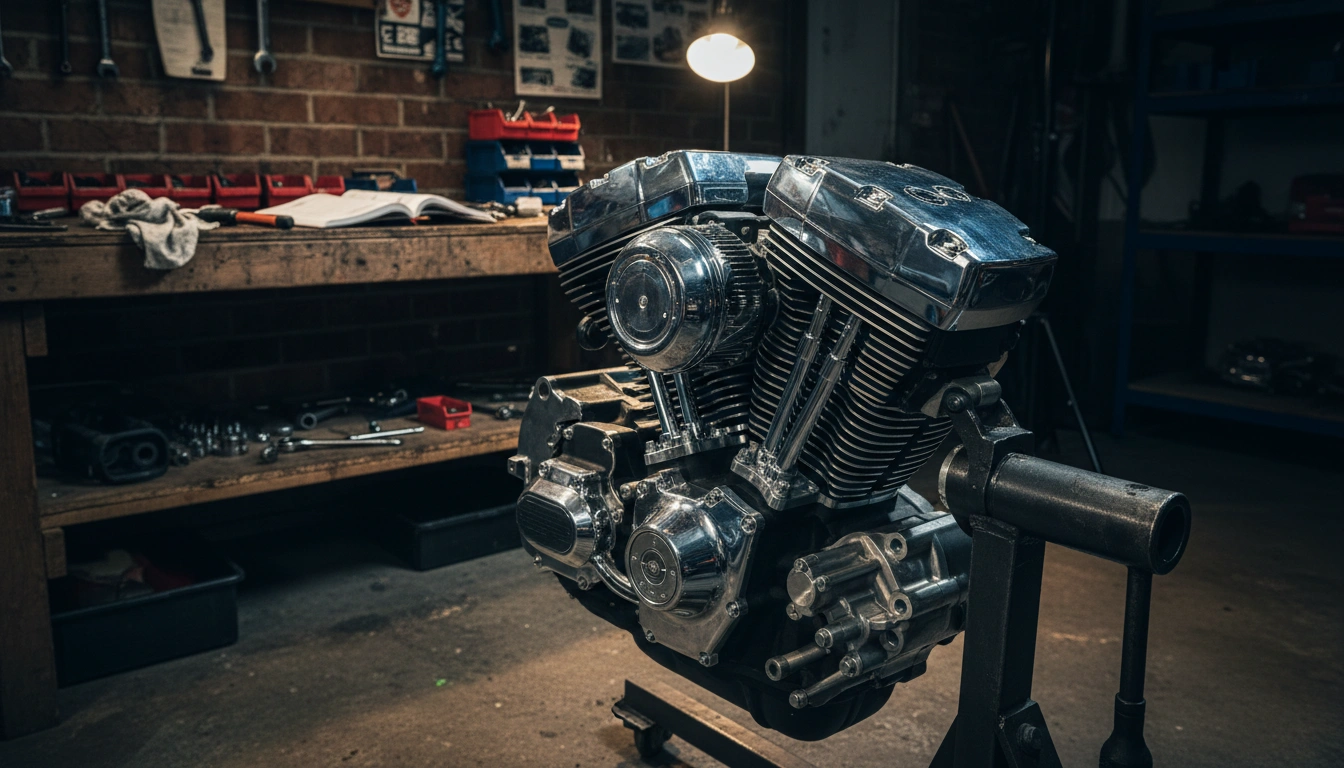
The Milwaukee-Eight (M8) is the best engine Harley-Davidson has built in decades – smoother, cooler-running, and more powerful than the Twin Cam it replaced. But like every first-generation engine, the earliest production runs had real problems. Our research analyzed NHTSA recall records, two HD service manuals covering 2017-2019 M8 production, and hundreds of owner reports to give you a clear picture of which years to avoid and which are safe to buy used.
For the full federal picture, see our analysis of every Harley-Davidson recall from 2017 to 2026, where brake-system campaigns – not engine issues – top the list.
Quick Answer
Avoid: 2017 (oil pump design and two NHTSA recalls), and 2018 Touring/Softail (clutch master cylinder recall 18V734000, early-production oil pump risk).
Buy with caution: Late 2018 and 2019 – verify the oil pump was updated, confirm 18V734000 remedy was performed.
Best years to buy: 2020 and newer. The oil pump design was finalized, the major recalls are resolved, and the M8 114 and 117 are proven engines.
What Is the Milwaukee-Eight and Why Does the Year Matter?
Harley-Davidson introduced the Milwaukee-Eight in 2017 across Touring and select Softail models, replacing the Twin Cam 103 and 110. The name refers to the eight valves (four per cylinder), a first for HD. It runs in 107, 114, and 117 cubic-inch displacements depending on model and year.
Per the HD Service Manual (2019 Touring M8, p. 4-3): the Milwaukee-Eight is a pressurized dry-sump engine with a twin gerotor, dual-scavenge oil pump that is crankshaft-mounted and driven. The scavenge gerotor draws oil from the cam and flywheel compartments and returns it to the oil tank. That design is mechanically sound when it works. The issue on early production units was in the details of the pump components – specifically the oil pressure relief valve, which changed between early and late production runs.
Milwaukee-Eight Year-by-Year: Avoid, Caution, or Buy?
Here is the full picture by model year, based on NHTSA records and HD Service Manual documentation.
| Model Year | Engine | Key Issues | NHTSA Recalls | Verdict |
|---|---|---|---|---|
| 2017 | M8 107 / M8 114 | Early-production oil pump (early pressure relief valve design); oil cooler line clamp failure; clutch cylinder leak | 17V333000, 18V734000 | AVOID |
| 2018 | M8 107 / M8 114 | Clutch master cylinder recall covers all Touring; early-vs-late oil pump split in production run | 18V734000 | CAUTION |
| 2019 | M8 107 / M8 114 | Late-production oil pump standard; no Touring-wide NHTSA engine recalls found; verify 18V734000 remedy on carry-over units | None found (Touring) | CAUTION |
| 2020 | M8 107 / M8 114 / M8 117 (CVO) | No engine or powertrain recalls found. Minor brake light recall (22V781000) unrelated to engine | 22V781000 (brake lights only) | BUY |
| 2021-2023 | M8 107 / M8 114 / M8 117 | No significant powertrain issues identified. Milwaukee-Eight considered mature by this point | None engine-related | BUY |
The Core Issue: Oil Sumping on 2017-Early 2019 Milwaukee-Eights
Oil sumping – where oil migrates from the external oil tank into the engine crankcase while the bike sits – is the defining complaint of early M8 owners. It is not unique to Harley (all dry-sump V-twins can sump to some degree), but the early M8 oil pump design made it worse than it needed to be.
The HD Service Manual (2018 Softail, p. 19,060) explicitly notes: “Early and late production oil pump components are not interchangeable.” The two production runs have different oil pressure relief valve designs – both use a spring-piston-roll-pin assembly; the running change was passage geometry – early pumps have two passages near the relief valve, late pumps have one. This is not a casual update. HD produced a service bulletin for the change, and the manuals document separate installation procedures for each version.
What does sumping feel like in practice? Owners on HDForums and roadglide.org describe the same sequence: start a bike that has sat for a week or more, get a puff of blue smoke on startup, see the oil level drop on the dipstick after the bike runs, then watch the level “come back” as the scavenge pump clears the sump. In mild cases it is cosmetic – smoke and a dirty air cleaner. In severe cases, the crankcase floods enough to cause a momentary loss of oil pressure on startup. That is the scenario that makes sumping worth taking seriously on 2017 units.
Multiple threads in the HDForums Milwaukee-Eight Engine subforum starting in 2017 document owners with early Street Glides and Road Glides reporting consistent blue smoke on first start after extended storage, pointing to the oil pump check valve as the failure point. Roadglide.org users in 2018 threads noted the same pattern and identified the production split as the dividing line between affected and unaffected bikes.
How to check before buying a used 2017-2018 M8
- Ask the seller to let the bike sit cold overnight, then watch for blue smoke on startup
- Check the air cleaner: oil residue on the filter is a reliable sign of active sumping
- Ask for service records – did the dealer perform a pump inspection or replacement under the production-change TSB?
- If a Feuling HP+ oiling system or equivalent has already been installed, the sumping issue is resolved
NHTSA Recall 17V333000: 2017 Oil Cooler Line Clamp Failure
This is a 2017-model-year-only recall covering Touring models including the Street Glide (FLHX), Road Glide (FLTRX), Road King (FLHR), and Electra Glide Ultra Classic (FLHTCU). NHTSA campaign 17V333000, HD internal reference 0170. Remedy began June 6, 2017.
Issue: A clamp used to secure the engine oil cooler line may have been improperly installed at the factory.
Consequence (NHTSA text): “The incorrectly installed clamp may result in the engine oil cooler line detaching, causing a sudden loss of oil, potentially into the path of the rear tire, increasing the risk of a crash.”
Remedy: Dealers inspect and correct oil cooler line clamps at no cost. Any 2017 Touring bought used should have this verified with our Harley VIN Decoder + Recall Lookup before purchase.
NHTSA Recall 18V734000: 2017-2018 Clutch Master Cylinder
This is the widest-scope recall in M8 history, covering 2017 and 2018 model years across nearly every M8 Touring model. NHTSA campaign 18V734000, HD internal reference 0173. Remedy began November 5, 2018.
Models covered: 2017-2018 Road King (FLHR), Road King Special (FLHRXS), Electra Glide Ultra Classic (FLHTCU), Ultra Limited (FLHTK), Ultra Limited Low (FLHTKL), Police Electra Glide (FLHTP), Police Road King (FLHP), Street Glide (FLHX), Street Glide Special (FLHXS), Road Glide Ultra (FLTRU), Road Glide (FLTRX), Road Glide Special (FLTRXS), Freewheeler (FLRT), Tri Glide Ultra (FLHTCUTG), CVO Limited (FLHTKSE), CVO Street Glide (FLHXSE). Also: 2017 Softail Slim S (FLSS), Fat Boy S (FLSTFBS), CVO Pro Street Breakout (FXSE), and 2018 115th Anniversary variants.
Issue (NHTSA text): “The secondary clutch actuator cylinder may leak fluid internally and the clutch master cylinder may lose the ability to generate enough lift to disengage the clutch.”
Consequence: “If the clutch cannot be disengaged it can result in a loss of control, increasing the risk of a crash.”
Remedy: New secondary clutch actuator piston assembly installed at no cost. Contact HD at 1-800-258-2464 or verify with our Harley VIN Decoder + Recall Lookup using the VIN.
Before buying any 2017 or 2018 M8, run the VIN through our Harley VIN Decoder + Recall Lookup. Both 17V333000 (2017 only) and 18V734000 (2017-2018) should show remedy completed. If either shows open, HD dealers perform recall repairs free of charge on any VIN.
The M8 114 Harmonic Balancer: What the Service Manual Says
The M8 107 and 114 both use dual internal balancer shafts, documented in the 2019 Touring Service Manual (p. 4-62 to 4-64). The manual specifies right-side balancer shaft width at 2.070-2.090 inches and balancer bearing torque at 80-110 in-lbs (9-12.4 N-m). The balancer shafts must be aligned to crankshaft timing marks during assembly, and the manual warns that “the balancer shaft may splay away from crankshaft” during installation, requiring careful alignment before case halves are joined.
Some 2017-2018 owners report a balancer-related rattle or vibration at idle that diminishes at speed. Our research found no specific NHTSA recall or confirmed TSB for balancer failures on the M8 as a systemic defect – this appears to be individual-unit variation rather than a model-wide failure pattern. If a used M8 shows unusual vibration at idle that persists after warm-up, have a dealer inspect the balancer shaft alignment before purchase.
Best Milwaukee-Eight Years to Buy Used
Ranked from strongest to weakest used-market choice, based on NHTSA recall data and oil pump production history:
- 2021-2023: Best overall. No known systemic powertrain issues. M8 117 available in CVO and High Output models. Short recall history with no engine-related campaigns.
- 2020: Excellent. First full model year with the production-revised oil pump standard across the range. Only recall found (22V781000) is brake-light related.
- Late 2019: Solid, but verify the oil pump production run via dealer service records. No Touring-wide NHTSA engine recalls found for the 2019 model year.
- 2018 (with caution): Confirm 18V734000 remedy is complete before purchase. Late-2018 production should have the revised oil pump. Service records are essential.
- 2017 (avoid for most buyers): Two NHTSA recalls plus highest probability of an early-production oil pump. Unless substantially below market with full documentation, pass.
Fixing the Oil Pump: The Feuling Upgrade Option
If you already own a 2017-early 2018 M8 with a confirmed sumping problem – or if you are buying one at a discount and want to address it properly – the Feuling HP+ Oiling System is the aftermarket solution the M8 community consistently recommends.
Feuling HP+ Oiling System – Oil Cooled M8 (2017-2026)
Includes a 6061 aluminum high-volume oil pump, high-flow cam plate, HP+ hydraulic roller lifters, cam installation kit, cam bearing, bolts, washers, and assembly lube. According to Feuling’s published test data, the system increases oil pressure by 10-30 psi, reduces engine temperatures 15-25 degrees F, reduces oil temperatures 15-30 degrees F, and eliminates wet sumping and oily air cleaners. Verified purchasers at J&P Cycles rate it 5/5 stars. Made in USA.
Check Price at J&P CyclesFor day-to-day maintenance on any M8, the HD Service Manual (2019 Touring, p. 2-3) specifies Screamin’ Eagle SYN3 Full Synthetic SAE 20W-50 as the preferred oil above 30 degrees F (-1 degrees C). Engine fill capacity is 4.0 qt (3.8L) per the 2018 Softail SM (p. 2-15). Oil change interval is every 5,000 miles (8,000 km) under normal conditions – see our 20W-50 oil roundup for third-party options that meet the HD 360 specification.
SAE 20W-50 Synthetic Oil for Milwaukee-Eight
Running the correct viscosity matters on the M8 oil system. The gerotor pump is sized for 20W-50 – using a lighter viscosity accelerates sumping by reducing check valve seal effectiveness at operating temperature. HD recommends 20W-50 synthetic for all but the coldest climates.
Browse 20W-50 Synthetic Options on AmazonMilwaukee-Eight vs Twin Cam: Which Engine Is More Problematic?
The Twin Cam’s problems are well-documented – cam chain tensioner failure, oil sumping on the 88ci, and compensator sprocket noise. Our Twin Cam years to avoid guide covers the full picture by era from 1999-2017. In direct comparison, the M8 is the better-engineered engine. The dual scavenge pump is more effective than the Twin Cam’s single scavenge design. The M8 runs cooler with oil or Twin-Cooled variants. And the balancer shafts eliminate the rough idle vibration that was a Twin Cam trademark.
The 2017-2018 oil pump situation is a first-generation production issue, not a fundamental design flaw – and it is fixable. If you are weighing a 2020+ M8 against a 2014-2016 Twin Cam at similar pricing, the M8 wins on most metrics. A 2017 M8 with no service history versus a documented 2014 Twin Cam 103 is a closer call – we would take the documented Twin Cam. Also see our Harley shifting problems guide for transmission-side issues that can affect both engine families.
Pre-Purchase Inspection Checklist
- Run the VIN at nhtsa.gov: Confirms whether 17V333000 (2017) and 18V734000 (2017-2018) have been remedied.
- Cold start test: Start the bike cold after at least 24 hours of sitting. Blue or white smoke lasting more than a few seconds suggests active sumping.
- Air cleaner inspection: Remove the air cleaner and check the filter for oil residue. Sumping leaves a clear oily film inside the airbox.
- Oil level warm vs cold: Check oil level cold, ride 20 minutes, check again. A significant drop followed by recovery when cold confirms active sump return behavior.
- Service records: Look for HD dealer stamps at the 1,000-mile break-in and every 5,000 miles. A missing break-in service on a 2017-2018 is a red flag.
- Clutch lever feel (2017-2018): Engage and disengage the clutch repeatedly. Sponginess or inconsistency may indicate 18V734000 was never remedied.
- Idle noise: A ticking on cold start from the cam chest is normal lifter bleed-down. Persistent rattling after warm-up warrants cam chain tensioner inspection – see our compensator problems guide for related drivetrain symptoms.
For Road King-specific guidance on M8-era models, see our Road King years to avoid guide. Once you have your M8 sorted, our Milwaukee-8 exhaust roundup covers the top aftermarket options by sound level and power gain.
Frequently Asked Questions
What year did Harley-Davidson fix the Milwaukee-Eight oil pump?
The oil pressure relief valve design changed between early and late production within the 2018 model year. The HD Service Manual (2018 Softail, p. 19,060) explicitly states that early and late production oil pump components are not interchangeable. By 2019, the updated design was standard across production. The 2020 model year is the first for which our research found no oil pump-related complaints in owner forums or NHTSA filings.
Is the Milwaukee-Eight 107 or 114 more reliable?
Both displacements use the same basic oil pump and dry-sump architecture, so reliability is tied to production year more than displacement. The 107 is the standard engine in most Touring and Softail models. The 114 was introduced as an upgrade option and in CVO models from 2017. Owner forum data does not show the 114 as significantly more problematic than the 107. Both share the same early-production oil pump concerns by year. Production date and service history matter more than displacement in the 2017-2018 window.
What is Milwaukee-Eight oil sumping and is it dangerous?
Sumping occurs when oil migrates from the external oil tank into the engine crankcase while the motorcycle sits. On startup, the scavenge pump clears the sump and returns oil to the tank. On a properly functioning M8, this happens in seconds. On early M8 units with a weak check valve, the sump can be severe enough that startup oil pressure is momentarily compromised before the scavenge pump catches up. Consistent blue smoke on startup, an oily air cleaner, and a drop-then-recover oil level are the diagnostic signs. Mild sumping is cosmetic. Severe sumping risks startup lubrication. Running correct 20W-50 viscosity oil and installing the Feuling HP+ oiling system resolves the issue permanently.
Are there any problems with the 2020 Milwaukee-Eight?
Our NHTSA research found no engine or powertrain recalls for 2020 M8 Touring models. The only campaign identified (22V781000) is a 2022-issued recall for a brake light issue unrelated to the engine. Owner forums do not show systematic oil or clutch complaints for 2020 M8 bikes at the level seen with 2017-2018 units. The 2020 M8 is our top used-market recommendation in the pre-2021 range.
How often should you change the oil on a Milwaukee-Eight?
Per the HD Service Manual (2019 Touring M8, p. 2-4), engine oil and filter should be replaced at the 1,000-mile break-in service and then every 5,000 miles (8,000 km) under normal conditions. In cold climates with frequent short rides below 60 degrees F (16 degrees C), the manual recommends reducing the interval to 1,500 miles (2,400 km) to prevent water accumulation. Recommended oil is Screamin’ Eagle SYN3 Full Synthetic SAE 20W-50. Engine fill capacity is 4.0 qt (3.8L). Our best 20W-50 oil roundup covers third-party alternatives that meet the HD 360 spec.
Which Milwaukee-Eight models are affected by the clutch recall?
NHTSA campaign 18V734000 covers 2017 and 2018 model years across virtually every M8 Touring and selected Softail models – Street Glide, Road Glide, Road King, Electra Glide Ultra, Ultra Limited, Freewheeler, Tri Glide, and all CVO variants in Touring. On Softail, it covers 2017 Slim S, Fat Boy S, and CVO Pro Street Breakout. If the VIN falls within these models and years, verify the recall remedy was performed before purchase. Remedy is free at any Harley dealer regardless of ownership history.
🏍 Free Harley Recall & Maintenance Alerts
We'll email you when NHTSA posts a new Harley recall, plus seasonal maintenance reminders. No spam, unsubscribe anytime.
By subscribing you agree to our Privacy Policy.
