
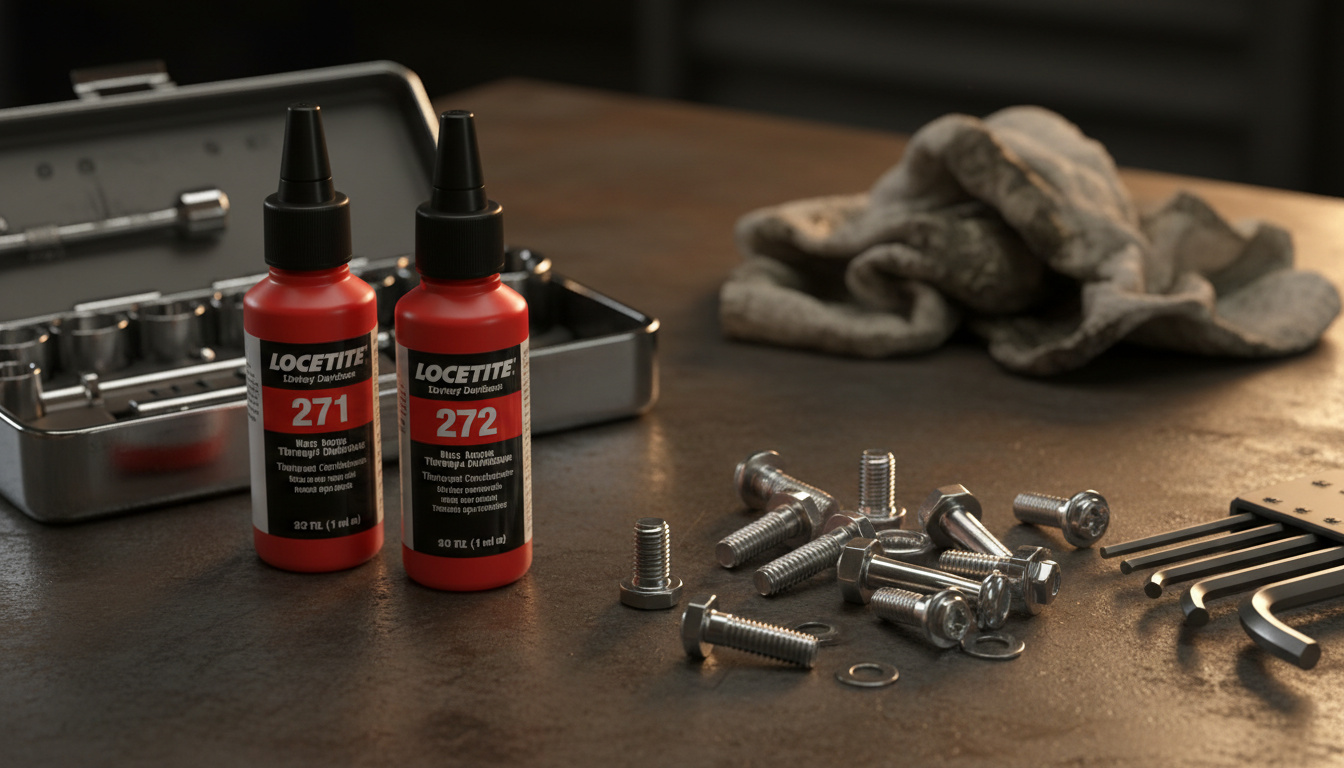
Both carry the same “high-strength” label and a price gap that feels arbitrary at first glance — but the uncured liquid colors differ: Loctite 271 is red; Loctite 272 is red-orange per Henkel’s TDS. Loctite 271 and 272 look nearly identical in the parts bin, but Harley-Davidson service manuals treat them as different tools for different fasteners — and picking the wrong one can mean a seized exhaust stud or a fastener that spins loose six months after service.
Our research pulled Henkel’s published Technical Data Sheets for both formulas alongside specifications called out in multiple HD service manuals (2013 Dyna, 2019 M8 Touring, and 1986-2003 Sportster). Here is what the specs actually say, where each belongs on a Milwaukee-Eight or Twin Cam, and the handful of places you should never reach for red at all.
Key Takeaways
- Loctite 271 — standard high-strength red, maximum service temperature ~300°F (149°C). Best for structural fasteners away from heat sources: transmission sprocket nuts, handlebar riser bolts, rear axle hardware.
- Loctite 272 — high-strength plus high-temperature red, rated to ~450°F (232°C). Designed for exhaust studs, header bolts, and any fastener inside the heat envelope of Harley air-cooled or oil-cooled engines.
- Both require heat to remove (~250°C / 482°F applied locally). Plan your service job accordingly before applying either formula.
- Neither belongs on service fasteners you expect to break loose on a regular maintenance interval — use Loctite 242 or 243 (blue) for those.
- The HD service manual for 2019 Touring (M8) explicitly lists Loctite 271 for the transmission sprocket nut. The 1988-2003 Sportster manual calls Loctite 272 for the pinion gear nut — a fastener near crankcase heat. (1986-1987 Sportsters use a lockwasher and nut without threadlocker per the manual.)
What Is Loctite 271?
Loctite 271 is Henkel’s standard red, high-strength anaerobic threadlocker. Anaerobic means it cures only in the absence of air and in the presence of metal ions — so it stays liquid in the bottle but locks hard once threads are torqued together.
According to Henkel’s published TDS for Loctite 271, the formula delivers a breakaway torque in the range of 17-40 N·m (150-350 lb·in) on a standard M10 steel fastener after 24-hour full cure at 22°C (72°F) per Henkel’s US TDS. The operating temperature range sits at -65°F to 300°F (-54°C to 149°C). Below that ceiling, 271 holds through vibration, shock, and thermal cycling without any special prep beyond clean, dry threads.
The HD 2013 Dyna service manual specifies 271 for handlebar riser fasteners torqued to 30-40 ft-lbs and for transmission sprocket nut installation (with initial torque of 100 ft-lbs). The 2019 Touring (Milwaukee-Eight) manual lists it for the transmission sprocket nut and as a small-fastener threadlocker throughout the chassis. These are all fasteners that live outside the primary heat zone of the engine.
What Is Loctite 272?
Loctite 272 adds one property on top of 271’s strength: elevated temperature resistance. Henkel’s TDS for 272 specifies an operating range of -65°F to 450°F (-54°C to 232°C) — 150°F hotter than 271’s ceiling.
The formula was developed specifically for fasteners in or near combustion and exhaust systems where cyclic thermal loading would weaken a standard threadlocker over time. On M10 steel after 24-hour cure, Henkel’s 272 TDS specifies a breakaway torque of 23 N·m (200 lb·in) and a prevailing torque of 25 N·m (220 lb·in) — values that hold through repeated heat-cool cycles due to the modified cure chemistry.
The 1986-2003 Sportster service manual is direct on this point: “On 1988-2003 models, apply threadlock (Loctite 272 or equivalent) to the pinion shaft nut prior to installation. Install the nut and tighten to 35-45 ft. lb. (47-61 N·m).” That nut lives inside the gear case, near the crankshaft — exactly the thermal environment 272 was built for.
The same Sportster manual notes that “Loctite 272 was originally applied to the pinion gear nut” from the factory — meaning Harley specified 272 at the OEM assembly level for that fastener, not as an afterthought or field repair recommendation.
271 vs 272: Side-by-Side Comparison
The specs are close enough to create real confusion. This table breaks down the properties that matter for Harley maintenance decisions.
| Property | Loctite 271 | Loctite 272 |
|---|---|---|
| Strength grade | High strength | High strength |
| Color | Red | Red-orange (per Henkel TDS) |
| Max service temp | 300°F (149°C) | 450°F (232°C) |
| Breakaway torque (M10 steel) | 17-40 N·m (150-350 lb·in) on M10 steel | Breakaway 23 N·m (200 lb·in), prevail 25 N·m (220 lb·in) |
| Full cure time | 24 hours at 72°F | 24 hours at 72°F |
| Fixture time | 10 minutes (steel) | 10 minutes (steel) |
| Removal method | Apply heat ~250°C (482°F) locally | Apply heat ~250°C (482°F) locally |
| Substrate compatibility | Steel, stainless, zinc-plated | Steel, stainless, high-alloy |
| Works on oily threads? | Clean dry threads preferred | Clean dry threads preferred |
| HD manual specification | Sprocket nuts, handlebar risers, chassis fasteners | Pinion gear nut, near-engine high-heat fasteners |
| Primary use case | Permanent fasteners away from heat sources | Exhaust studs, gear case fasteners, headers |
Which Red Threadlocker Does Your Harley Need?
The correct choice comes down to one question: does the fastener live near sustained heat above 300°F? That threshold is what separates the two products in the real world.
Use Loctite 271 for These Harley Fasteners
Loctite 271 is the correct call for structural fasteners that need to stay permanent but are not exposed to high-heat cycling. HD service manuals call it out specifically for these applications:
- Transmission sprocket nut — 2013 Dyna (and Twin Cam models broadly) specify 271 at 100 ft-lbs initial torque. The transmission case runs warm but stays well below 271’s 300°F ceiling.
- Transmission sprocket nut — 2019 Touring (Milwaukee-Eight) procedure specifies Loctite 271 when reusing the sprocket nut.
- Handlebar riser fasteners — 2013 Dyna specifies 271 on risers at 30-40 ft-lbs (40.7-54.2 N·m). These see vibration but no heat.
- Turn signal bracket screws — HD 2013 Dyna specifies one drop of 271 on bracket mounting screws.
- Chassis and frame fasteners not in the exhaust heat path.
- Primary chaincase and engine case bolts on external areas away from direct exhaust routing.
The consistent pattern across manuals: 271 lives everywhere on the bike that needs permanent lock strength but does not run through the exhaust or combustion heat zone.
Use Loctite 272 for These Harley Fasteners
Loctite 272 is the specification-correct choice anywhere heat cycling would degrade 271 over time. Harley engines run cylinder head temperatures well above 300°F under load — and exhaust surfaces can exceed that even at idle in warm weather.
- Exhaust studs and header bolts — the highest-heat fastener application on any air-cooled or oil-cooled Harley. If an exhaust stud backs out, only 272’s temp resistance keeps it in place through repeated heat-cool cycles.
- Pinion gear nut — the Sportster manual (covering 1988-2003 models) specifically calls for 272 (or equivalent) here from OEM assembly. (1986-1987 Sportsters use a lockwasher and nut without threadlocker.) The gear case sees transferred crankshaft heat.
- Primary drive fasteners adjacent to the engine case on high-output builds where sustained heat is a factor.
- Engine case fasteners on the hot side (near the heads or barrels) where thermal expansion cycles are more extreme.
- Cylinder base stud nuts on older Evolution and Shovelhead motors where studs are prone to loosening from thermal cycling.
Our research shows 272 is specified less often by name in HD service documentation than 271 — but it is the correct substitute anywhere near exhaust heat, and it is the OEM spec on the Sportster pinion nut specifically because of its thermal environment.
What About Loctite 242 and 243? (The Blue Alternatives)
Before reaching for any red threadlocker, it is worth asking whether a fastener actually needs permanent lock strength — or whether medium-strength blue is the better call.
Loctite 242 and 243 are medium-strength (blue) formulas designed for fasteners you will need to break loose with standard hand tools. They handle vibration, prevent corrosion, and add meaningful retention without the need for a heat gun at the next service. For a full head-to-head breakdown of those two, our existing post covers Loctite 242 vs 243 for Harley-Davidson in detail — including where HD service manuals call for blue specifically.
The practical rule: if you expect to service that fastener in the next five years, use blue. If it is a structural joint meant to stay permanently locked through the life of the component — and especially if it sees heat — that is when red earns its place.
Application Tips: Getting the Most from Red Threadlocker on a Harley
Even the correct product will underperform if surface prep is skipped. These are the conditions that matter for both 271 and 272.
Surface Preparation
Both formulas cure anaerobically — they need metal surfaces and the absence of air. Oil contamination is the primary failure mode. Henkel’s TDS for both 271 and 272 specifies clean, dry threads for optimal performance. In practice:
- Wipe threads with brake cleaner or acetone. Let dry completely before applying threadlocker.
- On rusty or pitted threads common on older Evo and Shovelhead bikes, wire-brush to bare metal first. Rust inhibits anaerobic cure.
- Oil-contaminated threads will still allow partial cure, but breakaway torque is reduced. Oil contamination inhibits anaerobic cure and significantly reduces retention — clean, dry threads are required for rated performance.
- If the original fastener had threadlocker on it, clean threads with a pick and wire brush before applying fresh compound.
Application Method
The “a few drops to the last few threads” instruction in HD service manuals is intentional — not arbitrary. Both 271 and 272 are fluid before cure and will wick into the joint via capillary action once the fastener is torqued. Excess compound does not strengthen the joint; it creates squeeze-out that can contaminate nearby surfaces or seals.
- Apply 2-3 drops to the last 3-4 threads of the male fastener.
- Install finger-tight, then torque to spec immediately — do not let it sit.
- On large-diameter fasteners (axle nuts, sprocket nuts), apply a complete ring of compound around the thread circumference rather than a linear drop.
- Fixture time is approximately 10 minutes on steel. Full cure takes 24 hours at room temperature.
Removal: Plan for Heat
Both 271 and 272 require localized heat application of approximately 250°C (482°F) for removal after full cure. For most Harley applications, a standard propane or MAP gas torch applied to the fastener boss for 30-60 seconds will soften the compound sufficiently. Attempt removal immediately while hot.
If you need to service transmission components on a Harley with shifting problems, always check whether threadlocker was applied to those fasteners at the previous service before attempting cold removal — stripped fasteners are almost always the result of forcing a threadlocked joint without heat.
On exhaust studs treated with 272, add caution around aluminum cylinder heads on Milwaukee-Eight and Revolution Max motors: excessive heat to soften the threadlocker can distort the aluminum. Use a close-fitting socket and apply minimal heat time, relying on a breaker bar rather than impact.
How 271 and 272 Fit Into the Full Loctite Harley Toolkit
Most Harley owners doing regular maintenance work with two or three Loctite products. Understanding where each lives in the lineup prevents both under-locking (using blue where red is spec’d) and over-locking (using red where you will need hand tools later).
For a complete breakdown of the blue medium-strength options and where HD manuals call for each, see our Loctite 242 vs 243 comparison for Harley-Davidson. For permanent red threadlockers, the 271 vs 272 choice reduces to one question: does the fastener live near exhaust or sustained engine heat?
For transmission-related decisions including fluid and service intervals, our research on the best transmission oil for the Harley 6-speed covers what goes in alongside what holds fasteners together. Proper threadlocker selection is part of any transmission rebuild or sprocket nut service.
Milwaukee-Eight owners tracking the complete maintenance picture can reference our Milwaukee-Eight maintenance schedule, which maps service intervals to the fastener and fluid specifications called out in the factory manual.
If you are working through oil selection for your Harley alongside a fastener service, understanding the interaction between oil contamination and threadlocker cure is relevant — clean threads before applying any anaerobic compound, regardless of how recently the engine was topped off.
What Harley Owners Ask About Red Threadlocker (FAQ)
These questions come up consistently in HD forums and service discussions. Answers below are grounded in Henkel’s published TDS data and HD service manual specifications.
Can I use Loctite 271 on exhaust studs?
Technically you can apply it, but it is not the optimal choice. Loctite 271’s maximum service temperature is 300°F (149°C). Harley exhaust studs — particularly on air-cooled Twin Cam and Milwaukee-Eight engines — routinely see surface temperatures above that threshold, especially at the cylinder head junction. At temperatures beyond 271’s ceiling, the cured compound can begin to degrade and lose retention. Loctite 272, rated to 450°F (232°C), is the appropriate formula for exhaust stud applications.
Is Loctite 271 the same as 272?
No — they share the same strength grade and color (red, high-strength), but the temperature rating is different. Loctite 271 is rated to 300°F (149°C). Loctite 272 is rated to 450°F (232°C). The difference is in the cure chemistry, which gives 272 its elevated heat resistance. For most Harley fasteners below the exhaust system, 271 is appropriate. For anything near sustained engine or exhaust heat, 272 is the correct product.
Does Loctite 272 work on Harley aluminum threads?
Anaerobic threadlockers like 272 cure more slowly on passive metals including aluminum. Henkel’s TDS notes that aluminum substrates may require a longer fixture time or the use of an activator (Loctite 7649 or 7471 primer) to ensure full cure. On Milwaukee-Eight and Revolution Max motors with aluminum cylinder heads, applying 272 with the appropriate activator spray on the aluminum-threaded side ensures full cure within practical fixture time. Without activator on aluminum, fixture time extends significantly and cure is slower — an activator (Loctite 7471 or 7649) is recommended for aluminum substrates to ensure reliable performance within practical fixture time.
How do I remove a fastener with red Loctite on it?
Both 271 and 272 require localized heat for removal after full cure. Apply a torch (propane or MAP gas) directly to the fastener boss at approximately 250°C (482°F) for 30-60 seconds, then attempt removal immediately while the joint is hot. Do not use an impact wrench on a fully cured red threadlocker joint without applying heat first — impact force on a cold cured joint will strip the fastener before it breaks the threadlocker bond.
Should I use blue or red threadlocker on Harley axle nuts?
Check your specific service manual — axle nut specifications vary by model and year. Many HD service procedures call for red (271) on rear axle nuts because axle hardware is a permanent structural joint that should not loosen under any circumstances. Blue (242 or 243) would be under-spec for a rear axle nut. However, some models use a specific axle nut torque value with a split-pin or cotter pin rather than threadlocker — always follow your model’s service manual rather than applying threadlocker by default.
Can I use Loctite 271 on Milwaukee-Eight exhaust header bolts?
No — Milwaukee-Eight header bolts sit directly at the cylinder head exhaust port, where sustained surface temperatures exceed 300°F under typical riding conditions. Loctite 271 is not rated above 300°F. Use Loctite 272 (rated to 450°F) or a comparable high-temperature anaerobic threadlocker. The distinction matters especially on M8 engines, where header bolt loosening is a known issue due to the engine’s thermal expansion characteristics under load. Many Milwaukee-Eight owners dealing with Milwaukee-Eight oil-related problems encounter header bolt issues during diagnosis — using the correct high-temp formula during reassembly is part of the fix.
What is the difference between Loctite 262 and 271?
Both are red, high-strength anaerobic threadlockers — the distinction lies in where HD service manuals specify each. Based on our research, the HD manuals use 262 on certain engine-internal fasteners (for example, cam and crank sprocket flange bolts and the clutch hub mainshaft nut in the 2013 Dyna), while 271 appears on drivetrain and chassis fasteners. The “fluid system vs. dry structural fastener” framing sometimes found online is not accurate to the manual specifications. If your service manual calls out 262 by name, use it; for general high-strength threadlocker applications outside engine internals, 271 is the correct choice.
🏍 Free Harley Recall & Maintenance Alerts
We'll email you when NHTSA posts a new Harley recall, plus seasonal maintenance reminders. No spam, unsubscribe anytime.
By subscribing you agree to our Privacy Policy.
