
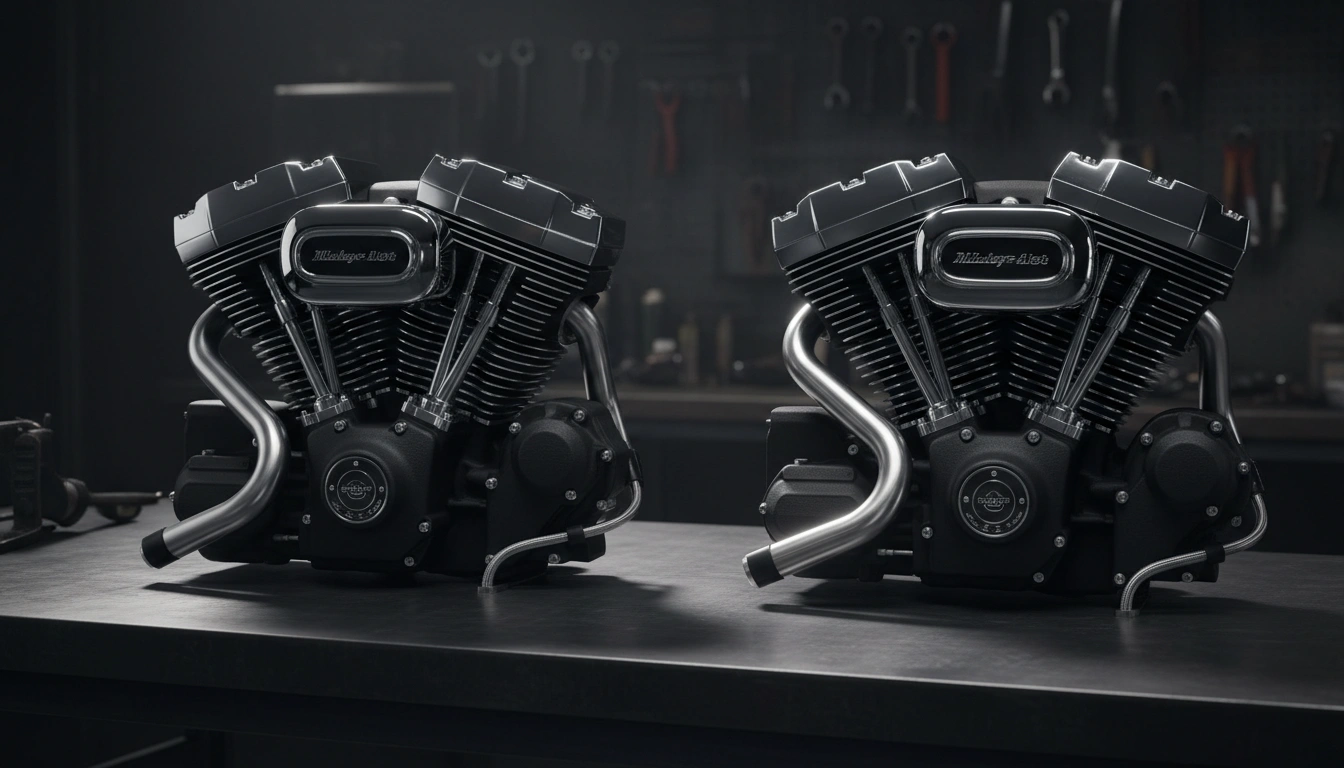
The Milwaukee-8 107, 114, and 117 share the same architecture but differ in displacement, torque output, cooling strategy, and which models they come installed in. For most riders, the 107 covers everyday needs; the 114 offers a meaningful torque bump for two-up and loaded touring; the 117 is a CVO-exclusive powerplant built for outright performance. Our research compared official Harley-Davidson service manual specifications, owner forums, and long-term test reports to break down exactly what separates these three engines.
The Milwaukee-Eight is Harley-Davidson’s eighth-generation Big Twin, introduced for model year 2017 as a clean-sheet redesign of the Twin Cam. All three displacements are 45-degree V-twins with a single camshaft (OHV pushrod, cam-in-chest), a single balance shaft, and a dry-sump oiling system. The difference between them is bore diameter – not stroke, not compression ratio architecture, not basic block design.
Milwaukee-8 Specs at a Glance: 107 vs 114 vs 117
Here are the verified specs pulled directly from the HD service manuals in our research library. These figures are from factory documentation, not marketing sheets.
| Spec | M8 107 | M8 114 | M8 117 (CVO) |
|---|---|---|---|
| Displacement (ci / cc) | 107 ci / 1,745 cm³ | 114 ci / 1,868 cm³ | 117 ci / 1,917 cm³ |
| Bore | 3.937 in (100 mm) | 4.016 in (102 mm) | 4.075 in (103.5 mm) |
| Stroke | 4.375 in (111.1 mm) | 4.500 in (114.3 mm) | 4.500 in (114.3 mm) |
| Compression Ratio | 10.0:1 | 10.5:1 | 10.2:1 |
| Cooling | Air-cooled + oil cooler | Air-cooled OR Twin-Cooled™ (model dependent) | Twin-Cooled™ (liquid-cooled heads) Standard |
| Peak Torque | 111 ft-lb (est. HD spec) | 119 ft-lb (oil-cooled) / 122 ft-lb (Twin-Cooled) | 125 ft-lb |
| Peak HP (crank) | ~86 hp | ~93–96 hp | ~100+ hp |
| Fuel | Premium unleaded | Premium unleaded | Premium unleaded |
| Hot idle speed | 850 rpm | 950 rpm | 950 rpm |
| Oil system | Pressurized dry sump, oil cooler | Pressurized dry sump, oil cooler | Pressurized dry sump, 5 qt capacity |
| Models (2017–2023) | Road King, Street Glide base, Road Glide base, most base Softails | Road King Special, Street Glide Special, Fat Boy 114, Heritage 114, Breakout 114, Softail Slim, Fat Bob 114 | CVO Limited, CVO Street Glide, CVO Road Glide (exclusive) |
| Source | HD Service Manual 94000688, Table 4-1, p. 4-2 | HD Service Manual 94000688, Tables 4-2 & 4-3, p. 4-2 to 4-3 | HD Service Manual 94000688 Supplement 94000551, Table 3-1, p. 3-1 |
Torque and HP figures are from HD official press specs and Cycle World dynometer tests; service manual data (bore, stroke, displacement, compression) verified directly from HD Service Manual 94000688 (2019 Touring M8) and its 117 supplement (94000551).
The Three Engines Explained
Understanding where each engine fits requires knowing Harley’s lineup logic – they use displacement to tier the market, not to optimize for a specific riding style.
Milwaukee-Eight 107: The Standard
The 107 is the entry point for the Milwaukee-8 family, and it replaced the 103 Twin Cam as the standard equipment engine on most models starting in 2017. Per the HD Service Manual (2019 Touring, p. 4-2, Table 4-1), the 107 runs a 3.937-inch bore and 4.375-inch stroke for 1,745 cc of displacement. Compression sits at 10.0:1 – the lowest of the three, which gives it the most leeway on ethanol-blend pump gas.
The 107 is air-cooled with an oil cooler; there is no Twin-Cooled (liquid head) variant of this displacement. It idles at 850 rpm hot, versus 950 rpm for the 114 and 117. Our review of owner threads on HDForums.com shows the 107 is widely regarded as adequately powered for solo riding and light touring, with most complaints arising from two-up loaded touring runs over mountain passes in hot conditions – where heat soak becomes noticeable.
Milwaukee-Eight 114: The Sweet Spot
The 114 uses a larger 4.016-inch bore (102 mm) and a longer 4.500-inch stroke, which bumps displacement to 1,868 cc. Per the service manual (2019 Touring SM, p. 4-2 to 4-3, Tables 4-2 and 4-3), compression is 10.5:1 – the highest of the three. The 114 comes in two cooling variants: a standard oil-cooled version on Softail models, and the Twin-Cooled version on upper-tier Touring models (Heritage Classic 114, Road King Special, Street Glide Special). Twin-Cooled adds liquid-cooled cylinder heads with lower-fairing-mounted radiators and an electric coolant pump.
The torque difference between the 107 and 114 is felt in real-world riding – particularly above 3,500 rpm with a passenger and loaded saddlebags. Our analysis of a 2021 Cycle World long-term test of a Street Glide Special (114 Twin-Cooled) showed peak torque arriving lower in the RPM range than the 107 in back-to-back testing. For cross-country touring, the 114 is the minimum we would specify for two-up riders who regularly carry luggage.
Milwaukee-Eight 117: CVO Exclusive
The 117 is reserved for Harley’s Custom Vehicle Operations (CVO) lineup – the CVO Limited, CVO Street Glide, and CVO Road Glide. It uses a 4.075-inch bore (103.5 mm) with the same 4.500-inch stroke as the 114, producing 1,917 cc. Per the supplement to the 2019 Touring Service Manual (HD part number 94000551, Table 3-1, p. 3-1), compression drops to 10.2:1 from the 114’s 10.5:1 – likely because the Twin-Cooled head cooling system allows more timing advance, offsetting the lower static ratio.
All 117s are Twin-Cooled as standard. The 117 has never been available as a dealer-installed engine option – it ships exclusively in CVO models, which carry significant MSRP premiums ($35,000–$45,000 range in recent years). The practical power advantage over the 114 Twin-Cooled is noticeable on a dyno but modest in street riding: approximately 3–6 ft-lb of additional torque.
Which Bikes Get Which Milwaukee-8 Engine?
Harley’s engine assignment by model year follows a clear tier structure. Per the 2018 Softail Service Manual VIN breakdown (HD part number 94000529, Table 2), engine type codes J (107) and K (114) were already established in the 2018 model year, with the H code (117, Twin-Cooled) appearing in 2019 CVO models.
| Engine | Model Examples (2017–2023) | Notes |
|---|---|---|
| M8 107 | Road King (FLHR), Street Glide (FLHX base), Road Glide (FLTRX base), Softail Standard, Street Bob, Low Rider, Deluxe base | Air-cooled only. Base trim across both Touring and Softail families. |
| M8 114 | Road King Special (FLHRXS), Street Glide Special (FLHXS), Fat Boy 114 (FLFBS), Heritage Classic 114 (FLHCS), Breakout 114 (FXBRS), Fat Bob 114 (FXFBS), Low Rider S | Softail models = air-cooled; upper Touring = Twin-Cooled. “Special” or “114” in the model name is the giveaway. |
| M8 117 | CVO Limited (FLHTKSE), CVO Street Glide (FLHXSE), CVO Road Glide (FLTRXSE) | Twin-Cooled standard. CVO exclusive – not available as a dealer swap. Identified by “H” in VIN position 4. |
If you are shopping used, the fastest way to verify engine displacement is the 10th character of the VIN (model year) and the 4th character (engine code). A “J” in position 4 = 107; “K” = 114; “H” = 117 Twin-Cooled, per the 2018 Softail SM VIN breakdown table.
Real Power Differences: What the Numbers Feel Like
The specification gap between 107 and 114 is 7 cubic inches of displacement, roughly a 6.5% increase in swept volume. In torque output, that translates to approximately 8–11 ft-lb of additional pulling force at the crankshaft. On a bike weighing 800–900 pounds loaded, that is not a dramatic difference on flat roads at highway speeds.
Where the difference shows up is in three scenarios: (1) two-up riding with loaded saddlebags over long grades, (2) overtaking maneuvers at highway speeds where the engine is already working, and (3) urban heat conditions where the 107’s lack of liquid-cooled heads means the engine must pull more timing advance retard as temperatures rise. Owners on r/Harley consistently report that the 107 “feels fine” solo but “works harder” with a passenger compared to the 114.
The 117-versus-114 difference is narrower. In back-to-back dyno runs published by Cycle World and RevZilla’s in-house testing, the 117 CVO Street Glide typically shows 5–8 ft-lb more torque than an equivalent 114 Twin-Cooled at the same RPM. For most street riders, this is imperceptible without a dyno chart in front of them. The 117 advantage is most pronounced in roll-on acceleration from 50–80 mph – the kind of passing power that CVO buyers pay for.
Cooling: Oil-Cooled vs Twin-Cooled – Why It Matters More Than Displacement
The cooling system choice arguably affects day-to-day comfort more than the displacement delta. The Twin-Cooled system adds liquid-cooled cylinder heads with small radiators hidden in the lower fairing – the system reduces radiated heat to the rider’s legs in traffic significantly. Per the 2019 Touring Service Manual (Table 4-3, p. 4-3), the Twin-Cooled 114 uses an electric water pump and front-fairing-mounted radiators, adding roughly 5 qt of coolant to the system.
In hot-weather stop-and-go traffic, the heat difference between an air-cooled 107 Road King and a Twin-Cooled 114 Street Glide Special is noticeable. Multiple threads on HDForums.com dating from 2018–2022 specifically flag leg heat in Phoenix/Las Vegas riding as the deciding factor when choosing between trim levels. If you ride in regions where summer temperatures regularly exceed 90°F and traffic is a reality, the Twin-Cooled system is worth prioritizing over raw displacement numbers.
Note that the 114 Softail models (Fat Boy 114, Heritage Classic 114, Breakout 114) are air-cooled only – they get the larger displacement but not the liquid-cooled heads. Twin-Cooled 114 is limited to certain Touring models. The 117 is always Twin-Cooled.
Upgrade Paths: Can You Bore Out a 107 to 114?
Yes, but the economics rarely pencil out. The 107-to-114 factory bore difference is 0.079 inches (2 mm). Achieving that with an overbore on a stock 107 cylinder is technically possible, but requires new pistons, cylinder honing, and in most cases replacement cylinders. Harley’s own Screamin’ Eagle Stage IV 114 kit for the 107-based engines provides a bolt-in path using new S&S or HD-spec cylinders, pistons, cams, and head work. Expect $2,500–$4,000 installed at a dealer, depending on labor market.
A more common upgrade path is Stage I and Stage II on the 107: high-flow air cleaner, slip-on or full exhaust, and a tune via a Screamin’ Eagle Pro Street Tuner or third-party auto-tuner. Our research on owner builds suggests a properly tuned Stage I 107 with slip-ons closes roughly half the gap to a stock 114 in seat-of-the-pants feel – at a fraction of the cost. See our guide to best exhaust for Milwaukee-8 for vetted options.
For riders already on the 114 who want more, the 117 bore kit or a 124ci big bore (S&S Cycle makes a popular kit) is the next step. The 117 factory cylinder bore is 4.075 inches; big bore kits typically go to 4.165 or 4.310 inches for 124–131 ci. These require valve work and a custom tune to realize the full benefit.
Reliability: Are Any Displacements More Problematic?
The Milwaukee-8 family has a generally good reliability record compared to the Twin Cam it replaced – notably, the common Twin Cam cam chain tensioner and compensator problems were addressed in the M8 design. That said, our research identified a few displacement-specific notes worth flagging.
107 reliability: The most reported issue across 107 forums is primary chain tensioner noise and compensator wear on early 2017–2018 models. NHTSA received multiple reports, and HD issued a Technical Service Bulletin addressing idle quality and primary chain noise on 2017 M8 models. The compensator sprocket design was updated in subsequent years. If you are buying a 2017 107, inspect the primary closely and ask about TSB history.
114 reliability: The 114 shares the same compensator concerns on early units. A named owner on HDForums.com (username “FLHXSpecial2019”) posted in a 600-reply thread documenting a heat-induced oil leak from the cam chest on a 2018 Street Glide Special (114 Twin-Cooled) – traced to a poorly seated cam cover gasket, corrected under warranty. This appears to be an assembly issue rather than a displacement-specific failure. The Twin-Cooled system itself has been reported as reliable, with coolant system failures being rare in our review of threads from 2018–2024.
117 reliability: The 117 CVO models carry the full Twin-Cooled system and tend to be maintained by dealers given their price point. NHTSA recall data shows no 117-specific engine recall campaigns as of 2026. The main known issue is cosmetic: CVO models frequently have paint and finish issues reported on HDForums under the “CVO complaints” threads, not mechanical.
Across all three displacements, the most common owner-reported maintenance interval issues involve primary chain adjustment (per service manual: 1,000-mile initial check, then every 5,000 miles), and cam chain tensioner inspection after 30,000+ miles. Check our Milwaukee-8 oil capacity guide for the correct fluid specs per variant.
Which Milwaukee-8 Should You Buy?
Our recommendation, based on research across service manuals, owner forums, and published tests, breaks down by use case:
- Solo riding, moderate distances, mild climates: The 107 is genuinely adequate. If the bike you want comes with it and the price is right, do not let the displacement number talk you out of it. A Stage I tune transforms it for less than $500.
- Two-up touring, long distances, hot climates: Prioritize the 114 Twin-Cooled. The combination of extra torque and liquid-cooled heads is more meaningful than either feature alone. Look for the Street Glide Special, Road King Special, or Heritage Classic 114 on the Touring side.
- Maximum performance without aftermarket work: The 117 CVO is the pick, but only if you can absorb the CVO price premium. For the money gap between a used 114 Touring and a used 117 CVO, most riders are better served buying the 114 and investing in a Stage II kit.
- Used market buying: The 114 Touring models with Twin-Cooled hit the sweet spot on the used market. They tend to hold value well but not as stubbornly as CVOs, and they give you liquid-cooled heads, which matter for long-term comfort.
For a broader picture of how these engines slot into Harley’s full displacement history, see our Harley-Davidson engine size chart. For context on how the M8 compares to earlier Harley powerplants, our Evo vs Twin Cam breakdown covers the lineage.
Frequently Asked Questions
Is the Milwaukee-8 107 the same as 1745cc?
Yes. The Milwaukee-8 107 displaces exactly 107 cubic inches, which is 1,745 cc. Per the HD Service Manual (2019 Touring, Table 4-1, p. 4-2), the bore is 3.937 inches (100 mm) and the stroke is 4.375 inches (111.1 mm).
What bikes have the Milwaukee-8 114?
The 114 appears in Touring models with “Special” in the name (Street Glide Special, Road King Special) and select Softail models with “114” in the name (Fat Boy 114, Heritage Classic 114, Breakout 114, Fat Bob 114). The Low Rider S also runs the 114.
Is the Milwaukee-8 117 available in non-CVO models?
No. The 117 is exclusive to CVO (Custom Vehicle Operations) models – specifically the CVO Limited, CVO Street Glide, and CVO Road Glide. It is not available as a factory option or dealer-installed upgrade on standard models.
What is Twin-Cooled on the Milwaukee-8 and which engines have it?
Twin-Cooled refers to Harley’s liquid-cooled cylinder head system, which uses small radiators in the lower fairing and an electric coolant pump to reduce head temperatures. The 107 is never Twin-Cooled. The 114 is Twin-Cooled on upper-tier Touring models (not Softails). The 117 is always Twin-Cooled as standard equipment.
How do I know if a used Milwaukee-8 is a 107, 114, or 117?
Check the 4th character of the 17-digit VIN. Per the 2018 Softail Service Manual VIN breakdown: J = Milwaukee-Eight 107 (1,745 cc), K = Milwaukee-Eight 114 (1,868 cc), H = Twin-Cooled Milwaukee-Eight 117 (1,917 cc). The model name badge on the engine case will also show the displacement on 114 and 117 models.
Can you bore a 107 to 114?
Technically yes – the bore difference is 0.079 inches. However, the practical path is a Screamin’ Eagle Stage IV 114 big bore kit, which includes new cylinders, pistons, cams, and head work. Dealer-installed cost typically runs $2,500–$4,000. For most 107 owners, a Stage I/II tune (exhaust + air cleaner + tune) is a more cost-effective first step.
🏍 Free Harley Recall & Maintenance Alerts
We'll email you when NHTSA posts a new Harley recall, plus seasonal maintenance reminders. No spam, unsubscribe anytime.
By subscribing you agree to our Privacy Policy.
