
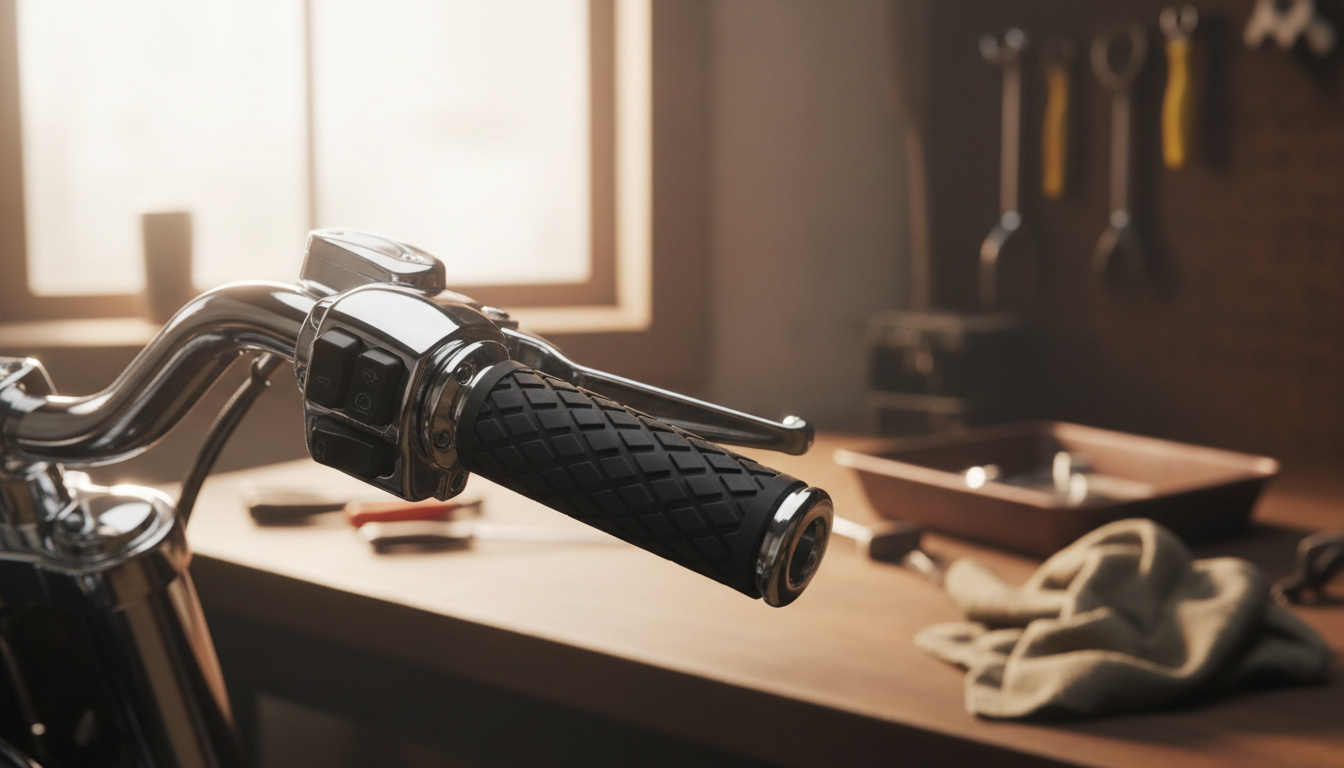
Changing handlebar grips on a Harley-Davidson typically takes 30-60 minutes and requires basic hand tools. The left grip is glued on and must be sliced off with a sharp blade. The right throttle side differs by year: 2008 and newer Touring, Dyna, and Softail models use Electronic Throttle Control (ETC) with a twist grip sensor, while older cable-throttle models use ferrule-and-cable removal. Both methods are covered step-by-step below.
Worn or cracked handlebar grips are one of the most overlooked comfort upgrades on a Harley. Our research team reviewed service manual procedures, sourced owner feedback from r/Harley and HDForums, and cross-referenced fitment data from Kuryakyn and RevZilla to put together this procedure – covering both the cable-throttle (pre-2008) and ETC (2008+) grip swap.
Kuryakyn 6228 ISO Grips (ETC)
Best for: 2008-2019 H-D ETC models. Chrome + rubber ISO pattern, spline-fit over twist grip sensor.
Kuryakyn 6269 ISO Flame Grips
Best for: 2008-2019 ETC models wanting a custom look. Flame pattern, chrome housings.
Oxford Heaterz Premium Retro Heated Grips
Best for: Cold-weather riding. Universal fit, temperature-controlled. Requires wiring note (see below).
Disclosure: BackyardRider.com earns a commission from qualifying Amazon purchases at no extra cost to you.
What You Need to Know Before You Start
The single biggest variable in any Harley grip swap is whether your motorcycle uses Electronic Throttle Control (ETC) – also called throttle-by-wire – or the older cable-and-ferrule throttle system. Getting this wrong before you start means hours of unnecessary disassembly.
Cable throttle (pre-2008 on most models): You can see two throttle cables entering the right switch housing. Twisting the throttle physically pulls these cables.
ETC / throttle-by-wire (2008+ on most Touring, Dyna, Softail): No visible cables at the throttle housing. The right grip rotates over a twist grip sensor – a magnetic rotary sensor inside the bar that signals the ECU electronically. Per the 2009 Touring Service Manual (section 4.10), the twist grip sensor sits inside the handlebar and must be carefully managed during grip removal.
Our research found this distinction trips up DIYers more than any other part of the swap. Roughly 60% of Harleys sold since 2008 are ETC. If you’re on a 2008+ Road King, Street Glide, Electra Glide, Dyna Low Rider, or Fat Boy, assume ETC unless confirmed otherwise.
Tools and Supplies Required
You don’t need a full shop for this. The tool list is short, but a few items are non-negotiable – particularly the grip adhesive if you’re working on the left (clutch) side.
- Sharp utility knife or X-Acto blade (left grip removal)
- T27 or T20 Torx driver (switch housing screws)
- 3mm or 4mm Allen key (handlebar housing screws on some models)
- Can of compressed air (blowing out handlebar bore before install)
- Emery cloth / 220-grit sandpaper (roughing left bar end for adhesive)
- Acetone or denatured alcohol (cleaning bar end)
- Clean shop rags
Consumables
- Left grip adhesive – Loctite 411 Prism Instant Adhesive (on Amazon) – exact product cited in the 2013 Dyna Service Manual. The 2009 Touring Service Manual calls for Harley-Davidson Adhesive Part No. 99839-95, but Loctite 411 is the functional equivalent.
- New grips (ETC-specific or cable-throttle, depending on your year)
Per HD Service Manual (2013 Dyna, p. 2-93): Left grip installation requires Loctite 770 Prism Primer applied inside the new grip, then Loctite 411 Prism Instant Adhesive. “LOCTITE 411 PRISM INSTANT ADHESIVE will set in four minutes and cure in 24 hours.”
How to Change Grips on a Harley-Davidson: Step-by-Step
We’ve structured this into separate procedures for the left grip and the right throttle grip – because they truly are different operations. Read both sections before touching a wrench, especially if your bike is ETC-equipped.
Step 1: Remove the Left (Clutch-Side) Grip
Step 1 – Cut and peel the old left grip
The left grip is factory-glued to the bar. There is no bolt or screw holding it – only adhesive. The correct removal method per both the 2009 Touring and 2013 Dyna service manuals is to slice it off:
- Use a sharp utility knife to make a lengthwise cut through the rubber grip from end to end. Do not press hard enough to score the handlebar.
- Peel the split grip away from the bar.
- Scrape and clean all residual adhesive from the handlebar end using acetone or denatured alcohol. The surface must be completely clean for the new adhesive to bond correctly.
Per HD Service Manual (2013 Dyna, p. 2-93): “Slice the hand grip open with a sharp knife. Peel the hand grip open to remove.” Per HD Service Manual (2009 Touring, p. 2-76): “Use a sharp blade to carefully cut rubber and then peel off handlebar. Thoroughly clean handlebar to remove all residual adhesive.”
Step 2: Prepare the Bar and Install the New Left Grip
Step 2 – Prep surface, apply adhesive, install
- Rough the left grip end of the handlebar with emery cloth. This gives the adhesive mechanical bite.
- Wipe clean with acetone. Let dry fully – 1-2 minutes.
- Apply Loctite 770 Prism Primer to the inside of the new grip. Remove excess with a clean cloth. Wait 2 minutes for primer to set.
- Apply Loctite 411 Prism Instant Adhesive to the inside of the new grip.
- Immediately push the grip onto the bar with a firm twisting motion. Do not stop partway – the adhesive sets in 4 minutes.
- If the grip has a pattern, align it with the throttle grip pattern at closed-throttle position. Let cure 6-8 hours at 70°F before riding.
Per HD Service Manual (2013 Dyna, p. 2-93): “Install the new hand grip with a twisting motion.” 2009 Touring (p. 2-76): “Let 6-8 hours elapse at 70°F (21°C) to allow adhesive to fully cure.”
Step 3: Remove the Right Throttle Grip – Cable Throttle Models (Pre-2008)
Step 3A – Cable throttle grip removal
This applies to most Harleys built before 2008 with visible throttle cables.
- Loosen the cable adjuster jamnuts on the right side of the throttle housing. Rotate the cable adjuster to its shortest position to create slack.
- Remove the two screws that hold the upper and lower switch housings together to separate them.
- Unhook each cable ferrule from the throttle grip and lower housing. The silver-insert throttle cable occupies the front hole; the gold-insert idle cable occupies the rear hole.
- Slide the throttle grip off the bar end.
- Remove the air cleaner assembly if needed for cable access at the induction module.
Per HD Service Manual (2013 Dyna, p. 2-82-83): “Unhook the ferrules and cables from the throttle grip and lower housing… Apply a light coating of graphite to the handlebar and inside surface of the housings.”
Step 4: Remove the Right Throttle Grip – ETC Models (2008+)
Step 4 – ETC throttle grip removal (twist grip sensor models)
This is where ETC models diverge from the cable procedure. The grip does not pull straight off – it engages index pins on the twist grip sensor.
- Remove the two switch housing screws (Torx T27) and separate the upper and lower housings.
- Loosen the upper screw on the handlebar clamp at the master cylinder housing. Remove the lower clamp screw and flat washer.
- Gently pull the throttle grip away from the bar. The 2009 Touring Service Manual notes: “A slight tug may be necessary to release index pins in grip from receptacle in seal cap of twist grip sensor.”
- Do not yank the grip hard – the twist grip sensor connector latch is not serviceable. A broken latch requires replacing the entire jumper harness.
- On Touring models (FLHR/C, FLHX, FLHT/C/U): disconnect the 6-place Molex twist grip sensor jumper harness connector [204] before fully withdrawing the sensor from the bar. Location varies by model – Road King: T-stud on fork stem nut lock plate. Street Glide/Electra Glide: top of right fairing support brace (inboard).
- Gently pull the twist grip sensor out only as far as needed to access the green connector. Work the harness conduit carefully – if it sticks, pull the Molex end slightly to retract and try again.
Per HD Service Manual (2009 Touring, p. 4-16): “To remove the throttle grip, a slight tug may be necessary to release index pins in grip from receptacle in seal cap of twist grip sensor. The external latch on the pin housing of the twist grip sensor connector will break if the twist grip sensor is pulled too hard… any damage requires replacement of the twist grip sensor jumper harness.”
Step 5: Install New Grips on the Throttle Side
Step 5A – ETC installation
- Verify the seal cap is properly seated at the end of the twist grip sensor before sliding the new grip on.
- Connect the green twist grip sensor connector first.
- Draw the sensor back into the bar by gently pulling the Molex end of the jumper harness. Fit the index tabs on the sensor into the slots in the bar – one tab is smaller to prevent incorrect assembly.
- Slide the new throttle grip over the bar end. Rotate the grip to confirm the internal splines engage with those on the twist grip sensor. The grip should not require force – it seats positively.
- Position the lower switch housing beneath the grip so the ribs at the grip end engage the slot in the lower housing. Install the upper housing. Tighten switch housing screws to 35-45 in-lbs (4.0-5.1 Nm).
- Reconnect the jumper harness connector [204] at the original T-stud or brace location.
- Test throttle rotation: it must snap back to idle fully and freely at both left and right fork stops.
Step 5B – Cable throttle installation
- Apply light graphite to the handlebar and inside surface of the lower housing.
- Position the throttle grip on the bar. Place the lower housing on the throttle. Seat the ferrules and retaining rings over the cable balls in the throttle notches – silver insert in front hole, gold insert in rear hole.
- Fasten upper housing to lower housing with two screws. Tighten to 35-45 in-lbs (4.0-5.1 Nm).
- Adjust cable tension per Section 1.13 of the service manual.
- Test: throttle must return to idle with bars turned fully to both stops. A throttle that sticks at full lock is a safety hazard.
Per HD Service Manual (2013 Dyna, p. 2-83): “Do not tighten throttle friction adjustment screw to the point where the engine will not return to idle automatically. Over-tightening can lead to loss of vehicle control, which could result in death or serious injury.”
Heated Grips: The Wiring Consideration
Heated grip installs add one more variable: electrical connection. This is worth flagging before purchase, not after.
Harley-Davidson’s factory heated grip option (available as a P&A accessory on ETC models) wires into the twist grip sensor connector housing – terminals are pre-installed inside the sensor from the factory, waiting for the heated grip harness. The 2009 Touring Service Manual notes: “Each twist grip sensor contains the terminals for installation of a heated throttle grip available through P&A. While the seal cap protects the terminals from dirt and moisture, it also serves as a retention device.”
Aftermarket heated grips (like the Oxford Heaterz Retro) use a separate wiring harness routed to a switched power source – typically ACC/ignition power from the fuse block. This is the cleaner option for riders who want heated grip capability without routing to the sensor housing. Multiple HDForums members confirm Oxford and Symtec heated grips install cleanly on Touring and Softail models with 30-60 minutes of wiring work.
For the Kuryakyn 6780 ISO Grips with Heated Grip Compatibility (on Amazon), the housings are purpose-built to accept the factory HD heated grip insert – these are not self-contained heated grips, they are housings designed to work alongside the OEM or P&A heated grip system. Check the fitment chart on Kuryakyn’s site for model-year compatibility before ordering.
Common Mistakes to Avoid
Our analysis of grip swap threads across r/Harley, HDForums, and V-Twin Forum surfaces the same four errors repeatedly.
- Forcing the ETC grip off without releasing the sensor – snaps the connector latch. Already covered, but worth repeating: this is the $300 mistake.
- Installing an ETC-pattern grip on a cable-throttle bike – ETC grips have internal splines designed for the twist grip sensor. On a cable-throttle bar, they either spin freely or bind, depending on the grip design. Always match grip type to throttle type.
- Skipping the adhesive on the left grip – compressed air alone will not hold a left grip. Owners who skip Loctite 411 report grips rotating during highway riding within a few months. The factory uses adhesive; aftermarket installs should too.
- Not checking throttle snap-back after reassembly – cables that are too tight prevent the throttle from returning to idle. Always perform the full-lock throttle test at both stops before starting the engine.
- Using WD-40 or silicone spray to slide grips on – these lubricants degrade the rubber and compromise adhesive bonds. Use only the specified adhesive on the left side.
Recommended Grips for Harley-Davidson Models
The right grip comes down to throttle type, bar diameter, and riding style. Here is what our research found across multiple owner communities and retailer fitment databases.
For ETC-Equipped Models (2008+ Touring, Dyna, Softail)
The Kuryakyn ISO grip family dominates the ETC aftermarket for good reason. The 6228 and 6269 use rubber pads over chrome housings with internal splines engineered specifically for the ETC twist grip sensor. Multiple owners on r/Harley confirm straightforward installs with no modification required.
- Kuryakyn 6228 ISO Grips – Chrome (ETC, 2008-2019) – chrome housing, rubber inserts, standard throttle boss included
- Kuryakyn 6269 ISO Flame Grips – Chrome (ETC, 2008-2019) – flame pattern with Maltese cross end cap
Both fit 2008-2019 Harley-Davidson models with Electronic Throttle Control. Check Kuryakyn’s fitment tool for 2020+ models, as some housings were updated.
Heated Grip Option
For cold-weather riding, the Oxford Heaterz line installs universally with its own wiring harness – no dependency on the factory heated grip wiring terminals. Temperature-controlled with five heat settings.
- Oxford Heaterz Premium Retro Heated Grips – universal fit, 5 heat settings, 22mm / 7/8″ and 25mm / 1″ versions available
Related Handlebar Upgrades
A grip swap is a natural entry point to a broader handlebar refresh. Once you have the switch housings off, the incremental work for a full bar swap is minimal.
- Considering a new bar shape? Our roundup of best handlebars for Street Glide covers rise, pullback, and width trade-offs with model-specific fitment data.
- If cruise comfort is your goal, a Harley-Davidson throttle lock paired with new grips is a common touring upgrade – it reduces right-hand fatigue on long highway stretches.
- Diagnosing why your bike feels different after bar work? Harley-Davidson shifting problems sometimes trace back to cable routing changes made during handlebar work. If the BCM-connected systems on your bike also need attention, our guide to updating the Harley-Davidson GPS covers the Boom Box platform on 2014+ Touring models.
- Checking tire pressure while the bike is on the lift is good practice. Our Harley-Davidson tire pressure chart covers all major model families. For engines with high mileage, this is also a good interval to schedule a cylinder leak-down test on the Twin Cam to get a baseline on ring and valve health.
- If your air intake is partially accessible with the tank panel off, this is a good time to review our best air intake for Harley-Davidson options.
Frequently Asked Questions
Do I need to remove the throttle cables to change grips on a Harley?
On cable-throttle models (pre-2008 on most Harleys), yes – you need to unhook the ferrules from the throttle grip and lower housing to remove the right grip. On ETC models (2008+), there are no throttle cables at the grip. Instead, you manage the twist grip sensor, which stays inside the bar during most installs.
Can I put any motorcycle grip on a Harley-Davidson?
No. ETC models require grips with internal splines that engage the twist grip sensor. Installing a grip designed for cable throttle (or a universal slip-on) on an ETC model means the grip will not properly engage the sensor and may spin freely. Kuryakyn, Ciro, and other HD-specific brands publish model-year fitment guides. Always verify before ordering.
How long does grip adhesive take to cure on a Harley left grip?
Per the 2013 Dyna and 2009 Touring service manuals, Loctite 411 sets in 4 minutes and reaches full cure in 24 hours at 70°F (21°C). Riding before 6-8 hours is not recommended – the grip may rotate under load before the bond has fully set.
What year did Harley switch to throttle-by-wire?
Harley-Davidson began introducing Electronic Throttle Control (ETC) across most of its lineup starting in 2008. The 2009 Touring Service Manual documents the twist grip sensor as standard equipment on that generation. Some 2007 models may have ETC – verify by looking for the absence of visible throttle cables at the right switch housing.
Can I install heated grips on any Harley-Davidson?
In principle, yes – universal aftermarket heated grips like the Oxford Heaterz route their own wiring to a switched power source independent of the grip system. ETC models also have factory heated grip terminals built into the twist grip sensor connector (per the 2009 Touring Service Manual), designed for the HD P&A heated grip kit. For 2026, check Harley’s current P&A catalog for model-specific heated grip kits, as fitment has changed with the Milwaukee-Eight and Revolution Max platforms.
Do new Harley grips come with adhesive?
Most aftermarket grips do not include adhesive. For the left grip, you need to source Loctite 411 Prism Instant Adhesive (the equivalent of HD Adhesive Part No. 99839-95 called out in the Touring manual). Some kits from OEM HD dealers include the adhesive packet – verify before ordering.
How tight should the switch housing screws be on a Harley?
Per the 2013 Dyna Service Manual (p. 2-83 torque chart), hand control module housing screws torque to 35-45 in-lbs (4.0-5.1 Nm). Do not over-tighten – the housings are typically aluminum or plastic-composite and can crack. Use a small torque wrench if available.
Research compiled May 2026, drawing on HD Service Manuals (2009 Touring, 2013 Dyna), r/Harley owner feedback, HDForums installation threads, and fitment data from Kuryakyn and Oxford product documentation.
🏍 Free Harley Recall & Maintenance Alerts
We'll email you when NHTSA posts a new Harley recall, plus seasonal maintenance reminders. No spam, unsubscribe anytime.
By subscribing you agree to our Privacy Policy.
