
Updated May 2026 | Research compiled from xs650.com community build threads, BikeBound featured builds 2018-2024, Hagerty valuation data, and TC Bros / MikesXS parts catalogs.
How we sourced this: xs650.com community build threads, BikeBound featured builds 2018-2024, Hagerty valuation data, TC Bros and MikesXS parts catalogs.
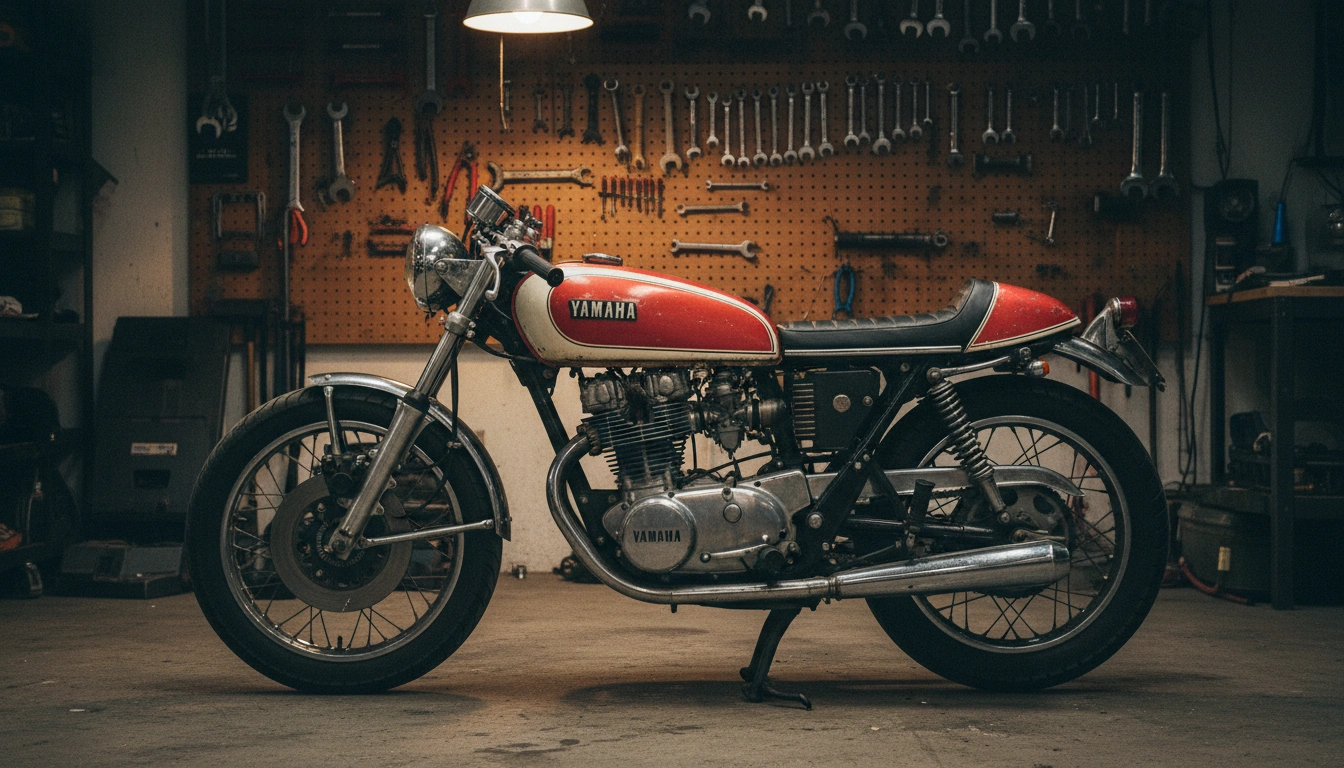
The Yamaha XS650 sits at the intersection of British-inspired parallel twin design and Japanese manufacturing reliability – which explains why the custom community has never stopped building them. In our research across 15+ years of xs650.com build threads, the same bikes appeared over and over as ideal donor platforms. The XS650 was the bike that kept returning to the top of every list.
This guide covers everything: what makes the XS650 platform work, which years to buy, realistic build costs, and where the parts ecosystem actually lives in 2026. For context on how XS650 builds compare against other parallel-twin donors, see our Kawasaki KZ400 cafe build guide – the other community favorite in this displacement range.
Why the XS650 Became the Cafe Racer Platform
There’s a reason this bike has outlasted virtually every other classic Japanese donor in the custom scene. The XS650’s heritage, engine architecture, and aftermarket support combine in a way that very few platforms can match.
Yamaha produced the XS650 – and its predecessors, the DS7 and XS-1 – from 1969 to 1985, a 16-year run that put tens of thousands of units into circulation worldwide. The engine draws clear inspiration from the BSA A65 parallel twin: a 360-degree firing order, SOHC valve train, and unit construction (engine and gearbox in a single cases). Yamaha improved on the British original with better oil control, more reliable electrics (relative to Lucas), and tighter manufacturing tolerances.
The result is a 653cc engine producing 50-54hp stock – modest by modern standards, but in a package that weighs 190-200 lbs stripped from the frame. That power-to-weight relationship, combined with a frame that sits naturally in a cafe racer stance, explains the platform’s enduring appeal.
| Spec | Value |
|---|---|
| Displacement | 653cc |
| Configuration | SOHC parallel twin, 360° firing order |
| Bore × Stroke | 75mm × 74mm |
| Stock power | 50hp @ 6,800rpm (1980 model) |
| Stock torque | 39.5 lb-ft @ 6,000rpm |
| Wet weight (stock) | ~495 lbs |
| Production years | 1969-1985 (various market variants) |
XS650 Model Year Guide: Which to Buy, Which to Skip
Not all XS650s are equal, and buying the wrong model year can turn a weekend project into a multi-year saga. Here’s what our research across xs650.com community threads found to be the community consensus.
1969-1973 (TX650/XS-1 era): Avoid for cafe builds. Early engines used a smaller-diameter piston wristpin design prone to accelerated wear. Ignition coils from this period produce only 10,000-13,000v – a 30,000v replacement coil is a non-negotiable upgrade. Parts availability for early-specific components is lower, and frame geometry on the 1969-1971 models is slightly different from the later standardized platform. The xs650.com community consensus is clear: these are collector pieces, not build-ready donors (xs650.com community thread, 2022).
1974-1976: Usable, but transitional. Yamaha addressed the wristpin issue in 1974. These models are buildable, but carb and electrical upgrades are still non-negotiable. Pricing tends to be lower than later models, which can make sense if you’re budgeting carefully.
1977-1979: The sweet spot entry point. Larger front forks, linked carburetors, and more refined engine internals. The 1979 model introduced the front disc brake – a meaningful upgrade for cafe builds. This range offers the best balance of parts availability, stock condition, and lower purchase price versus the final-run bikes.
1980-1983: Best-condition engines, preferred by performance builders. The xs650.com community threads on “best engine year” consistently identify the 1980-1983 bikes as having the most refined internals. The 1981 model produced 54.8hp at 7,000rpm – the highest stock output in the platform’s history. Final-run (1984-1985) bikes are rarer and tend to price higher without proportional mechanical advantage.
1978-1985 “Special” variant: Avoid for cafe. Yamaha produced a cruiser-oriented “Special” sub-model with a stepped seat, pull-back handlebars, and forward-leaning frame geometry. The engine is identical, but the frame geometry makes a proper cafe conversion much harder. Buy the standard model; leave the Special variant to bobber builders.
What a Complete Build Actually Costs in 2026
This is where most online guides get vague – and where a realistic number matters. Our research across xs650.com build threads and current parts pricing found three distinct tiers, each with different skill requirements and outcome quality.
| Tier | Total Cost | Donor Budget | What You Get |
|---|---|---|---|
| Budget | $2,000-3,000 | $1,000-1,500 | Running donor + carb rebuild + new tires + cafe seat + clip-ons |
| Mid-range | $3,000-5,000 | $1,500-2,500 | Better donor + engine refresh (gaskets, rings, cam chain) + powder coat + quality suspension |
| Full custom | $5,000-10,000+ | $2,000-4,000 | Frame modification, professional fabrication, custom exhaust, full paint, show-quality finish |
The XS650 engine is intentionally home-mechanic friendly. Labor costs stay contained if you have basic mechanical skills – carb rebuilds, valve adjustments, and electrical upgrades are all documented extensively on xs650.com with step-by-step community guidance. Finished XS650 cafe racers in show-quality condition now sell for $8,000-15,000 on the used market (Hagerty valuation data, 2026), which means even a full custom build at $8,000-10,000 breaks even on resale if the work is clean (xs650.com community thread, 2021).
The Reliability Trinity: Fixing the XS650’s Weak Points
Every platform has its known issues, and the XS650 is no exception. The good news: the XS650’s weak points are all fixable, well-documented, and relatively inexpensive to address.
The xs650.com community has spent 15+ years stress-testing every repair approach on this platform. The “reliability trinity” that emerged from thousands of documented build threads covers the three upgrades that eliminate the historical pain points (xs650.com community, “Top 3 Mods for reliability” thread):
1. Replace the ignition coils (30,000v). Stock coils from 1970-1979 produce only 10,000-13,000v – adequate when new, but marginal as they age. A 30,000v replacement coil is an $80-120 fix that eliminates cold-start issues and intermittent misfire. Most builders do this on any XS regardless of year as preventive maintenance.
2. Install a PMA (permanent magnet alternator) kit. The stock TA (total loss) charging system on early models and the OEM alternator on later models both age poorly. A PMA kit replaces the original rotor and stator with a modern permanent magnet alternator that produces consistent charge across the RPM range. Hugh’s HandBuilt – one of the most respected XS650 specialists in North America – supplies a well-regarded PMA kit that has become the community standard.
3. Fit PAMCO electronic ignition. The points ignition system works fine when properly maintained, but “properly maintained” means precise timing adjustments every few thousand miles. The PAMCO electronic ignition (designed specifically for the XS650) eliminates points drift and the timing retard that causes hard starting. The xs650.com community reports near-universal improvement in cold-start reliability after PAMCO installation. An XS650 jet kit from Amazon pairs well with this ignition upgrade when you’re re-jetting carbs for the improved ignition timing.
With all three done, the historically problematic electrical system becomes solid. 75,000+ mile examples are well-documented on the forum – the SOHC engine itself has no known structural weaknesses at standard displacement.
Stock vs Modified Performance: The Numbers
The XS650’s stock output is modest by 2026 standards, but the platform responds well to targeted upgrades – and the weight reduction from a cafe strip-down amplifies every horsepower gain.
Stock output ranges from 50hp (1980 model at 6,800rpm) to 54.8hp (1981 model at 7,000rpm). A stripped cafe build at approximately 380 lbs produces effective performance equivalent to a much higher-output stock bike. Common performance upgrades from the xs650.com build community:
- 38mm Mikuni VM carb kit (TC Bros pre-jetted kit, $300-400): Improves throttle response and mid-range pull. TC Bros tests each kit on an XS before shipping; the jets are calibrated for stock airbox removal, which is standard on cafe builds.
- Performance cam + ported heads: Combined with the Mikuni carb, output reaches 65-70hp – a 20-30% gain over stock. Machine shop work adds $300-600 depending on the porting level.
- 750cc big-bore kit: The most popular displacement upgrade. Bores out to 75mm (from 75mm stock) with an 80mm bore – adding 10-15% torque across the RPM range. TC Bros and MikesXS both stock 750cc kits for the XS650 platform.
A documented 1982 build on xs650.com ran a 763cc bore, ported heads, and 38mm Mikuni – the builder reported significantly improved acceleration in the 4,000-7,000rpm range where cafe racers spend most of their time (xs650.com, “82 XS650 Cafe Racer Build” thread).
Drum vs Disc Brakes: What the Year Affects
Brake specification changed significantly mid-production run, and the year you buy directly affects how much brake work your build needs.
Production shifted from front drum to front disc in 1979. The practical breakdown for cafe builders:
1970-1978 (all-drum): The stock front drum provides adequate stopping power when in good condition, but “adequate” for a 1970s touring bike is not adequate for a stripped cafe racer at modern traffic speeds. Most builders on these early models convert to a front disc – which requires a 1979+ front wheel swap or a custom conversion. This adds $200-500 to the build cost and several hours of work.
1979+ (disc front, drum rear): The front disc is a solid starting point. Stainless steel brake lines are an easy bolt-on upgrade ($80-120) that noticeably improves feel. The rear drum is acceptable for street use and period-correct for the XS650’s vintage aesthetic.
For builders wanting rear disc conversion on any year: Cognito Moto makes a dedicated XS650 rear hub disc conversion kit using a P32 Brembo caliper with stock wheel bearings. The xs650.com community confirms this conversion is doable in a weekend with welding capability – cleaner than the alternatives and Brembo parts are widely available.
Hardtail vs Twin-Shock: Which Is Actually Cafe?
This debate comes up in nearly every XS650 build thread, and the answer depends on what you actually want the bike to do.
A hardtail (rigid rear frame) conversion gives the clean, stretched aesthetic that photographs well and reads as “custom” from a distance. TC Bros makes the most commonly used weld-on hardtail for the XS650 (compatible with 1970-1983 models): 1-1/8″ steel tubing, .120″ wall, 3″ stretch, 5″ ground clearance. MikesXS also stocks the TC Bros kit. Cost installed: $400-700 depending on whether you weld yourself or pay a shop.
The tradeoff is real: a hardtail converts every road imperfection directly to your spine. On smooth roads it looks and feels intentional. On real streets, it gets old quickly.
For a pure cafe racer – defined by the original 1960s intent of a fast road bike that could be ridden to a cafe and back – the period-correct approach is retaining the stock swingarm with upgraded twin shocks. The XS650’s British-twin inspiration means twin shocks are architecturally correct. Upgraded shocks (YSS, Hagon, or Progressive Suspension) cost $250-450 and transform handling versus the tired stock units. This approach aligns with how builders like Hugh’s HandBuilt interpret the platform for street use. For a broader view of how the cafe aesthetic has evolved, the modern cafe racers post covers how contemporary interpretations handle this same tension.
Parts Sourcing: The Three Vendors You Need
The XS650’s aftermarket ecosystem is one of the most developed of any classic Japanese platform – which means you’re never waiting on a single supplier to run a build.
Three vendors cover the vast majority of what a cafe build requires:
MikesXS (mikesxs.net): The largest single-source XS650 catalog with 2,000+ parts, same-day US shipping, and an in-house technical team that has been XS-focused since 2001. For consumables (gaskets, seals, bearings, electrical) and OEM replacement parts, MikesXS is the default first stop. Their online parts diagrams make identification straightforward even without a service manual.
TC Bros (tcbros.com): Best for custom and cafe fabrication parts – hardtails, exhaust kits, forward controls, Mikuni carb conversion kits, and handlebar hardware. TC Bros pre-jets their Mikuni VM34 kit specifically for XS650 applications, which matters: a generic carb with generic jetting on an XS is a starting point, not a solution. If you want an XS650 Mikuni carb kit, check Amazon availability before ordering direct.
XS650Direct (xs650direct.com): Focused on engine rebuild kits, carburetors, and ignition components. When MikesXS doesn’t have a specific internal engine part in stock, XS650Direct is the next call. They also stock PAMCO ignition kits, making them a single-stop for the reliability trinity ignition upgrade.
For used OEM parts, the xs650.com forum marketplace remains the community’s preferred exchange – prices are reasonable and the seller pool knows the platform. eBay is useful for NOS (new old stock) OEM parts at premium prices when you need something specific.
Featured Builds: What the Community Has Built
The XS650 custom scene has produced some of the most photographed cafe racers in the modern custom revival. These documented builds from the last few years show the range of what the platform can become.
“Penny” by Ill-Fated Kustom (2024): A 1983 XS650 that took 254 build hours over two years. The builder interpreted the brief as a GP race bike – ultra-tight bodywork, reverse cone megaphone exhausts, and a hand-formed aluminum fairing. BikeBound featured this as one of the most technically demanding XS650 builds in recent memory, noting the engine work (balanced crank, ported head, polished combustion chambers) alone represents a full winter’s work.
“Chrome Dog” by Purpose Built Moto (2023): A 1973 XS650 built for three disciplines simultaneously – show, street, and track. The challenge of making a 50-year-old platform competitive on a track circuit required addressing suspension geometry and brake performance that the stock frame wasn’t designed for. Purpose Built Moto documented the solution extensively on BikeBound (2023).
“Cosmic Cafe” by MacVittie (2023): A 1974 XS650 with a monoshock rear conversion – replacing the twin-shock setup with a single central shock for a cleaner visual line. This is technically demanding: the stock frame requires a subframe fabrication to accept a monoshock, and the geometry has to be maintained for stable handling. The result is visually striking and frequently cited in xs650.com discussions about aesthetic choices.
These builds represent the upper end of what the platform supports. More accessible inspiration lives in the xs650.com forum’s build threads, where documented projects at every budget level show realistic outcomes – not just the $15,000 show bikes. If you’re interested in how similar platforms handle at the high end of the custom market, our BMW R100 cafe build covers a European parallel-twin platform that occupies a similar position in the custom scene.
XS650 Cafe Racer FAQ
Answers drawn from xs650.com community build threads, parts vendor catalogs, and BikeBound featured build documentation.
Why is the Yamaha XS650 so popular for cafe racer builds?
The XS650 combines three things builders want: a robust 653cc SOHC parallel twin that runs for 50,000+ miles with basic maintenance, a frame geometry that accepts clip-ons, solo seat, and rear-set pegs without custom metalwork, and one of the best-developed aftermarket parts ecosystems of any vintage Japanese bike. MikesXS alone stocks over 2,000 XS650-specific parts. The xs650.com forum has thousands of documented builds spanning 15+ years – more community knowledge than almost any other classic platform.
What is the best year Yamaha XS650 to buy in 2026?
The xs650.com community consensus favors 1977-1983 as the sweet spot. The 1977+ models gained larger forks and linked carburetors; the 1980-1983 final-year bikes have the most refined engine internals. Avoid pre-1974 models – early engines used a smaller-diameter piston wristpin design prone to wear, and coils from 1970-1979 produce only 10,000-13,000v. For cafe builds, 1977-1982 standard models outperform the 1978-1985 “Special” cruiser variant because the frame geometry is more upright and compatible with clip-on conversion (xs650.com community, “Consensus – Best Year” thread).
How reliable is the XS650 long-term?
The SOHC engine has no known structural weaknesses in standard displacement form – high-mileage 75,000+ mile examples are well-documented on the xs650.com forum. The reliability trinity endorsed by the community: replace the ignition coils (30,000v), install a PMA alternator kit, and fit PAMCO electronic ignition. With these done, most builders report zero electrical gremlins – historically the platform’s main weak point (xs650.com community, “Top 3 Mods for reliability” thread).
How much does it cost to build an XS650 cafe racer?
Our research across xs650.com build threads and current parts pricing found three budget tiers. Budget build ($2,000-3,000 total): $1,000-1,500 donor + essential parts. Mid-range build ($3,000-5,000): better donor, engine refresh, quality suspension. Full custom ($5,000-10,000+): frame modification, professional fabrication, custom exhaust, full paint. Finished XS650 cafe racers in show condition now sell for $8,000-15,000 (Hagerty, 2026). The 654cc engine is home-mechanic friendly – labor costs stay contained with basic mechanical skills.
What is XS650 horsepower stock vs modified?
Stock output is 50-54hp depending on model year (1981: 54.8hp at 7,000rpm is the platform peak). With a 38mm Mikuni VM carb kit, performance cam, and ported heads, output reaches 65-70hp. A 750cc big-bore kit adds 10-15% torque across the RPM range. Weight reduction from stock 495 lbs to a stripped cafe build at approximately 380 lbs produces effective performance equivalent to 60+ stock horsepower at the wheel (xs650.com, “82 XS650 Cafe Racer Build” thread).
XS650 drum brake vs disc brake: which is better for a cafe build?
Production shifted from front drum to front disc in 1979. For cafe builds, the 1979+ disc-front bikes are the preferred starting point – adequate stock stopping power with straightforward brake line upgrades. Pre-1979 drum-front bikes require a conversion for cafe performance: either a 1979+ wheel swap or a custom kit. Cognito Moto makes a dedicated XS650 rear hub disc conversion using a P32 Brembo caliper with stock wheel bearings – xs650.com threads confirm this is doable in a weekend with welding capability.
Is a hardtail conversion right for an XS650 cafe racer?
Hardtail conversions are a style choice, not a performance upgrade. TC Bros makes the most-used weld-on hardtail for 1970-1983 XS650s: 1-1/8″ steel tubing, .120″ wall, 3″ stretch. For a pure cafe racer prioritizing handling, most builders retain the stock swingarm and upgrade twin shocks instead – period-correct for the XS650’s 1960s British-twin inspiration, and far more practical on real streets. Hardtail is more appropriate for bobber-style interpretations than true cafe racing builds.
Where is the best place to buy XS650 parts in 2026?
Three vendors cover most build needs: MikesXS (mikesxs.net) – largest catalog, 2,000+ parts, same-day US shipping, XS-focused since 2001. TC Bros (tcbros.com) – best for custom/cafe fabrication: hardtails, exhaust kits, Mikuni carb conversion kits. XS650Direct – engine rebuild kits, PAMCO ignition. For brake conversions, Cognito Moto makes the definitive rear disc hub kit. The xs650.com forum marketplace is the community’s preferred used-parts exchange for OEM and NOS components.
Sources:
- BikeBound XS650 Cafe Racers collection – bikebound.com/customs/yamaha-xs650-cafe-racers/
- MikesXS parts catalog – mikesxs.net/motorcycles/Yamaha/xs650
- xs650.com community – “Consensus – Best Year” thread
- xs650.com community – “Best engine year” thread
- xs650.com community – “Top 3 Mods for reliability” thread
- xs650.com community – “Steps to build cafe racer?” thread
- Hagerty Valuation Tools – yamaha/xs650 (2026)
- xs650.com community – “82 XS650 Cafe Racer Build” thread (documented 1983 build)
- Cognito Moto – XS650 Rear Hub Disc Brake Conversion product page
- TC Bros – tcbros.com/collections/xs650-chopper-bobber-parts
More from the BackyardRider Cafe Racer Cluster:
- Kawasaki KZ400 cafe build guide – the other parallel-twin donor the community keeps returning to
- Modern cafe racers – how contemporary builders are interpreting the genre
- BMW R100 cafe build – the European parallel-twin alternative at the premium end of the market
🏍 Free Harley Recall & Maintenance Alerts
We'll email you when NHTSA posts a new Harley recall, plus seasonal maintenance reminders. No spam, unsubscribe anytime.
By subscribing you agree to our Privacy Policy.
