
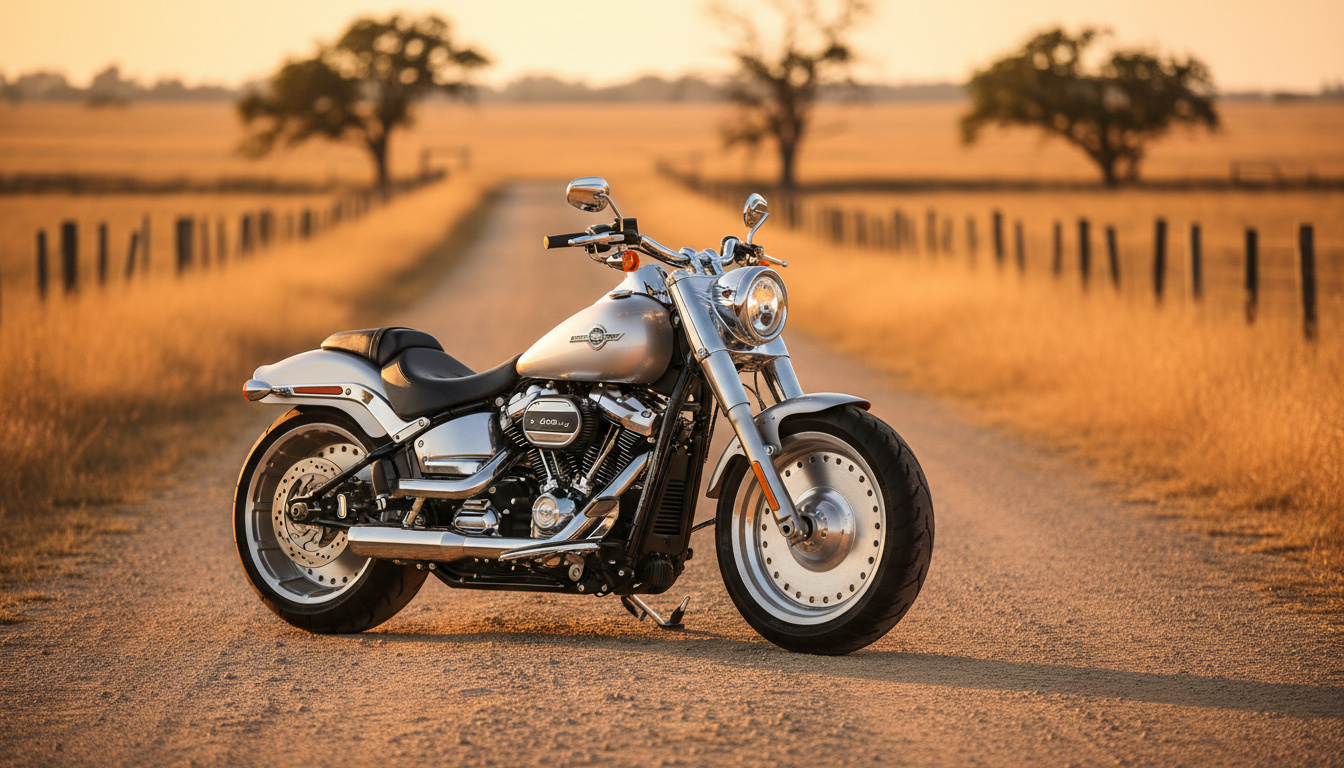
The short answer: avoid the 2007 Fat Boy (cam chain tensioner wear and a battery cable fire recall), treat the 1990–1992 and 1999 Evo years with caution due to documented electrical and fuel issues, and give extra scrutiny to early 2018–2019 M8 production bikes that may carry an early-spec oil pump. The best years to buy are 2020–2024 Milwaukee-Eight 114 models, where the oil pump, clutch hydraulics, and powertrain were fully sorted.
The Harley-Davidson Fat Boy is one of the most recognizable cruisers in the world — those solid disc wheels and wide, low stance made it a pop-culture icon after its 1990 debut. But like any long-running model, it passed through several engine platforms: the Evolution (1990–1999), Twin Cam 88 (2000–2006), Twin Cam 96 (2007–2017), and Milwaukee-Eight (2018–present). Our research across NHTSA recall records, Harley-Davidson service documentation, and hundreds of owner forum threads found that the model’s reliability story varies sharply by era. This guide gives you the year-by-year breakdown you need before buying a used Fat Boy.
Fat Boy Year-by-Year Overview Table
The table below condenses our findings into a quick-reference verdict for every Fat Boy model year. Use it as your starting point, then read the era-by-era sections for the full picture.
| Model Year(s) | Engine | Verdict | Primary Concern |
|---|---|---|---|
| 1990–1992 | Evolution 80ci | Caution | NHTSA recall 92V180000 — starter relay fire risk |
| 1993–1998 | Evolution 80ci | Buy with inspection | Age-related maintenance; no major platform issues |
| 1999 | Evolution 80ci (carb) | Caution | NHTSA recall 99V200000 — fuel tank vent overflow |
| 2000–2006 | Twin Cam 88B | Buy with inspection | No recalls; rubber-mounted engine reduces vibration |
| 2007 | Twin Cam 96 + EFI | Avoid | Cam chain tensioner wear + battery cable fire recall (07V173000) |
| 2008–2017 | Twin Cam 96 / 103 | Buy with inspection | Verify tensioner service history; 103ci preferred |
| 2018–2019 | Milwaukee-Eight 107 | Caution | Early oil pump variants; break-in sumping reports |
| 2020–2024 | Milwaukee-Eight 114 | Best buy | Updated oil system; proven reliability record |
What Makes a Fat Boy Year “Problematic”?
Platform transitions and first-year production runs carry the most risk in any motorcycle lineup, and the Fat Boy is no exception. When Harley switches engine families — from Evo to Twin Cam, or Twin Cam to Milwaukee-Eight — the first one to two model years typically surface issues that later calibrations resolve. Our research found three recurring categories: recall-level safety defects (documented by NHTSA), drivetrain reliability issues that appear across owner forums at high frequency, and first-year EFI calibration problems that Harley addressed via dealer software updates.
Evolution Era Fat Boys (1990–1999): The Evo Classics
The Fat Boy launched in 1990 with Harley’s 80-cubic-inch Evolution V-Twin — the engine that saved the company in the 1980s. Evo Fat Boys are generally durable bikes in good hands, but the earliest years carry documented recall history you should verify before purchase.
1990–1992: Starter Relay Fire Risk (NHTSA Recall 92V180000)
NHTSA issued recall campaign 92V180000 covering 1990, 1991, and 1992 Harley-Davidson FLSTF models. The defect: the starter relay could short-circuit when the motorcycle was parked, creating a fire risk. Harley’s remedy was dealer replacement of the relay. If you’re looking at an early Evo Fat Boy, confirm with the VIN that this recall was completed. Most surviving examples have had it done, but private sellers don’t always have records.
Beyond the recall, early Evo Fat Boys have spent 30-plus years accumulating maintenance needs. Our research on HDForums threads covering vintage Softail ownership found that rubber fuel lines, carb diaphragms, and primary chain adjusters are the usual deferred-maintenance items on bikes of this age. None of these are dealbreakers — they’re budget items to factor into the purchase price.
1999: Fuel Tank Vent Overflow (NHTSA Recall 99V200000)
The 1999 FLSTF carries a separate NHTSA recall — campaign 99V200000 — for a fuel tank vent fitting that could become plugged, allowing the carburetor to overflow fuel. The consequence NHTSA documented: fuel dripping from the carburetor could contact hot engine surfaces and ignite. Again, dealer-completed remedy should be confirmed via NHTSA’s VIN lookup before purchase.
The 1999 Fat Boy was also the last carbureted model. Many owners on V-TwinForum consider this a feature rather than a flaw — carb tuning is simpler than early EFI diagnostics, and a well-maintained 1999 is straightforward to own. Just verify the recall history.
1993–1998: The Sweet Spot of the Evo Era
The 1993–1998 Fat Boys are the cleanest Evo-era buying options. No platform recalls, the carbureted 80ci Evolution was at its most refined, and 30 years of aftermarket support means parts are widely available. These bikes require a thorough mechanical inspection given their age — valve lash, primary chain, head gaskets — but owners who’ve maintained them report reliable performance. Our research found consistent praise for the 1995–1998 range on HDForums, with owners frequently citing low trouble rates when basic maintenance was kept up.
Twin Cam Era Fat Boys (2000–2017): Know Your Tensioners
Harley introduced the Twin Cam 88B engine for the Fat Boy in 2000 — the “B” designation means counterbalanced, using balance shafts to reduce vibration. This platform ran through 2006 with the 88ci displacement, then grew to 96ci in 2007, and many models received the 103ci option from 2012 onward. The key reliability variable across all Twin Cam Fat Boys is cam chain tensioner condition.
2000–2006: Twin Cam 88B — Solid Foundation
The TC88B years are the most dependable Fat Boys in the Twin Cam family. The rubber-mounted engine eliminates most vibration complaints common to early V-Twins, no major platform recalls were issued, and the carbureted/early EFI versions are simple to maintain. The balance shaft system — which the 2007 Softail Service Manual documents as a dual counterbalancer assembly with a dedicated chain drive — requires periodic inspection but rarely fails catastrophically when service intervals are followed.
Pre-purchase inspection priority for a 2000–2006 Fat Boy: check cam chain tensioner shoe thickness. Per the HD Service Manual (2007 Softail, p. 3-63), tensioners should be replaced when the chain contact shoe material measures less than 0.060 in. (1.52 mm). A leakdown test is also recommended — these engines are old enough that cylinder sealing deserves scrutiny.
2007: The Year to Avoid — Cam Tensioners + Fire Recall
The 2007 Fat Boy is the single year we recommend avoiding outright in the Twin Cam family. Two independent issues converge: the documented NHTSA fire risk (recall 07V173000, noted above), and the first-year introduction of Twin Cam 96 displacement paired with Electronic Fuel Injection on the Softail platform. Early EFI calibration on the TC96 required multiple dealer software updates before fueling and throttle response were fully sorted. Owners on HDForums from 2007–2009 described stumbling at low RPM and inconsistent idle warm-up behavior — symptoms that later TC96 bikes don’t exhibit once the software was refined.
The cam chain tensioner issue deserves specific attention on the 2007. The 2007 Softail Service Manual notes that the automatic cam chain tensioner should be inspected per section 6.3. The tensioner shoe wear limit is the same 0.060 in. threshold, but first-year TC96 owners on V-TwinForum reported faster-than-expected shoe wear in the 2007, particularly in bikes with extended oil change intervals. HD addressed cam plate oiling improvements in subsequent years. If you’re committed to a 2007, get a shop to pull the cam cover and measure shoe thickness before buying.
2008–2017: Twin Cam 96 and 103 — Much Improved
From 2008 onward, the Twin Cam Fat Boy is a substantially better bike than the 2007. HD addressed the EFI calibration with updated software, and cam chain tensioner oiling was improved. The 103ci option (introduced broadly in the Softail line from 2012) is the preferred buy in this range — more torque, slightly better low-end pull, and the same platform reliability. Our research on HDForums found owners of 2010–2017 Fat Boys consistently reporting 40,000–80,000 miles with only routine maintenance when tensioners and oil changes were kept current.
Per the HD Service Manual (2013 Softail, Section 3.24), cam chain tensioner inspection is a scheduled maintenance item. Replace tensioners — primary and secondary — if shoe material is less than 0.060 in. (1.52 mm) thick, or if they show cracking or deformation. The 2013 manual specifies secondary cam chain tensioner fastener torque at 90–120 in-lbs (10.2–13.6 Nm). Ask sellers of high-mileage TC-era Fat Boys for tensioner service documentation. If they don’t have it, price in the repair.
For Twin Cam reliability context across the Harley lineup, our Twin Cam years to avoid guide covers engine-family-wide issues that apply beyond the Fat Boy specifically.
Milwaukee-Eight Era Fat Boys (2018–Present): First-Year Growing Pains
The 2018 model year was a complete reset for the Fat Boy. Harley’s Milwaukee-Eight engine — the company’s eighth-generation Big Twin, introduced across the Touring line in 2017 — arrived on the redesigned Softail platform in 2018. The Fat Boy became the FLFB (107ci) and FLFBS (114ci) designations. Per the 2018 Softail Service Manual (94000529), the Fat Boy uses a pressurized dry-sump lubrication system with a twin gerotor, dual scavenge, crank-mounted oil pump. Running weight for the FLFBS is documented at 314 kg (692 lb) per the Harley-Davidson Source Book.
2018–2019: Early M8 — Inspect the Oil System
The 2018–2019 M8 Fat Boys are desirable bikes — the Milwaukee-Eight is a genuinely better engine than the Twin Cam — but first-year production carried a nuance worth knowing. The 2018 Softail Service Manual includes a specific note in the oil pump section: “Early and late production oil pump components are not interchangeable.” This language reflects a mid-production revision to the oil pump assembly. Owners of very early 2018 production bikes reported oil sumping symptoms — where oil migrates past the pump and pools in the engine crankcase after sitting — more frequently than later 2018 and 2019 production runs.
Sumping is not catastrophic, but it causes blue smoke on cold starts and, if left unaddressed, can wash the cylinder walls. Our dedicated Milwaukee-8 oil sumping guide covers diagnosis and the fix in detail. For Fat Boy buyers: ask sellers of 2018–2019 models whether oil sumping has been addressed or if the oil pump was replaced under warranty or TSB guidance.
A user on HDForums in a thread titled “2018 FLFB oil issues first start” wrote: “After sitting two weeks the bike smoked like crazy on startup — dealer confirmed sumping and replaced the pump under warranty. No issues since.” This pattern — caught and resolved under warranty — is common for 2018 production bikes. If the bike you’re looking at is past the warranty window, ask for dealer service records showing the oil system was inspected or updated.
We found no NHTSA recall specific to the Fat Boy designation for 2018–2019 in our search of the NHTSA database (searched under FLSTF and FLFB model codes). However, the broader M8 platform had TSBs issued for powertrain refinements — consult NHTSA’s TSB database and your local Harley dealer for the full list applicable to any specific VIN.
2020–2024: The Best Fat Boys Ever Built
The 2020 and later Fat Boys represent the Milwaukee-Eight at its most refined. Harley standardized the Fat Boy at the Milwaukee-Eight 114 displacement for this generation, dropping the 107ci base option. The oil pump revisions that addressed early 2018 sumping reports were already baked into 2020+ production. Owner reports across HDForums and Reddit’s r/Harley consistently describe these bikes as trouble-free through 20,000–30,000 mile ownership periods when oil changes are performed at or before the 5,000-mile interval HD specifies for this engine.
For M8 platform-wide context — including issues that affect the Touring models as well — our Milwaukee-8 years to avoid guide covers the full engine-family picture.
Fat Boy vs. Other Softail Models: What’s Different
The Fat Boy shares its platform with other Softail models, so some issues in this guide overlap with what you’d find researching a Heritage Classic or Slim. However, the Fat Boy’s specific configuration — solid disc wheels, wide front tire, lower seat height — gives it a distinct parts-wear pattern. The disc wheels are heavier than spoked alternatives, which puts marginally more load on wheel bearings. Our research found Fat Boy-specific wheel bearing complaints slightly more frequent than comparable Softails on HDForums, particularly on high-mileage TC-era examples. Budget for wheel bearing inspection on any Fat Boy over 40,000 miles.
If you’re comparing seat comfort between the Fat Boy and the Heritage Classic, our best seat for the Heritage Softail Classic guide includes aftermarket upgrades that fit multiple Softail models. For exhaust upgrades on M8 Softail platforms, see our 2-into-1 exhaust guide.
Fat Boy Buying Checklist: What to Inspect Before You Buy
Regardless of model year, every used Fat Boy purchase warrants these specific checks. Sellers who refuse pre-purchase inspections by independent mechanics are a red flag.
- VIN recall check: Run the VIN at our Harley VIN Decoder + Recall Lookup before negotiating. Confirm 92V180000 (1990–1992), 99V200000 (1999), and 07V173000 (2007) are completed if applicable.
- Cam chain tensioner (TC-era): Ask for documentation or have a shop inspect. Shoe wear below 0.060 in. (1.52 mm) means immediate replacement — budget $400–800 parts and labor.
- Oil sumping check (2018–2019 M8): Cold-start the bike after it’s sat overnight. Blue/gray smoke on startup that clears within 30 seconds is normal condensation. Sustained smoke for 2+ minutes on a warm day suggests sumping.
- Compression and leakdown (all years): Any bike over 30,000 miles benefits from a cylinder leakdown test. Evo-era Fat Boys over 20 years old especially.
- Disc wheel bearings: Lift the front, spin the wheel, feel for roughness or play. Rear wheel same. Budget bearing replacement if any roughness exists.
- Primary chain and compensator: Listen for clunking on cold starts — common on TC-era bikes with worn compensator sprockets. Our Harley compensator problems guide covers this in detail.
- Service history: 5,000-mile oil changes for M8, 3,000-mile for TC-era are Harley’s own intervals. Gaps in service records increase risk regardless of year.
Which Fat Boy Years Are the Best to Buy?
Our ranked recommendations for used Fat Boy purchases, from best to acceptable:
| Rank | Years | Why |
|---|---|---|
| 1st | 2020–2024 (M8 114) | Best engine, resolved oil system, no major recalls, highest resale value |
| 2nd | 2012–2017 (TC103) | Proven 103ci, tensioner issues well-understood, strong parts availability |
| 3rd | 2008–2011 (TC96) | Solid improvement over 2007, EFI sorted, verify tensioner history |
| 4th | 1993–1998 (Evo) | Clean recall history, great vintage value, age-appropriate maintenance required |
| 5th | 2000–2006 (TC88B) | Dependable, no recalls, rubber mounting adds comfort |
| Caution | 2018–2019 (M8 107) | Good bikes with a known quirk — verify oil system before buying |
| Caution | 1990–1992, 1999 | Confirmed recalls — verify completion, factor in age |
| Avoid | 2007 (TC96) | Fire recall + first-year EFI issues + tensioner wear rate |
Frequently Asked Questions
What year Fat Boy should I avoid?
The 2007 Fat Boy is the single year to avoid. It carries NHTSA fire recall 07V173000 (battery cable/oil tank contact), first-year Twin Cam 96 EFI calibration issues, and accelerated cam chain tensioner wear compared to later TC96 bikes. If you’re committed to a 2007, have an independent shop pull the cam cover and inspect tensioner shoe thickness before buying.
What is the best year Harley Fat Boy to buy used?
The 2020–2024 Milwaukee-Eight 114 Fat Boys are the best used buys when your budget allows. The oil system issues that appeared in early 2018–2019 production were resolved, the 114ci engine produces 119 ft-lbs of torque, and these bikes have proven reliability through owner reports up to 30,000 miles. If budget is the constraint, 2012–2017 Twin Cam 103 models are the best value in the used market.
Do Milwaukee-Eight Fat Boys have oil sumping problems?
Early 2018 production Milwaukee-Eight Fat Boys had the highest sumping reports. The 2018 Softail Service Manual notes that early and late production oil pump components are not interchangeable — indicating a mid-year revision. 2019 models improved, and 2020-onward bikes have a fully sorted oil system. To check: cold-start the bike after it’s sat for 24+ hours and watch for sustained blue smoke beyond 30 seconds.
How long do Harley Fat Boy engines last?
Well-maintained Fat Boys regularly reach 100,000 miles regardless of era. Twin Cam examples with documented tensioner service and 5,000-mile oil changes (or 3,000-mile with conventional oil) are the most consistently long-lived in our forum research. Milwaukee-Eight engines, with proper break-in and synthetic oil at 5,000-mile intervals, appear on track to surpass that benchmark. The engine is not the limiting factor — neglected maintenance is.
Is the Fat Boy the same as the Heritage Softail?
No, though they share a platform. The Fat Boy (FLSTF/FLFB) is distinguished by solid disc wheels — both front and rear — and a lower, more aggressive stance. The Heritage Softail Classic (FLSTC/FLHCS) uses spoked wheels and a more upright, touring-oriented ergonomic. Both share the same engine and many powertrain components, so the reliability issues in this guide largely apply to the Heritage as well. The disc wheels on the Fat Boy are heavier, putting more load on wheel bearings at high mileage.
What does the Fat Boy cam chain tensioner recall involve?
There was no formal recall specifically for cam chain tensioner failure on the Fat Boy — tensioner wear is a maintenance issue rather than a safety defect in NHTSA’s classification. However, Harley-Davidson issued technical service bulletins (TSBs) related to cam plate oiling for the Twin Cam platform, and tensioner shoe inspection is a scheduled service item in Harley’s own maintenance schedule. The 2007 Fat Boy had an actual fire recall (07V173000) unrelated to the tensioners — it involved the battery cable routing.
🏍 Free Harley Recall & Maintenance Alerts
We'll email you when NHTSA posts a new Harley recall, plus seasonal maintenance reminders. No spam, unsubscribe anytime.
By subscribing you agree to our Privacy Policy.
