
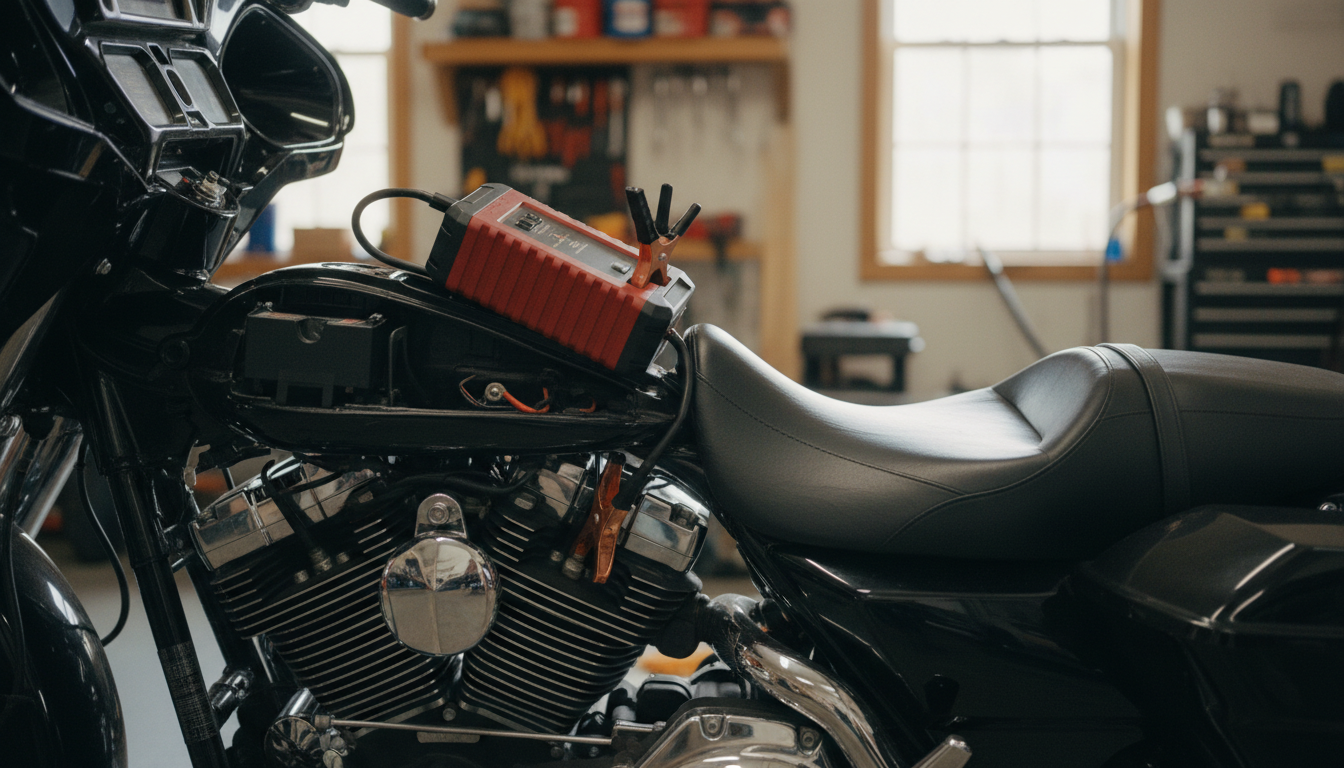
The battery on a Street Glide or Road King doesn’t sit out in the open like a car battery. It’s under the seat, or behind a side cover, wired into a charging system built around a battery rated for 405 cold cranking amps. When that battery goes flat, most of the jump starters sold on Amazon were designed for a Honda Civic – not a 900-pound bagger with a battery buried under bodywork.
Our research desk pulled the battery specification tables directly out of Harley-Davidson factory service manuals for Touring, Softail, Dyna, and Sportster models to answer two questions nobody selling these packs bothers to answer: how much peak amperage does a jump starter actually need for a Harley battery, and where do the clamps actually go when the terminals aren’t sitting in plain sight under the tank like they are on a car.
We don’t ride these bikes for a living – we’re the team that reads every service manual and spec sheet so you don’t have to dig through 300 pages of PDF to find one line about cold cranking amps. Here’s what we found, and which pack matches your bike.
Key Takeaways
Short on time? Here’s the whole article in five bullets.
- Current Touring models (2014-2026 Street Glide, Road Glide, Road King, Ultra) run a 28Ah/405 CCA battery per Harley’s own service manual – noticeably bigger than a Dyna or Softail’s 17.5-19Ah/270-315 CCA pack, and almost 3x a Sportster’s 12Ah/225 CCA battery.
- The NOCO Boost GB50 (1500A) and GOOLOO A3 (3000A) carry enough peak-amp headroom for a big Touring battery in cold weather; the smaller NOCO GB20 (500A) is sized right for a Sportster and shouldn’t be your only option for a full-dress bagger.
- On most baggers, the battery hides under the seat or a side cover – you clamp the actual battery posts (or a documented remote terminal), never a random frame bolt or bracket.
- All six packs use lithium chemistry with reverse-polarity and spark-proof protection, which matters on a motorcycle where the terminals sit closer to fuel lines and plastic bodywork than on a car.
- The GOOLOO A3 doubles as a 150 PSI tire inflator, which is arguably more useful on a road trip than the extra peak amps most riders will never need.
| NOCO Boost GB40 1000A UltraSafe Jump Starter | 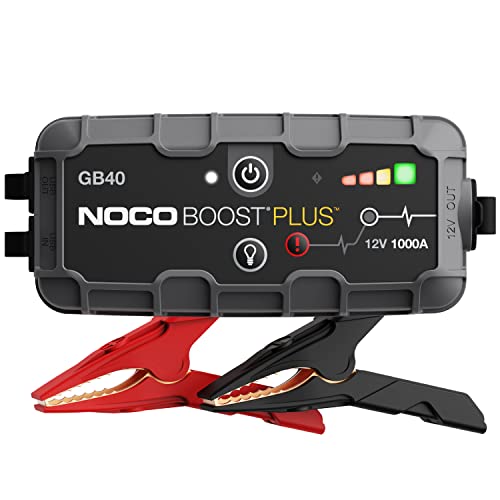 |
Best Overall | Peak Amps: 1000A | Engine Range: 6.0L gas / 3.0L diesel | Battery: 24Wh lithium-ion | VIEW LATEST PRICE | Read Our Analysis |
| NOCO Boost GB50 1500A UltraSafe Jump Starter | 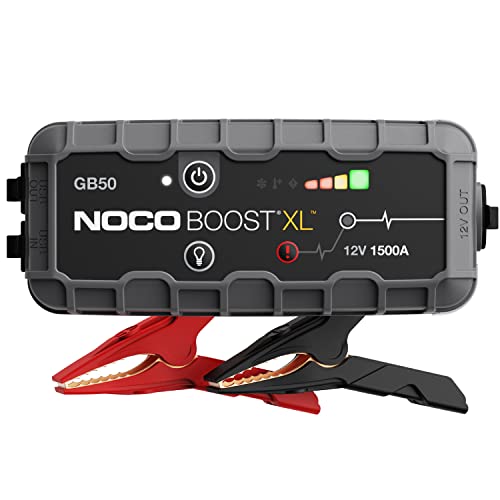 |
Best for Big Touring / Trike / CVO | Peak Amps: 1500A | Engine Range: 7.0L gas / 4.5L diesel | Battery: 35Wh lithium-ion | VIEW LATEST PRICE | Read Our Analysis |
| NOCO Boost GB20 500A UltraSafe Jump Starter | 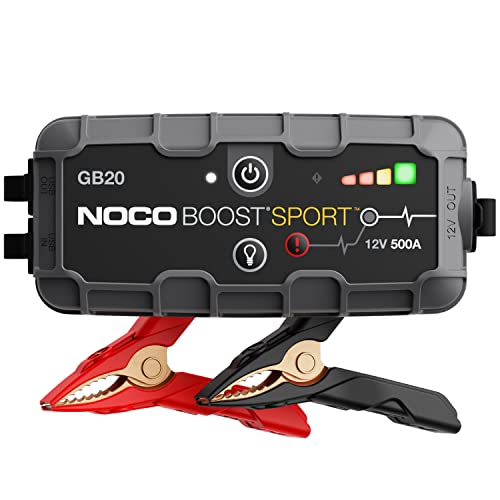 |
Best Compact / Sportster Pick | Peak Amps: 500A | Engine Range: Up to 4.0L gas | Weight: 2.1 lb | VIEW LATEST PRICE | Read Our Analysis |
| GOOLOO A3 3000A Jump Starter with Air Compressor |  |
Best Multi-Tool | Peak Amps: 3000A | Air Compressor: 150 PSI | Engine Range: 9.0L gas / 6.5L diesel | VIEW LATEST PRICE | Read Our Analysis |
| AstroAI S8 1500A Jump Starter |  |
Best Value | Peak Amps: 1500A | Engine Range: 6.0L gas / 3.0L diesel | Flashlight: 3-mode | VIEW LATEST PRICE | Read Our Analysis |
| YESPER 1500A Pocket Jump Starter |  |
Best Ultra-Compact / Budget Pick | Peak Amps: 1500A | Battery: Not published | Size: Pocket-sized | VIEW LATEST PRICE | Read Our Analysis |
More Details on Our Top Picks
NOCO Boost GB40 1000A UltraSafe Jump Starter
The GB40 sits right at the middle of NOCO’s Boost lineup, and that middle spot is exactly why it works for most Harley owners. At 1000A peak, it clears a Sportster’s 225 CCA battery with room to spare and still has enough headroom for a Dyna or Softail’s 270-315 CCA pack without buying more jump starter than you’ll ever use.
NOCO’s UltraSafe design is the real selling point here. The clamps won’t spark on contact and the unit shuts itself down on reverse polarity, which matters more on a bike than a car – the battery terminals on a Dyna sit closer to plastic side covers and wiring harnesses than anything under a car hood, so a spark-happy clamp is a bigger risk.
The 24Wh lithium-ion pack is rated for up to 20 jump starts per charge, doubles as a USB power bank, and carries an IP65 rating so a surprise rain shower won’t kill it. Where it falls short: a fully depleted 405 CCA Touring battery in freezing weather is asking more of 1000A than it’s built to comfortably deliver – size up to the GB50 for that bike.
- Peak Amps:1000A
- Battery Capacity:24Wh lithium-ion
- Engine Range:Up to 6.0L gas / 3.0L diesel
- Jump Starts Per Charge:Up to 20
- Water/Dust Rating:IP65
- LED Light:100-lumen, 7 modes including SOS/strobe
- Safety:UltraSafe spark-proof clamps, reverse-polarity protection
- USB Output:Yes, power bank function
NOCO Boost GB50 1500A UltraSafe Jump Starter
This is the pack sized for the battery Harley actually puts in current Touring models. Per the 2019 Touring service manual, a Street Glide or Road King runs a 28Ah/405 CCA sealed AGM battery – the biggest battery in the Harley lineup by a wide margin, and one that a Sportster-sized jump pack simply wasn’t built to move.
At 1500A peak and 35Wh of internal lithium capacity, the GB50 is rated for engines up to 7.0L gas or 4.5L diesel, which covers a full-dress Ultra Limited or a trike with margin left over. That margin matters most in the exact scenario where you’ll need it: a cold garage, a battery that’s been sitting for weeks, and a starter motor asking for every amp it can get.
It carries the same UltraSafe spark-proof clamps as the smaller GB40, plus a built-in LED light and USB power bank function. The tradeoff for the bigger battery is size – this isn’t the pack you tuck into a Sportster’s tiny under-seat tray. If you ride a Touring model, trike, or CVO, keep this one in the saddlebag; anything smaller does fine with the GB40 or GB20.
- Peak Amps:1500A
- Battery Capacity:35Wh lithium-ion
- Engine Range:Up to 7.0L gas / 4.5L diesel
- Battery Type:12V lithium
- Safety:UltraSafe spark-proof clamps, reverse-polarity protection
- LED Light:Built-in
- USB Output:Yes, power bank function
- Rated Use:Car, truck, motorcycle, SUV, boat, ATV, RV
NOCO Boost GB20 500A UltraSafe Jump Starter
A Sportster’s 12V, 225 CCA, 12 Ah battery is the smallest one Harley builds – roughly half the CCA rating of a Dyna and a little more than half of a current Touring bike’s. The GB20 is sized to match it instead of overshooting it with amperage you’ll never use.
At 2.1 lb, this is the pack that actually fits in the small under-seat storage on an XL-frame bike without eating your whole storage allowance. It carries the same 500A peak rating NOCO lists for engines up to 4.0L gas, which lines up cleanly with a Sportster’s smaller displacement and smaller battery.
It keeps the IP65 rating and 100-lumen LED flashlight from the rest of the Boost lineup and charges over USB-C at up to 2.1A. The catch: don’t grab this one if you also ride a Touring bike or a Softail – it’s built for the smallest Harley battery on the road, and jumping a 405 CCA Touring pack in cold weather asks more than its rating supports.
- Peak Amps:500A
- Battery Capacity:24Wh lithium-ion
- Engine Range:Up to 4.0L gas
- Jump Starts Per Charge:Up to 20
- Water/Dust Rating:IP65
- LED Light:100-lumen
- Charging Input:USB-C, 5V/2.1A max
- Weight:2.1 lb (0.95 kg)
GOOLOO A3 3000A Jump Starter with Air Compressor
Nothing else on this list can also air up a tire, and that’s the actual reason to buy the A3 over a dedicated jump starter. It carries a 150 PSI compressor rated to inflate a tire to 20 PSI in roughly two minutes, with an auto-shutoff so you can’t overfill a motorcycle tire by accident.
The jump-starting side isn’t an afterthought either – at 3000A peak and rated for engines up to 9.0L gas or 6.5L diesel, this is more amperage than any Harley battery needs, including the 405 CCA Touring pack. GOOLOO rates it for 50+ starts per charge, and it’s built to operate from -20°C to 60°C (-4°F to 140°F), which covers a genuinely cold garage start.
Five inflation modes and five nozzles cover car, motorcycle, and ball inflation, making this less a single-purpose emergency tool and more a garage-and-saddlebag multitool, with a built-in LED light for roadside use after dark. It’s bigger and heavier than a single-purpose pack, and most of that 3000A rating is unused headroom on a motorcycle battery – but if you want one tool for a dead battery and a soft tire on the same trip, this is the one that does both.
- Peak Amps:3000A
- Engine Range:Up to 9.0L gas / 6.5L diesel
- Air Compressor:150 PSI, 35L/min airflow, auto-shutoff
- Inflation Modes:5, with 5 nozzles included
- Jump Starts Per Charge:50+
- Operating Temp:-20°C to 60°C (-4°F to 140°F)
- LED Light:Built-in
- Safety:Reverse-polarity protection
AstroAI S8 1500A Jump Starter
The S8 lands in the same 1500A class as the pricier NOCO GB50, but scaled down to match a Dyna, Softail, or older Twin Cam Touring bike’s 19Ah/270-315 CCA battery rather than the newer 405 CCA one. It’s rated for engines up to 6.0L gas or 3.0L diesel.
Inside is a 45C high-rate lithium cell built for the kind of quick, high-current burst a motorcycle starter demands, paired with smart jumper cables that include reverse-polarity protection. That’s the feature that matters most for a first-time buyer – it’s the same failsafe that keeps a mixed-up clamp connection from becoming an expensive mistake.
Beyond jump-starting, it works as a power bank and carries a 3-mode flashlight (steady, strobe, SOS) genuinely useful if you’re stuck roadside after dark. It doesn’t carry the extra headroom of the GB50 or the air compressor of the GOOLOO A3, but for a Dyna, Softail, or pre-2014 Touring bike, it covers the CCA rating you actually need without paying for capacity that battery won’t use.
- Peak Amps:1500A
- Engine Range:Up to 6.0L gas / 3.0L diesel
- Battery Type:45C high-rate lithium
- Voltage:12V
- Flashlight:3 modes – steady, strobe, SOS
- Function:Jump starter, power bank, flashlight
- Cables:Smart jumper cables, reverse-polarity protection
- Safety:Spark-resistant clamp design
YESPER 1500A Pocket Jump Starter
Every pack on this list claims to be portable. The YESPER is the one that actually fits in a jacket pocket – YESPER lists it as roughly a third thinner, a quarter smaller, and a third lighter than a typical 1500A pack in this class.
Despite the small footprint, it still carries a 1500A peak rating, with an engine range up to 7.0L gas or 5.5L diesel on its U.S. listing – enough to comfortably cover a Dyna, Softail, or Sportster, with usable margin on an older Twin Cam Touring bike too.
YESPER lists 10 separate protection circuits, including the spark-proof and reverse-polarity protection you’d expect from any pack clamped to a motorcycle battery, plus a built-in USB port for charging a phone or GPS off the bike. This is the pick for riders who want something small enough to live permanently in a jacket pocket or tank bag – just not the one to reach for on a full-dress Touring bike’s 405 CCA battery in freezing weather. Step up to the GB50 or GOOLOO A3 for that job.
- Peak Amps:1500A
- Battery Capacity:Not published by the manufacturer
- Engine Range:Up to 7.0L gas / 5.5L diesel
- Voltage:12V
- Size:~33% thinner, 27% smaller, 34% lighter than typical packs in class
- Safety:10 protections, including spark-proof and reverse-polarity
- USB Output:Built-in port
- Use Case:Pocket/tank-bag carry
How Much CCA Does a Jump Starter Actually Need for a Harley?
This is the question every “best motorcycle jump starter” list skips, and it’s the one that determines whether the pack in your saddlebag actually works when you need it.
Harley doesn’t put the same battery in every model. Our research desk pulled the battery specification tables directly out of the factory service manuals to compare what each platform runs:
| Model Family | Battery Size | CCA Rating | Source |
|---|---|---|---|
| Touring (2014+ / Milwaukee-Eight, e.g. Street Glide, Road King, Ultra) | 28 Ah, sealed AGM | 405 CCA | 2019 Touring Service Manual, Table 4. Battery Specifications |
| Touring (pre-2014, Twin Cam chassis) | 19 amp hour | 270 CCA | 2009 Touring Models Service Manual, §7.2 Specifications: Electrical, Table 7-3 |
| Dyna (2006-2017, Twin Cam) | 19 A hour | 315 CCA | 2013 Dyna Service Manual, §7.2 Electrical Specifications |
| Softail (Twin Cam, pre-2018) | 19 amp hour | 270 CCA | 2010 Softail Service Manual, §7.2 Specifications: Electrical, Table 7-3 |
| Softail (2018+ / Milwaukee-Eight) | 12V / 17.5 Ah, sealed AGM | 315 CCA | 2018 Softail Service Manual, Table 1. Battery Specifications |
| Sportster (XL models) | 12V / 12 Ah, sealed and maintenance-free | 225 CCA | 2013 Sportster Service Manual, §6.2 Electrical Specifications, Table 6-1 |
The pattern that jumps out: the current-generation Touring battery (405 CCA) is close to double the CCA rating of a Sportster (225 CCA), and noticeably ahead of a Dyna or Softail (270-315 CCA). That’s not a small difference, and it’s the reason a one-size jump starter recommendation doesn’t hold up across the Harley lineup.
There’s no single industry-standard formula that converts a battery’s CCA rating into “the exact peak-amp jump starter you need,” because peak amps on a portable pack and cold cranking amps on a battery aren’t measured the same way. What matters in practice is margin: a jump starter rated close to or below a battery’s CCA number can struggle on a cold morning or a deeply discharged battery, while one with real headroom above it gives a more reliable start with less strain on the pack.
In practice: a Sportster’s 225 CCA battery or a Dyna/Softail’s 270-315 CCA battery is well within reach of a 500-1500A pack like the GB20 or AstroAI S8 – you don’t need the 3000A GOOLOO A3’s extra bulk for these bikes. The 405 CCA Touring battery is the outlier. If you ride a Street Glide, Road Glide, Road King, Ultra Limited, or a trike, the GB50 or GOOLOO A3 give you the margin a smaller pack doesn’t, especially in cold weather when a battery’s effective output drops.
Where to Actually Clamp on a Bagger
This is the part that trips people up the first time. Pop the seat expecting to see a battery like you would under a car hood, and instead you find bodywork.
On Touring and Softail models, the battery sits under the rider’s seat – Harley’s own service manual lists “Battery, Remove and Install” as the very next procedure after the seat removal steps, with the tray bolted to the frame beneath. Pull the retaining hardware for your model year, lift the seat, and the terminals are right there. On some Dyna models, the battery is also under the seat, with the wiring harness routed to a breakout connector under the left side cover – if you only find a plastic side cover, check under the seat first.
The rule that matters more than the exact location: clamp the actual battery terminals, not a random frame bolt, a fork lower, or a chrome cover screw. A frame bolt might be grounded, but it’s not a documented positive connection point, and using one risks a bad connection, a spark near fuel lines, or simply not enough contact area to carry a real cranking load. If your model has a factory-documented remote positive stud or jump-start post (check your owner’s manual – not every model has one), use that. Otherwise, remove the seat or side cover and clamp the battery posts directly, exactly as Harley’s own service procedure describes for a battery swap.
If you genuinely can’t reach the terminals without tools you don’t have on the road, that’s a sign to call for a tow rather than force a connection to something that isn’t the battery.
Peak Amps vs. CCA: What the Numbers Actually Mean
These two numbers get used interchangeably online, and they shouldn’t be. Cold Cranking Amps (CCA) is a rating stamped on the battery itself – the current a fully charged, healthy battery can sustain for 30 seconds at 0°F while staying above a minimum voltage. It’s a battery spec, and it’s what Harley publishes in the service manual tables above.
Peak Amps on a portable jump starter is the maximum surge current the pack can deliver for a very short burst – long enough to help crank a dead or weak battery, not to replace it. Manufacturers test it differently than CCA, so the two numbers aren’t directly interchangeable, but they point at the same real-world question: does this pack have enough current capacity to reliably help start this battery? A 500A pack clamped to a 225 CCA Sportster battery has clear margin. The same pack on a 405 CCA Touring battery that’s been sitting dead for two weeks in a cold garage has a lot less margin – exactly the scenario where a bigger pack like the GB50 earns its keep.
Is It Safe to Jump a Motorcycle Battery With a Lithium Pack?
Short answer: yes, with the same precautions you’d use with any jump starter, plus one that matters more on a bike. All six packs here use reverse-polarity protection and spark-resistant clamp design, the baseline safety feature you want whether your Harley runs the sealed AGM battery Harley ships stock (confirmed in every manual checked) or an aftermarket lithium-iron-phosphate swap some owners run for weight savings. Reverse-polarity protection refuses to complete the circuit if you clamp positive-to-negative by mistake, the single most common way people damage a bike’s electronics with a jump starter.
One difference worth knowing: if your Harley runs an aftermarket lithium battery instead of the stock AGM, check that battery manufacturer’s own jump-starting guidance first. Some lithium motorcycle batteries have a built-in battery management system that can shut down under certain fault conditions, and the fix there is usually a full charge on a dedicated charger, not a jump.
Cold Weather and Winter Storage Considerations
A battery that reads fine on a warm afternoon can struggle to turn over an engine after a cold night – exactly when most riders reach for a jump starter in the first place.
If your Harley sits for weeks between rides, a jump starter is a good emergency tool, but it’s treating a symptom. A proper winter storage routine with a maintainer keeps the battery from reaching the deeply discharged state where jump-starting becomes necessary at all. Reaching for a jump pack every few weeks on a bike that isn’t ridden daily usually points to a parasitic drain or a charging system issue worth diagnosing, not a battery that just needs a bigger jump starter.
A jump starter also isn’t a permanent fix for a battery that won’t hold a charge. If you’re jumping the same bike repeatedly, check common voltage regulator symptoms first – a failing regulator can undercharge or overcharge a battery until no amount of jump-starting keeps it reliable. If the battery itself is simply worn out, our guide to Harley battery replacement options covers what to buy instead.
Jump Starter Comparison Table
Here’s every spec side by side, so you can match a pack to your specific bike in one look.
| Jump Starter | Peak Amps | Battery | Engine Range (Gas/Diesel) | Extra Feature | Best For |
|---|---|---|---|---|---|
| NOCO Boost GB40 | 1000A | 24Wh lithium-ion | 6.0L / 3.0L | IP65, 100-lumen LED | Most Harleys (Dyna/Softail/older Touring) |
| NOCO Boost GB50 | 1500A | 35Wh lithium-ion | 7.0L / 4.5L | Highest headroom of the NOCO lineup | Current Touring, trike, CVO (405 CCA battery) |
| NOCO Boost GB20 | 500A | 24Wh lithium | 4.0L gas only | 2.1 lb, USB-C charging | Sportster (225 CCA battery) |
| GOOLOO A3 | 3000A | Not published | 9.0L / 6.5L | 150 PSI air compressor | Riders who also want a tire inflator |
| AstroAI S8 | 1500A | 45C high-rate lithium | 6.0L / 3.0L | 3-mode flashlight, budget price | Dyna/Softail/older Touring on a budget |
| YESPER 1500A Pocket | 1500A | Not published | 7.0L / 5.5L | Smallest, pocket-carry size | Riders who want it in a jacket pocket |
Frequently Asked Questions
What CCA rating do I need in a jump starter for a Harley-Davidson?
It depends on the model. Per Harley’s own service manuals, a Sportster runs a 225 CCA battery, a Dyna or Softail runs 270-315 CCA, and a current-generation Touring bike (2014+) runs 28Ah/405 CCA – almost double a Sportster’s rating. Match the jump starter’s peak-amp class to your bike: a 500-1000A pack covers a Sportster or Dyna/Softail comfortably, while a Touring bike, trike, or CVO benefits from a 1500A+ pack like the NOCO GB50 or GOOLOO A3.
Can a small jump starter like the NOCO GB20 start a big Touring bike?
It might, on a mildly discharged battery in mild weather – but it’s not the reliable choice. The GB20 is rated at 500A and sized for a Sportster’s 225 CCA battery, well under a Touring bike’s 405 CCA rating. For a Street Glide, Road King, or Ultra Limited, especially one that’s sat for weeks or is starting cold, a 1500A-class pack like the GB50 gives real margin instead of asking a compact pack to do more than it’s built for.
Where do you clamp a jump starter on a Harley bagger with the battery under the seat?
Remove the seat (or side cover, on some Dyna models) to expose the terminals and clamp there directly – positive to positive, negative to negative or a documented ground point. Harley’s own service manual lists battery removal as the step immediately following seat removal, confirming that’s the intended access point. Never clamp to a frame bolt, fork lower, or chrome cover screw; those aren’t documented connection points.
Is it safe to jump-start a Harley’s AGM or lithium battery with a portable pack?
Yes, with a jump starter that has reverse-polarity protection and spark-resistant clamps, which all six packs here include. Harley ships its bikes with sealed AGM batteries stock, per every service manual checked. If your bike runs an aftermarket lithium battery instead, check that battery’s own manufacturer guidance first – some lithium packs have a battery management system that can behave differently under a jump.
Does cold weather change how big a jump starter I need?
Yes. A battery’s effective cranking output drops in cold weather, and a deeply discharged battery in a cold garage is the toughest scenario a jump starter faces. That’s exactly where extra peak-amp headroom above the battery’s CCA rating matters most – why Touring, trike, and CVO owners with a 405 CCA battery are better matched to the GB50 or GOOLOO A3 than a smaller pack.
If I keep my Harley on a battery tender, do I still need a jump starter?
A maintainer connected during winter storage prevents most deep-discharge situations, but it doesn’t help if the battery drops while you’re already out riding – from a parasitic drain, a short trip that didn’t fully recharge it, or a charging fault. A compact jump starter is worth keeping in the saddlebag regardless: it’s the tool that gets you moving on the road, not in the garage.
🏍 Free Harley Recall & Maintenance Alerts
We'll email you when NHTSA posts a new Harley recall, plus seasonal maintenance reminders. No spam, unsubscribe anytime.
By subscribing you agree to our Privacy Policy.
