
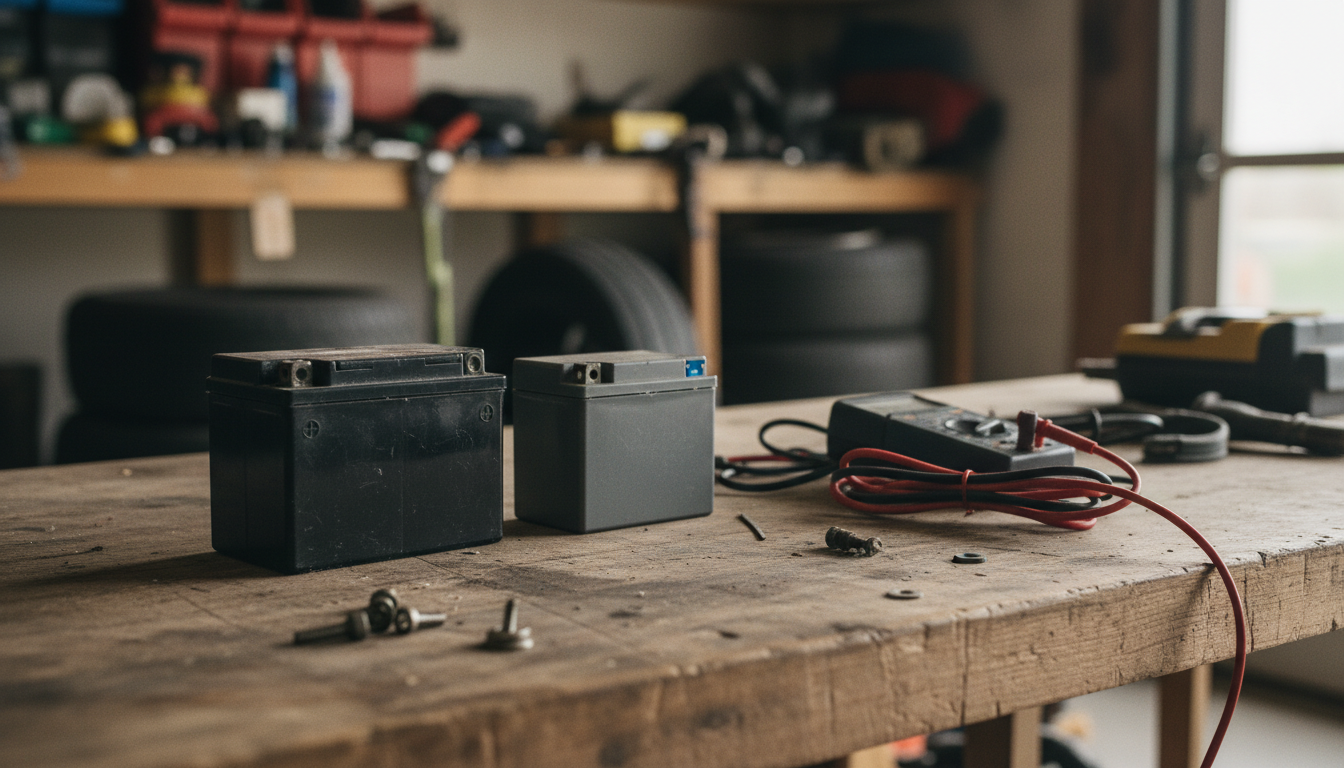
A dead battery does not care that you have a ride planned. It waits for the one morning you are already running late, then leaves your Harley clicking instead of cranking – usually the first cold snap of the season, or the first ride after a bike sat in the garage for two months.
Our research team pulled cold-cranking-amp and group-size specs directly from Harley-Davidson factory service manuals – the same documents dealership techs use – and cross-referenced them against 20-plus H-D owner’s manuals spanning Dyna, Softail, Touring, and Sportster. We then checked which AGM and lithium batteries on the market actually match those specs, rather than just “fit most Harleys.” We also built out a full AGM-vs-lithium comparison, because that decision matters more than which brand you pick within either category.
This guide covers every Harley platform, not just one model. If you ride a Milwaukee-Eight Street Glide specifically, our dedicated Street Glide battery guide goes deeper on that one bike’s CAN-bus charging quirks. Let’s get into it.
Key Takeaways
- Harley Touring models (Street Glide, Road Glide, Road King, Electra Glide, CVO) use the larger YTX30L-BS group (28 Ah / 405 CCA), while Dyna and Softail models use the smaller YTX20HL-BS group (19 Ah / 315 CCA) – mixing these up is the single most common battery-buying mistake.
- AGM picks in this guide run $59.99 to $135.60; lithium picks run $159.99 to $210.90 – roughly 2-3x the sticker price, matching Harley-Davidson’s own AGM-vs-lithium FAQ pages.
- Lithium batteries need a lithium-capable charger. Connecting a standard AGM battery tender to a lithium battery is a documented failure mode, not a theoretical one – see the charger-compatibility section below.
- Cold starts favor AGM: it delivers rated cranking amps at low temperatures immediately, while lithium chemistry’s internal resistance rises in the cold and can need a few extra cranks to self-warm before it delivers full current.
- Factory battery cable torque differs by platform: 60-70 in-lbs (6.8-7.9 N·m) on Milwaukee-Eight Touring models, but 6-9 ft-lbs (72-108 in-lbs / 8.1-12.2 N·m) on Milwaukee-Eight Softail models (Per HD Service Manuals, 2019 Touring M8 §2.23 and 2018 Softail 94000529) – check your own model before you reach for a torque wrench, and note that – over-torquing is a documented way to crack a terminal post on a brand-new battery.
| Yuasa AGM SLA YTX20HL-BS Battery |  |
Best Overall | Group Size: YTX20HL-BS | Fits: Dyna & Softail | Type: AGM, factory-activated | VIEW LATEST PRICE | Read Our Analysis |
| TYKOOL LFP30L-BS-STD Lithium Battery |  |
Best Lithium for Touring | Group Size: YTX30L-BS equiv. | Fits: Touring (1997-2024) | Weight: 4.5 lbs (vs 21 lbs AGM) | VIEW LATEST PRICE | Read Our Analysis |
| UPLUS EB20H-3 Motorcycle Battery YTX20HL-BS |  |
Best Budget Pick | Group Size: YTX20HL-BS | CCA: 310 | Price: Under $60 | VIEW LATEST PRICE | Read Our Analysis |
| Weize YTX30L-BS AGM Battery |  |
Best Value for Touring | Group Size: YTX30L-BS | CCA: 400 | Fits: Street Glide, Road King & more | VIEW LATEST PRICE | Read Our Analysis |
| Yuasa YIX30L High Performance AGM Battery |  |
Best for Cold Climates | Group Size: YTX30L-BS equiv. | CCA @ 0°F: 400 | Tech: Lead-calcium plates | VIEW LATEST PRICE | Read Our Analysis |
| AMPXELL Lithium Motorcycle Battery YTX20L-BS |  |
Best Lithium for Dyna & Softail | Group Size: YTX20L-BS equiv. | CCA: 720 | Capacity: 12 Ah | VIEW LATEST PRICE | Read Our Analysis |
| MMG Lithium Ion Battery YTX20HL-BS |  |
Lightest Lithium Pick | Weight: 3.09 lbs | Cycle Life: 2,000+ | Group Size: YTX20HL-BS equiv. | VIEW LATEST PRICE | Read Our Analysis |
More Details on Our Top Picks
Yuasa AGM SLA YTX20HL-BS Battery
Yuasa is the OEM battery supplier Harley-Davidson actually ships on the assembly line, so buying a Yuasa-branded replacement in the correct group size is about as close to “stock” as an aftermarket purchase gets. This is the pick we point Dyna and Softail owners toward when they just want the correct battery and don’t want to think about it further.
It ships factory-activated – filled, sealed, and charged before it leaves Yuasa’s plant, not a dry unit you have to fill with acid and charge yourself. That matters more than it sounds like, because a battery that sits activated-but-uncharged on a store shelf for months develops sulfation that never fully reverses.
Yuasa’s own product literature points to lock-bonded plates for vibration resistance and a heat-sealed case to prevent electrolyte leakage – both directly relevant on an engine platform that vibrates a lot more than a car does. Recharge speed is also a factory-stated advantage of AGM construction generally: up to five times faster than a flooded battery, per Harley-Davidson’s own AGM battery FAQ.
Buy this one if you ride a Dyna or Softail and want the same battery family the bike left the factory with. If you ride a Touring model, skip to the YTX30L-BS options below – this group size is too small for that platform.
- Group Size:YTX20HL-BS
- Battery Type:Sealed AGM, factory-activated
- Fits:Dyna & Softail families (see compatibility chart below)
- Construction:Lock-bonded plates, heat-sealed case
- Maintenance:Maintenance-free, no acid filling required
- Brand:Yuasa (Harley-Davidson’s OEM battery supplier)
- Terminal Layout:Standard YTX20HL-BS post configuration
- Recharge Speed:Up to 5x faster than flooded battery (AGM design trait)
TYKOOL LFP30L-BS-STD Lithium Battery
This is the lithium option we’d point a Touring rider toward specifically because the listing states its engineering target by name: Harley-Davidson Touring models, 1997-2024, including Street Glide, Road King, Electra Glide, and Ultra Limited. That is a narrower, more useful claim than “fits most motorcycles.”
The headline number is 650 CCA from a battery that weighs 4.5 lbs, compared to roughly 21 lbs for a lead-acid YTX30L-BS. That is not a small weight difference on a bike where every pound sits high and forward near the steering head. The built-in BMS (battery management system) includes a digital voltage readout on the case, so you can check state of charge without pulling out a multimeter.
The manufacturer is unusually direct about the tradeoff that matters most: this battery is rated for charging systems with a regulated output under 15.0V, and the listing explicitly warns against lead-acid chargers with desulfurization or pulse-repair modes. That is not marketing copy – it is the exact failure mode covered in our AGM vs. lithium section below.
Buy this if you have a Touring-family Harley, want to shave roughly 16 lbs off the battery alone, and are prepared to retire your old lead-acid tender for a lithium-compatible charger.
- Group Size:YTX30L-BS equivalent (also cross-references 66010-97C, 66010-97B)
- Chemistry:LiFePO4 (lithium iron phosphate)
- CCA:650
- Weight:4.5 lbs (vs. ~21 lbs for a lead-acid YTX30L-BS)
- Fits:Harley-Davidson Touring, 1997-2024 (per manufacturer listing)
- BMS Features:Digital voltage/SOC readout, over-charge and over-discharge protection
- Rated Cycle Life:2,500+ per manufacturer
- Charger Requirement:Dedicated LiFePO4 charger only; regulated charging system under 15.0V
UPLUS EB20H-3 Motorcycle Battery YTX20HL-BS
Under $60 for a correctly-sized AGM battery is close to the floor of what is available for this group size, and this one still hits the numbers that matter: 18 Ah and 310 CCA, which clears the minimum for any Dyna or Softail application.
It is sealed, maintenance-free, and ships in the exact physical dimensions of a YTX20HL-BS/YTX20L-BS case – roughly 6.9 x 3.4 x 6.1 inches – so it drops into the stock battery tray without spacers or modification.
The manufacturer backs it with a 15-month warranty, which is shorter than the multi-year coverage on the premium AGM options in this guide. For a second bike, a seasonal rider, or anyone replacing a battery that failed well before the typical 3-5 year AGM lifespan, that is a reasonable trade for the price.
Buy this if budget is the deciding factor and you ride a Dyna or Softail. If you tour year-round in genuinely cold climates, we’d spend the extra money on the Yuasa above instead.
- Group Size:YTX20HL-BS / YTX20L-BS
- Capacity:18 Ah
- CCA:310
- Battery Type:Sealed AGM, maintenance-free
- Dimensions:6.89 in x 3.43 in x 6.1 in
- Weight:13.1 lbs
- Warranty:15 months (manufacturer)
- Fits:Dyna & Softail families
Weize YTX30L-BS AGM Battery
Touring riders need the larger YTX30L-BS group, and this is the value option in that size: 30 Ah and 400 CCA, right in line with Harley’s own factory spec of 28 Ah / 405 CCA for Touring models built since 2011.
It ships already charged, sealed, and ready to install – no acid filling. Weize’s listing is direct about the buying logic that applies to every battery in this group-size class: match the dimensions, terminal polarity, and CCA of your old battery, and it will fit. This one measures 6.54 x 4.96 x 6.89 inches, the standard YTX30L-BS footprint.
At 18 lbs, it is a full lead-acid battery – there is no weight-saving angle here, which is exactly why it costs less than half of the lithium options covering the same group size.
Buy this if you ride a Street Glide, Road King, Road Glide, or Electra Glide and want a straightforward, correctly-sized AGM replacement without paying Yuasa OEM-brand pricing or lithium pricing.
- Group Size:YTX30L-BS / YIX30L-BS
- Capacity:30 Ah (10-hour rate)
- CCA:400
- Battery Type:Sealed AGM, ships charged
- Dimensions:6.54 in x 4.96 in x 6.89 in
- Weight:18.04 lbs
- Fits:Touring family (Street Glide, Road King, Road Glide, Electra Glide)
- Terminal Layout:Left negative (-), right positive (+)
Yuasa YIX30L High Performance AGM Battery
Yuasa positions its YIX series specifically around cold-climate performance, and the spec that backs that claim is 400 CCA measured at 0°F (-18°C) – not the more flattering 32°F rating some competitors quote. For riders in the northern half of the country who start their bike on genuinely cold mornings, that is the number worth checking before you buy.
The construction is Yuasa’s lead-calcium plate design, which the manufacturer states holds specific gravity more than three times longer than conventional lead-antimony batteries – relevant if your bike sits for weeks between rides over winter. It is factory-activated (filled, sealed, and charged before shipping) in the YTX30L-BS/YIX30L-BS group size.
At 22 lbs with acid, it is the heaviest AGM option in this guide, which is the tradeoff for the extra plate area that gives it the cold-weather CCA advantage.
Buy this if you ride a Touring-family Harley through actual winters and start it in sub-freezing temperatures regularly. If you store your bike over winter instead, the weight penalty buys you less, and the TYKOOL lithium pick’s low self-discharge rate becomes more relevant.
- Group Size:YTX30L-BS / YIX30L-BS
- Capacity:30 Ah (10-hour rate)
- CCA @ 0°F (-18°C):400
- Plate Technology:Lead-calcium (per manufacturer, holds charge 3x longer than lead-antimony)
- Dimensions:6 9/16 in x 5 in x 7 7/8 in
- Weight (with acid):22 lbs
- Activation:Factory-activated AGM, sealed and charged before shipping
- Fits:Touring family, cold-weather riding
AMPXELL Lithium Motorcycle Battery YTX20L-BS
Every lithium battery in this guide targeting the Touring group size costs over $150. This one covers the smaller YTX20L-BS/YTX20HL-BS group that Dyna and Softail riders need, at a more moderate lithium price point.
Rated output is 720 CCA from 12 Ah – a much higher CCA-to-capacity ratio than the equivalent AGM, which is typical of LiFePO4 chemistry’s ability to deliver current fast. The manufacturer states an operating range of -4°F to 140°F (-20°C to 60°C), though as covered below, lithium’s usable cranking power still drops more sharply in true cold than AGM’s does.
It includes a USB charging port built into the case and ships with its own two-way Type-C charger rated up to 30W – useful if you don’t already own a separate lithium-compatible tender, though we’d still recommend a dedicated smart charger for long-term storage maintenance over relying on the included unit alone.
Buy this if you ride a Dyna or Softail, want the weight savings of lithium, and don’t need the Touring-specific engineering (or price tag) of the TYKOOL pick above.
- Group Size:YTX20L-BS equivalent (also cross-references YTX20-BS, YTX20H-BS, YTX24HL-BS)
- Chemistry:LiFePO4
- Voltage:12.8V
- Capacity:12 Ah
- CCA:720
- Operating Range:-4°F to 140°F (-20°C to 60°C) per manufacturer
- Included Charger:Two-way USB-C, 30W max
- Fits:Dyna & Softail families
MMG Lithium Ion Battery YTX20HL-BS
At 3.09 lbs, this is the lightest battery in this entire guide – roughly 50-70% lighter than the AGM alternatives in the same group size, per the manufacturer. If shaving unsprung and high-mounted weight is the whole point of going lithium for you, this is the pick that delivers the most of it.
Rated cycle life is over 2,000 charges with up to a full year of shelf life before the battery needs a top-up charge – useful if the bike is a fair-weather ride that sits for months at a time. MMG’s listing also notes the chemistry is free of the hazardous lead and acid found in AGM designs.
It carries the broadest cross-reference list of any battery in this guide, covering everything from YTX20HL-BS to several BTX and GYZ part-number variants – worth double-checking against your specific model’s OEM part number before ordering, since “compatible with” lists this long are common in the category but the physical footprint still needs to match your battery tray.
Buy this if minimum weight is your top priority and you ride a Dyna or Softail. If Touring-specific engineering matters more to you than raw weight savings, the TYKOOL pick above is the better match for that platform.
- Group Size:YTX20HL-BS equivalent
- Chemistry:Lithium-ion
- Weight:3.09 lbs
- Dimensions:6.89 in x 3.42 in x 5.12 in
- Rated Cycle Life:2,000+ per manufacturer
- Shelf Life:Up to 1 year before recharge needed
- Fits:Dyna & Softail families (verify against OEM part number)
- Chemistry Safety:No lead or liquid acid (manufacturer claim)
AGM vs. Lithium: Which Actually Makes Sense for Your Harley
Every battery in this guide falls into one of two chemistries, and the choice matters more than which brand you pick within either one.
Cold Cranking Behavior
AGM delivers its rated CCA immediately at low temperatures – it is the same lead-acid chemistry Harley-Davidson ships as original equipment specifically because it handles vibration and cold starts predictably. Lithium’s internal resistance rises as temperature drops, which can reduce usable cranking current until the battery has warmed slightly from the first crank attempts. A lithium battery will generally still start the bike in the cold, but AGM’s behavior is more consistent for a rider who starts the bike outdoors on genuinely cold mornings all winter.
Weight
This is lithium’s clearest advantage. The TYKOOL Touring-size lithium battery in this guide weighs 4.5 lbs against roughly 21 lbs for an equivalent lead-acid YTX30L-BS – about 16 lbs saved, high and forward on the frame near the steering head. On a Dyna or Softail, the MMG pick at 3.09 lbs saves a similar proportion versus its AGM equivalent. Whether that weight reduction is noticeable while riding is a matter of some debate among riders, but it is not a marketing exaggeration – it is a direct consequence of lithium iron phosphate’s energy density versus lead-acid.
Price Per Year of Service
AGM batteries in this guide run $59.99 to $135.60 and typically last 3-5 years with proper maintenance – call it roughly $15-35 per year of service. Lithium batteries run $159.99 to $210.90, but Harley-Davidson’s own lithium battery FAQ states its LiFe batteries are rated for more than 1,000 charge cycles versus 500 for a well-maintained AGM – roughly double the service life, commonly cited in the 8-10 year range for riders who don’t cycle the battery hard. Run that math and lithium works out to a comparable or slightly better cost per year, not a premium you pay forever – the AGM’s lower upfront cost is offset by needing to buy it again sooner.
Charger Compatibility – the Failure Mode That Actually Happens
This is the AGM-vs-lithium difference that catches riders off guard, because it shows up months after the purchase, not at install. A standard lead-acid battery tender reads voltage and current in a way that does not translate to a lithium battery’s internal battery management system (BMS) – a standard lead-acid tender generally cannot read through a lithium pack’s control board, so it cannot reliably tell whether the battery needs charging or has already reached full charge Owners commonly report switching a Battery Tender Junior to a lithium-compatible model after finding the standard version simply wouldn’t maintain a lithium battery correctly.
The TYKOOL Touring lithium battery in this guide states this directly in its own specifications: it requires a charging system with regulated output under 15.0V, and its manufacturer explicitly warns against “lead-acid chargers with desulfurization or pulse-repair modes.” Riders who install a lithium battery and keep their old AGM-rated tender plugged in over winter storage are the ones most likely to come back to a battery that won’t hold charge – not because the battery failed, but because the charger was never speaking its language. If you switch to lithium, budget for a lithium-compatible charger at the same time; our battery tender comparison guide covers which models handle both chemistries.
Cold-Weather Storage
If your riding season ends in October and starts in April, self-discharge rate matters more than CCA. Lithium wins clearly here – the TYKOOL battery in this guide is rated at under 1% self-discharge per month, and Harley-Davidson’s own lithium FAQ states its LiFe batteries hold charge for up to 12 months disconnected. A quality AGM battery on a smart maintainer will get through winter fine too, but it needs that maintainer connected (and, per the point above, it needs to be the right kind of maintainer for whichever chemistry is on the other end of the cable).
Battery Group Size & CCA by Harley Model
The most common battery-buying mistake on a Harley is not choosing AGM vs. lithium – it’s buying the wrong physical group size for the platform. Every spec below comes directly from a Harley-Davidson factory service manual or owner’s manual, not a generic fitment chart.
| Harley Family | Example Models | Factory Battery Spec | Retail Group Size | Source |
|---|---|---|---|---|
| Touring (2011-2016, Twin Cam 103) | Street Glide, Road King, Road Glide, Electra Glide | 28 Ah / 405 CCA | YTX30L-BS | HD Service Manual (2011 Touring, §7.2 Specifications: Electrical) |
| Touring (2017+, Milwaukee-8) | Street Glide, Road Glide Special, Road Glide Ultra, CVO Street Glide | 28 Ah / 405 CCA | YTX30L-BS | HD Service Manual (2019 Touring M8, §8.2 Specifications: Electrical); HD Road Glide Special & CVO Street Glide Owner’s Manuals |
| Touring (pre-2011, Twin Cam 96) | Street Glide, Road King (2009 model year) | 19 Ah / 270 CCA | YTX20L-BS | HD Service Manual (2009 Touring, §7.2 Specifications: Electrical) |
| Freewheeler Trike | Freewheeler | 28 Ah / 405 CCA | YTX30L-BS | HD Freewheeler Owner’s Manual |
| Dyna (1999-2009, Twin Cam 88/96) | Street Bob, Super Glide, Wide Glide, Low Rider | 19 Ah / 270 CCA | YTX20L-BS | HD Service Manual (2009 Dyna, §7.2 Specifications: Electrical) |
| Dyna (2013-2017, Twin Cam 103) | Street Bob, Wide Glide, Low Rider | 19 Ah / 315 CCA | YTX20HL-BS | HD Service Manual (2013 Dyna, §7.2 Specifications: Electrical) |
| Softail (2007-2009, Twin Cam) | Heritage Classic, Fat Boy, Softail Deluxe | 19 Ah / 270 CCA | YTX20L-BS | HD Service Manual (2008 Softail, p. 8-1) |
| Softail (2013-2017, Twin Cam 103) | Softail Slim, Breakout, Heritage Classic | 19 Ah / 315 CCA | YTX20HL-BS | HD Service Manual (2013 Softail, §7.2 Specifications: Electrical) |
| Softail (2018+, Milwaukee-8) | Fat Bob, Breakout, Low Rider S, Softail Slim | 19 Ah / 315 CCA | YTX20HL-BS | HD Fat Bob, Breakout & Softail Slim Owner’s Manuals |
| Sportster (Evolution 1200) Not the 2022+ Nightster, which is a Revolution Max 975T and is not covered here | Forty-Eight, Iron 883, Roadster, Nightster (2007-2012 Evolution XL1200N), Seventy-Two | 12 Ah / 225 CCA | ~YTX14-BS class (smaller than Dyna/Softail) | HD Forty-Eight, Iron 883 & Roadster Owner’s Manuals |
| Street 500/750 | Street 500, Street 750 | 12 Ah / 225 CCA | ~YTX14-BS class | HD Street 500 & Street 750 Owner’s Manuals |
| V-Rod / VRSC (discontinued 2017) | Night Rod, Muscle | 12 Ah / 200 CCA | Smaller group, below Sportster spec | HD VRSC Electrical Diagnostics Manual (2008, p. 4-1) |
Two things worth noting in that table. First, Touring-family battery specs changed between 2009 and 2011 – if you own an earlier Twin Cam 96 Touring bike, don’t assume it takes the same battery as a newer one on the same nameplate; verify your model year against the chart. Second, if you ride a Street Glide specifically, our dedicated Street Glide battery guide covers M8-specific CAN-bus charging behavior in more depth than we can here.
Buying Guide: How to Choose the Right Harley Battery
Group size gets you in the right physical footprint. These four factors decide which specific battery within that group size is worth buying.
Match Group Size Before Anything Else
Use the chart above, or pull the battery spec directly from your model’s owner’s manual (Electrical section, near the back). A battery in the wrong group size may physically wedge into the tray with force, but the strap, terminal reach, and vent routing are designed around a specific case size – don’t improvise here.
Check CCA Against the Factory Minimum, Not Just the Group Size Label
Two batteries can share a group-size label and still differ meaningfully in CCA – our picks above range from 310 CCA (UPLUS, budget AGM) to 720 CCA (AMPXELL, lithium) within the smaller group size alone. Match or exceed your model’s factory CCA spec from the chart above; going higher doesn’t hurt, going lower risks marginal cold starts.
Confirm Terminal Polarity Before You Order
The Weize listing in this guide calls out left-negative, right-positive as the standard YTX30L-BS layout – but polarity can vary by manufacturer even within a nominally identical group size. Check your old battery, or the listing’s stated polarity, before ordering, especially if you are buying a cross-reference/equivalent part rather than an exact group-size match.
Decide on AGM vs. Lithium Before You Shop, Not After
Re-read the AGM vs. lithium section above and make that call first. It determines whether you also need to budget for a new charger, and it is a more consequential decision than which specific brand you buy within either chemistry.
Torque the Terminals to Spec When You Install It
Per Harley-Davidson’s own service procedure, battery cable screws torque to 60-70 in-lbs (6.8-7.9 N·m) on Milwaukee-Eight Touring models, while Milwaukee-Eight Softail models call for 6-9 ft-lbs (72-108 in-lbs) – so check your own platform first, and note that over-tightening is explicitly called out in the factory manual as a way to damage the terminal posts. Disconnect the negative cable first when removing a battery, and connect the positive cable first when installing the new one, per the same factory procedure.
Rule Out a Charging System Problem Before You Blame the Battery
A brand-new battery that goes dead again within weeks is rarely a bad battery – it’s usually the charging system failing to keep it topped off. If you’ve replaced the battery more than once on the same bike, check our Harley charging system problems guide and our voltage regulator symptoms guide before you buy a third battery – a failing stator or regulator will kill any battery in this roundup, AGM or lithium, on the same schedule.
Harley Battery Comparison Table
| Battery | Chemistry | Group Size | CCA | Weight | Price | Best For |
|---|---|---|---|---|---|---|
| Yuasa AGM YTX20HL-BS | AGM | YTX20HL-BS | Not stated (OEM spec) | Standard AGM weight | $115.64 | Dyna & Softail, OEM match |
| TYKOOL LFP30L-BS Lithium | LiFePO4 | YTX30L-BS equiv. | 650 | 4.5 lbs | $159.99 | Touring, weight savings |
| UPLUS EB20H-3 AGM | AGM | YTX20HL-BS | 310 | 13.1 lbs | $59.99 | Dyna & Softail, budget |
| Weize YTX30L-BS AGM | AGM | YTX30L-BS | 400 | 18.04 lbs | $69.99 | Touring, value |
| Yuasa YIX30L AGM | AGM | YTX30L-BS equiv. | 400 @ 0°F | 22 lbs | $135.60 | Touring, cold climates |
| AMPXELL Lithium YTX20L-BS | LiFePO4 | YTX20L-BS equiv. | 720 | Not stated | $175.66 | Dyna & Softail, high CCA |
| MMG Lithium YTX20HL-BS | Lithium-ion | YTX20HL-BS equiv. | Not stated | 3.09 lbs | $210.90 | Dyna & Softail, lightest option |
Frequently Asked Questions
Is a Street Glide battery the same size as a Softail battery?
No. Touring models (Street Glide, Road King, Road Glide, Electra Glide) use the larger YTX30L-BS group (28 Ah / 405 CCA), while Softail and Dyna models use the smaller YTX20HL-BS group (19 Ah / 315 CCA on current models). Check the compatibility chart above against your specific model and year before ordering.
Can I put a lithium battery in an older Harley with a standard charging system?
Physically, yes, if the group size and terminal polarity match. The catch is charging: standard lead-acid battery tenders are not built to read a lithium battery’s internal BMS correctly, which is a documented compatibility issue on rider forums. Budget for a lithium-compatible charger at the same time you buy the battery – our research desk compared lithium-safe battery tenders and chargers if you want to shop for both at once.
Do I need to disconnect the battery before working on my Harley’s electrical system?
Yes. Harley-Davidson’s factory service procedure calls for disconnecting the negative cable first when removing a battery, and connecting the positive cable first when reinstalling – reversing that order risks a spark near the battery that can cause an explosion, per the factory warning in the same procedure.
How much torque should I use on battery terminal bolts?
Harley-Davidson’s factory spec is 60-70 in-lbs (6.8-7.9 N·m) on Milwaukee-Eight Touring models and 6-9 ft-lbs (72-108 in-lbs) on Milwaukee-Eight Softail models, so check your own platform rather than assuming one figure covers both. Over-tightening is called out specifically in the service manual as a way to damage the terminal posts, so don’t guess past that number even if the bolt feels like it wants to go tighter.
How do I know if my Harley battery is actually dead versus just low?
Harley-Davidson’s own battery inspection procedure uses an open-circuit voltage test: if the reading is below 12.6V, charge the battery and re-check after it has rested at least an hour. A reading of 12.7V or above means the battery holds surface charge and needs a load test to confirm actual condition, rather than a voltage check alone. If you need the bike running before you can get to a full charge cycle, our research desk reviewed a jump starter sized for a Harley battery as the faster workaround.
Why is my new lithium battery not holding a charge after winter storage?
The most common cause is charging it with a non-lithium-compatible tender left connected over storage – the charger either fails to maintain it correctly or never properly tops it off, which reads exactly like a battery failure but isn’t one. Confirm your charger is explicitly rated for lithium/LiFePO4 chemistry before troubleshooting the battery itself.
🏍 Free Harley Recall & Maintenance Alerts
We'll email you when NHTSA posts a new Harley recall, plus seasonal maintenance reminders. No spam, unsubscribe anytime.
By subscribing you agree to our Privacy Policy.
