
Quick answer: Harley-Davidson maintenance is more expensive than most Japanese motorcycles – but less than many riders expect if you handle the basics yourself. A typical annual service bill at a dealer runs a few hundred dollars for routine items. The real costs come from tires, major interval services, and anything that requires dealer labor. DIY-capable owners can cut that number significantly.
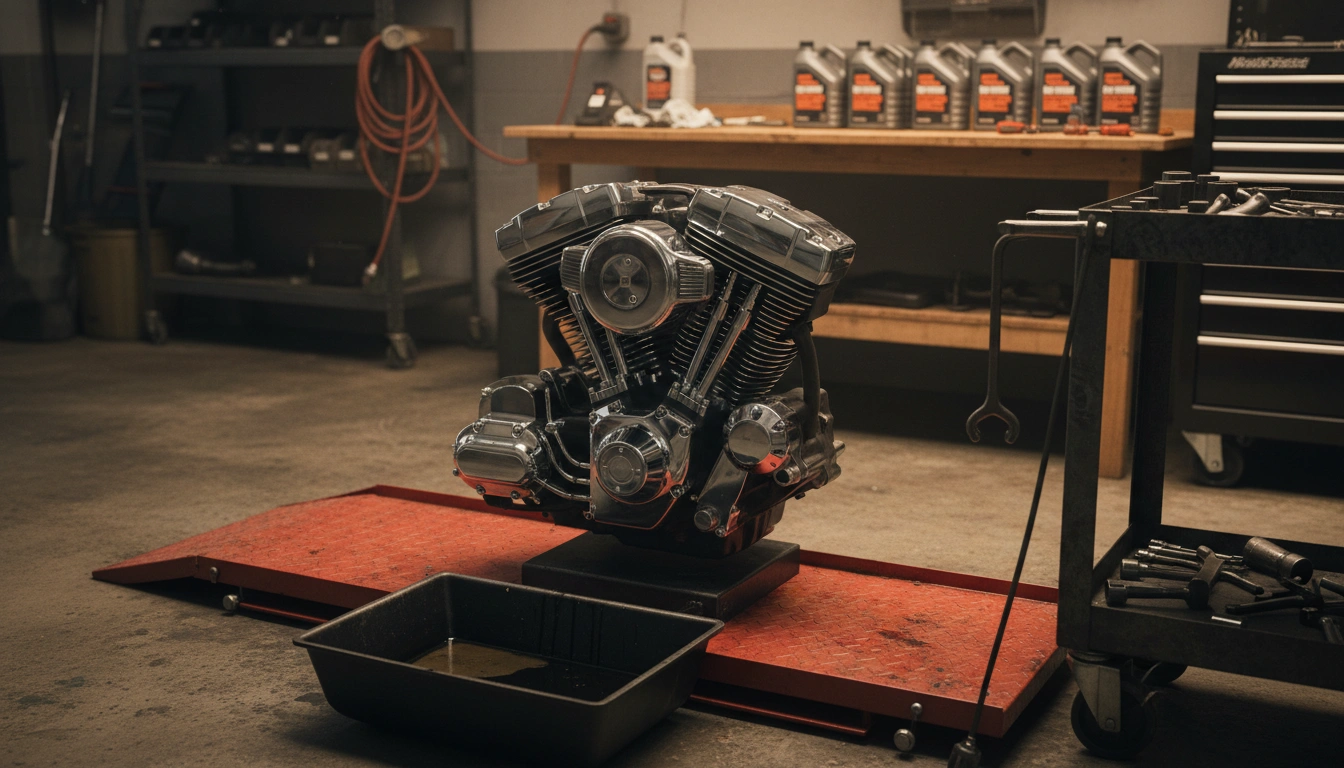
We combed through hundreds of owner threads on r/Harley and HDForums, cross-referenced the official Harley-Davidson service schedules, and dug into the HD Service Manual records in our research library to give you a cost picture that’s actually grounded in real data – not dealer scare tactics or forum hyperbole.
The Official Harley Maintenance Schedule: What You’re Actually Committing To
This is the foundation. Every cost conversation starts here – and most riders don’t realize how structured this schedule actually is until they own one.
Per the HD Service Manual (2009 Touring, Table 1-1: Regular Service Intervals), Harley Touring models follow a defined multi-interval schedule:
- 1,000-mile first service – Engine oil and filter, primary chaincase lubricant, transmission lubricant, clutch adjustment, drive belt inspection, air cleaner service, brake and clutch controls, tire pressure. This is the break-in service and it covers all three fluid holes at once.
- 5,000-mile intervals – Engine oil and filter, air cleaner service, tire inspection, clutch check, brake inspection, drive belt, fuel lines, brake fluid level.
- 10,000-mile intervals – Everything at 5k, plus primary chaincase lubricant and steering head bearing lubrication.
- 20,000-mile intervals – Everything above, plus transmission lubricant, spark plug replacement, critical fastener check.
The service manual also specifies annual items: battery inspection and brake fluid flush every two years (DOT 4). Spark plugs get inspected at each interval but only replaced at 20,000 miles.
What this means in practice: for a rider putting on 5,000 miles per year, expect two or three meaningful service events in the first year (1k break-in, 5k), then one per year after that – unless you hit a 10k or 20k milestone.
The “Three-Hole” Fluid System: Why Harleys Cost More to Service Than You Expect
This trips up new Harley owners constantly. Most motorcycles have one engine and one transmission in a shared sump. Harleys have three separate fluid reservoirs – and they’re all on their own schedule.
- Engine oil – Per the HD Service Manual (2009 Touring, p. 1-15), initial fill is 3.5 quarts (3.3 liters). Recommended: SAE 20W50 for temperatures above 40°F (4°C), SAE 10W40 for colder climates.
- Primary chaincase lubricant – The primary drives the clutch. Per the same manual, this gets changed at 1,000 miles and then every 10,000 miles. Harley specifies its own Formula+ Transmission and Primary Chaincase Lubricant (Part No. 99851-05).
- Transmission lubricant – Separate from the engine. Per the HD Service Manual (2009 Touring, p. 1-18), capacity is approximately 32 fl. oz. (0.95 liters). Changed at 1,000 miles and again at 20,000 miles.
Three drains, three fills, three products. That first-service bill is larger than it looks on paper because all three fluids need changing at 1,000 miles. Independent shops that aren’t familiar with Harleys sometimes miss the primary or trans fluid entirely – which is worth asking about explicitly.
Dealer vs. DIY: Where the Real Savings Live
The cost gap between dealer service and doing it yourself is wide enough to change the entire math of Harley ownership – especially for owners who are comfortable with basic mechanics.
Dealer labor rates for Harley-Davidson service vary heavily by region. Urban dealers in high-cost-of-living areas charge more than rural dealers. Based on forum consensus across HDForums and r/Harley threads reviewed for this post, a basic oil service at a dealer typically runs more than the same job at an independent shop. The first 1,000-mile service – which includes all three fluid changes plus inspection checks – is consistently reported as the most expensive routine service, precisely because it hits every fluid at once.
The DIY math looks very different. The fluids themselves are the main cost. A 20W50 synthetic engine oil change kit (oil + filter) for a Twin Cam is widely available. If you’re doing your own work, a good starting point is a complete oil change kit like the MaxHiflo complete V-Twin synthetic 20W50 oil change kit which bundles the oil and filter together for Twin Cam engines. This kind of kit saves time on sourcing individual components and ensures the filter spec matches. Adding the primary and transmission fluids separately is still a modest outlay compared to dealer labor.
One important note from the HD Service Manual (2009 Touring, p. 1-11): in cold climates, oil change intervals should be reduced to 1,500 miles (2,400 km) for bikes used frequently for short trips under 15 miles in temperatures below 60°F (16°C). Dealers in cold-weather states will note this – DIY owners sometimes don’t.
For more on oil selection, see our deep dive: best 20W50 oil for Harley-Davidson.
Big-Ticket Items That Catch Owners Off Guard
Routine oil changes are manageable. The items below are where maintenance costs become genuinely significant – and where budgeting ahead makes a real difference.
Tires
Harley tires – especially on heavier Touring models – wear faster than most sport bike tires because of the weight and upright load. Front tires typically last longer than rears. For Touring bikes carrying luggage and a passenger, rear tire life can be shorter than a solo sport bike. Mounting and balancing at a dealer adds labor on top of the tire cost itself. For our full breakdown of pressure specs by model: Harley-Davidson tire pressure chart.
Spark Plugs
Per the maintenance schedule (HD Service Manual 2009 Touring, Table 1-1), spark plugs are inspected at each service interval but only replaced at 20,000 miles. Harley V-twins use two plugs (one per cylinder), so it’s a small part cost but requires some access work depending on the model. The plugs themselves are inexpensive – it’s the labor to remove bodywork on some models that adds up at a dealer. Our guide to the best spark plugs for Harley-Davidson covers plug specs by engine family.
Brakes
Brake pad wear depends heavily on riding style and terrain. City riding burns through pads faster than highway cruising. Brake fluid gets a full flush every two years per the service schedule – that’s a dealer item for most owners. Neglecting the flush leads to moisture buildup in the DOT 4 fluid, which raises the boiling point risk on long mountain descents.
The 20,000-Mile Major Service
The 20k service is the most comprehensive and expensive scheduled maintenance on the Harley calendar. It combines everything from the 1k, 5k, and 10k intervals – plus transmission fluid change, spark plug replacement, critical fastener torque check, and fuel tank filter replacement at 25,000 miles. If your bike hits 20k at the dealer, budget accordingly – this isn’t a one-item visit.
How Harley Maintenance Compares to Other Brands
Honest comparison is important here. Harleys are not the most expensive motorcycles to maintain, but they’re not the cheapest either.
Japanese inline-four sport bikes and naked bikes from Honda, Kawasaki, Yamaha, and Suzuki generally have lower labor costs at dealers and wider independent shop familiarity. Their valve adjustment intervals (typically every 12,000-16,000 miles) add a specific cost that Harleys (pushrod V-twins with external adjustment access) handle differently. Harley’s pushrod design means valve adjustments are more accessible compared to overhead cam designs that require removing the fuel tank and airbox.
BMW and Ducati are consistently reported as more expensive to service than Harley on a per-service-visit basis, based on forums and owner reports compiled for this post. BMW’s shaft-drive models add their own fluid service. Ducati’s dry clutch and desmodromic valve system have specialized service requirements.
The honest summary: Harley maintenance is “premium American V-twin” territory – above average compared to Japanese entry-level bikes, roughly comparable to mid-tier European cruisers. The big variable is whether you DIY or use a dealer.
Reducing Your Harley Maintenance Costs: What Actually Works
Forum veterans have a consistent set of recommendations that come up repeatedly in cost-cutting discussions. We’ve cross-referenced them against what the service manual actually requires.
- Learn the three-fluid oil change – Engine oil, primary, and transmission. This is the highest-frequency recurring cost. The service manual calls for dealer “qualification” on some tasks, but the fluid changes themselves are within reach for mechanically inclined owners. For HD Service Manual guidance on dipstick reading: Harley-Davidson oil dipstick guide.
- Find a qualified independent shop – Independent mechanics who specialize in American V-twins charge less per hour than dealers. The key qualifier is “who specializes in Harleys” – not every general mechanic knows the three-fluid system or the Harley-specific torque specs.
- Know your oil change frequency – Our post on how often to change motorcycle oil covers the nuances beyond the basic 5,000-mile interval. Short-trip riders and cold-climate riders need to service more frequently per the factory manual.
- Service before storage – Fresh oil going into winter storage prevents acid buildup from combustion byproducts sitting in the crankcase. Our winter storage guide for Harley-Davidson covers this and other pre-storage steps.
- Use the correct trans fluid – Using the wrong fluid in the transmission or primary is a forum-documented source of clutch and transmission issues. Our guide to best transmission oil for Harley 6-speed models covers the spec requirements.
Frequently Asked Questions
The questions we see most often from prospective Harley owners researching the real cost of ownership.
How often does a Harley-Davidson need servicing?
Per the official Harley-Davidson service schedule (HD Service Manual 2009 Touring, Table 1-1), the standard interval is every 5,000 miles after the initial 1,000-mile break-in service. Engine oil and filter are changed at every service. Primary chaincase lubricant is changed at 1,000 miles and then every 10,000 miles. Transmission fluid is changed at 1,000 miles and every 20,000 miles after that.
Is the 1,000-mile service really necessary?
Yes. The break-in service is when metal particles from the engine break-in process are purged from the oil. Skipping it means those particles continue circulating. The factory schedule calls for engine oil, primary, and transmission fluid changes plus a full inspection pass. Skipping it is a false economy on a several-thousand-dollar machine.
Can I do my own Harley maintenance?
Many owners do. The three-fluid oil change, air filter replacement, spark plug replacement, and drive belt inspection are all tasks that mechanically comfortable owners handle themselves. The HD Service Manual notes that some procedures “should be performed by an authorized Harley-Davidson dealer unless you have the proper tools, service data and are mechanically qualified.” The fluid changes themselves are generally accessible. Valve adjustments, brake system work, and electrical diagnosis are more commonly left to qualified shops.
What is the most expensive Harley maintenance item?
Tires tend to be the largest single recurring expense outside of scheduled service, especially on Touring models. The 20,000-mile major service is the most expensive scheduled maintenance event. Unexpected items – compensator sprocket wear (inspected at each rear tire change per the service manual), cam chain tensioner issues on older Twin Cam engines, and electrical problems on higher-mileage bikes – are the ones that create real budget surprises.
How does Harley maintenance compare to insurance and other ownership costs?
For full ownership cost context, maintenance is one piece. Insurance, registration, storage, and financing all factor in. See our overview of Harley-Davidson insurance options and, if you’re evaluating entry points, how much the cheapest Harley-Davidson costs as a baseline for the full cost picture.
If you’re financing the purchase, our Harley-Davidson motorcycle loan calculator lets you run payment scenarios before you sign.Are Harley-Davidson bikes harder to maintain as they age?
Older models (Evolution era, 1984-1999; early Twin Cam, 1999-2006) have well-documented issues that newer owners should understand before buying used. The Twin Cam cam chain tensioner is a known failure item on earlier production years. Our post on Harley-Davidson Evolution engine problems covers what to watch for. Milwaukee-Eight (2017+) engines are generally regarded as more refined mechanically.
Does Harley offer a maintenance plan?
Harley-Davidson dealerships often offer prepaid maintenance plans, sometimes bundled with new bike purchases. Whether these plans represent good value depends on your dealer’s labor rates and how many miles you ride annually. For riders who plan to use a dealer for all scheduled service and will hit multiple service intervals within the plan period, they can represent reasonable value. For DIY-capable riders or those who prefer independent shops, they typically do not.
What engine oil does Harley-Davidson recommend?
Per the HD Service Manual (2009 Touring, Table 1-5), the recommended viscosity for most riding conditions above 40°F (4°C) is SAE 20W50 with an HD 360 rating. For colder temperatures, SAE 10W40 is recommended. Harley specifies its own branded oil but also acknowledges that oils certified for diesel engines (CF-4, CG-4, CH-4, CI-4) can be used as a temporary substitute. For a full analysis of third-party options: best 20W50 oil for Harley-Davidson.
Disclosure: BackyardRider.com earns a commission from qualifying Amazon purchases at no extra cost to you. Research compiled May 2026, based on HD Service Manual data (2009 Touring), HDForums threads, and r/Harley owner reports.
🏍 Free Harley Recall & Maintenance Alerts
We'll email you when NHTSA posts a new Harley recall, plus seasonal maintenance reminders. No spam, unsubscribe anytime.
By subscribing you agree to our Privacy Policy.
