
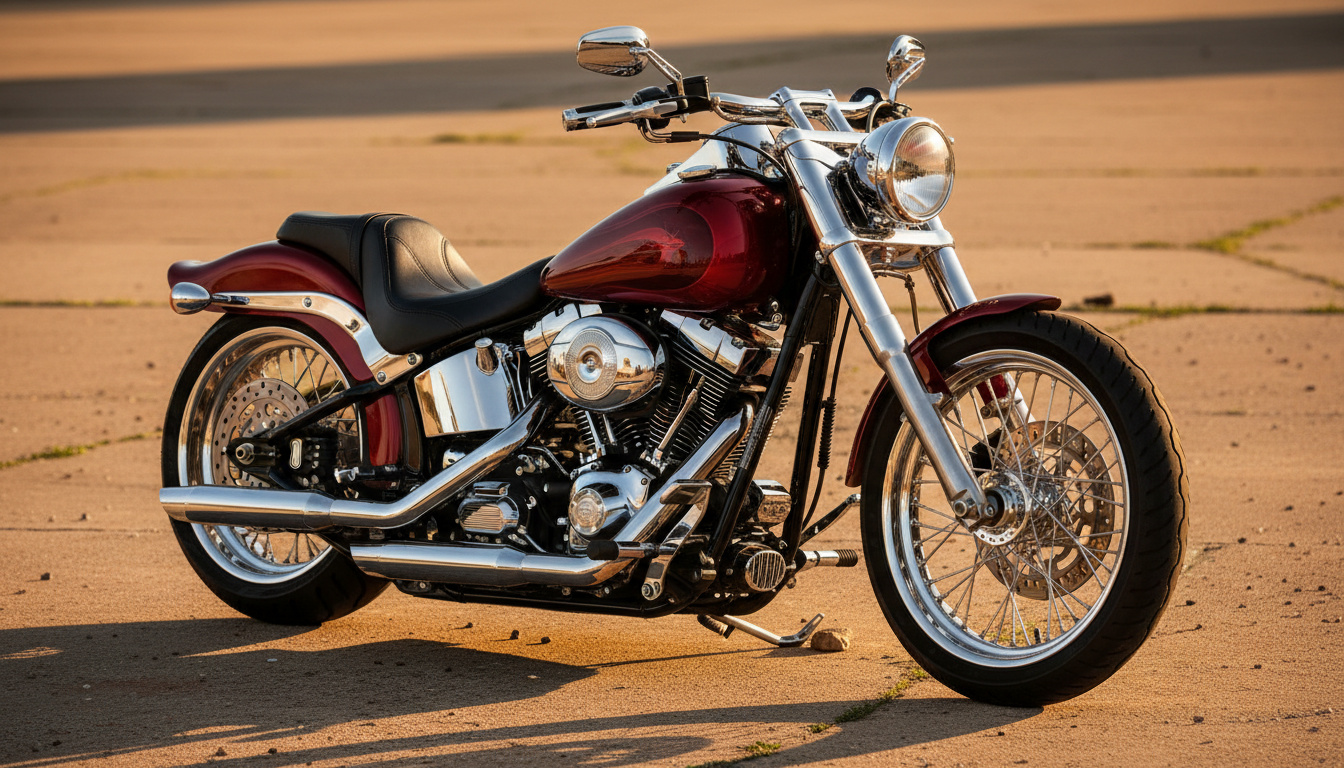
The Harley-Davidson Softail Deuce is a factory-built custom Softail produced from 2000 through 2007. It was conceived by Willie G. Davidson to deliver showbike styling straight from the crate – a stretched 4.9-gallon tank, towering 21-inch front wheel, 17-inch rear, and a slammed, drag-strip-inspired silhouette that no other stock motorcycle matched at the time. It remains one of the most recognizable H-D designs of the Twin Cam era.
Quick Answer: What Is the Harley-Davidson Deuce?
The Harley-Davidson Deuce (officially the FXSTD Softail Deuce) is a factory-custom Softail cruiser built from 2000 to 2007. Designed by Willie G. Davidson, it features a stretched 4.9-gallon fuel tank, a 21-inch front spoke wheel, a 17-inch rear, and a low, slammed chassis inspired by 1950s bobbers and drag bikes. Power came from the Twin Cam 88B counterbalanced engine (88ci / 1450cc in 2000-2006, upgraded to 96ci / 1584cc in 2007). The EFI variant carried the FXSTDI designation. Production ended after the 2007 model year. As of 2026, clean used examples trade as collector pieces.
The Design Story: Willie G. and the Factory Custom Era
This is where the Deuce story gets genuinely interesting – it was never meant to be a bike that required aftermarket work to look good. It was meant to arrive at the dealership already done.
Harley-Davidson’s styling department, led by Willie G. Davidson (grandson of co-founder William A. Davidson), drew direct inspiration from the custom bike culture of the 1940s and 1950s. Our historical overview of 1903-1929 Harley-Davidson bikes traces the original V-twin and bobber culture that Willie G. was channeling with the Deuce design. The goal was to translate the aesthetic of hand-built “bobbers” and drag-style machines into a production model – something buyers could ride out of the showroom without touching.
The Deuce debuted for model year 2000 as part of Harley’s Softail lineup, which uses a rear suspension system hidden under the frame to mimic the hardtail look of vintage bikes. The Softail rear suspension – a patented design that dates to the early 1980s – uses triangulated swingarm geometry and coil-over shocks mounted horizontally beneath the transmission. From the outside, the bike appears rigid. That visual deception was exactly the point.
Where the Deuce went further than other Softails was in its proportions. The stretched, low-profile tank and the exaggerated wheel sizes created a silhouette that was unmistakably different from the Heritage Softail Classic or the Fat Boy. Our research into period reviews from Cycle World and Motorcyclist confirms the Deuce was consistently described as HD’s most visually aggressive production Softail of its era.
FXSTD vs. FXSTDI: What Is the Difference?
The letter “I” at the end of the designation tells you everything about how the fuel gets delivered to the engine. Understanding this split is the single most useful thing to know when shopping used Deuce examples.
The FXSTD (no “I”) used a carburetor – specifically a CV (Constant Velocity) carb – as fuel delivery for the early production years (2000 through approximately 2003 for U.S. models). The FXSTDI designation indicates Electronic Fuel Injection (EFI). Per the 2007 Softail Service Manual VIN decoder, the FXSTDI engine code is defined as “1584cc air-cooled, fuel injected, counterbalanced” (HD Service Manual, 2007 Softail, Table 2-4, VIN Item 5).
The practical difference:
- FXSTD (carb): Easier to tune for aftermarket exhaust and air cleaners, no ECM to reflash, but requires choke in cold weather and can develop jetting issues over decades.
- FXSTDI (EFI): Cleaner cold starts, better fuel economy, but requires a tuner (Power Commander, TFI, or Harley SE Pro Street) when modifying intake or exhaust. The Power Commander is the most common aftermarket fix for EFI Harleys.
HD transitioned the U.S. Softail lineup toward EFI progressively from the early 2000s. By 2007 (the final Deuce model year), all U.S. Deuces were EFI (FXSTDI).
The Twin Cam 88B Engine: What “B” Means
Most riders know Harley’s Twin Cam 88 – but the “B” variant powering the Softail family is a different animal, and it matters for anyone buying or maintaining a Deuce.
The standard Twin Cam used in Dyna and Touring models mounts directly to the frame, relying on rubber motor mounts to dampen vibration. The Twin Cam 88B (and later 96B) adds an internal counterbalancer – a pair of counter-rotating balance shafts driven off the crankshaft – to manage the vibration inherent in a big-bore V-twin. This allows the Softail’s rigid-mount design (engine bolted directly to the frame) without transmitting full engine vibration through the chassis to the rider.
Per the HD Service Manual (2007 Softail, Chapter 3, Specifications):
- Engine type: 4-cycle, 45-degree, air-cooled V-twin
- Bore: 3.75 in. (95.25 mm) [88ci / 1450cc, 2000-2006]
- Stroke: 4.375 in. (111.13 mm)
- Torque (2007 96ci): 91 ft-lbs @ 3000 RPM (123 Nm) at the crank (HD Service Manual, 2007 Softail, p. 3-1)
- Piston displacement (2007): 96 cubic in. / 1584 cc
- Engine oil pressure: 30-38 PSI at 2000 RPM (HD Service Manual, 2007 Softail, p. 3-1)
The counterbalancer assembly is located in the lower crankcase and is driven by a dedicated chain. Per the 2007 Softail Service Manual (Section 3.29, Counterbalancer Assembly), the counterbalancer uses specific chain tension requirements and must be timed correctly during engine rebuilds. This is one of the key areas where an experienced Harley mechanic – not a general automotive shop – is essential for teardown work.
For context on how the Twin Cam 88B compares to earlier engine families and what years had the most documented issues, see our Twin Cam years to avoid guide and the Evo engine problems history.
Styling Details: What Makes the Deuce Look Different
Numbers on a spec sheet don’t capture the visual impact – so here is what actually separates the Deuce’s look from every other Softail HD built during the same period.
The tank. The FXSTD’s stretched 4.9-gallon tank (per the 2007 Softail Service Manual, p. 1-19; vs. 5.0 gallons for other Softail models) is longer and lower-profile than the standard Softail tank. Combined with the forward-set seat, this creates the “nose down, tail up” drag-bike stance.
The wheels. The 21-inch front wheel is the defining visual element. Most Softail models of this era ran a 16 or 21-inch front and a 16-inch rear. The Deuce paired the 21″ front with a 130/90-16 rear in early years, then switched to a 160/70B17 in later models. Per the 2007 Softail Service Manual tire fitment tables, the FXSTD rear uses a T17 x 4.5 MT rim with a 160/70B17 73V tire. That wider 17-inch rear gives the rear end a muscular, proportional stance that balances the tall front.
The “Lazer” cut wheels. From approximately 2003 onward, HD offered the Deuce with machined, lace-cut (sometimes called “Lazer” in HD catalog language) aluminum wheels as an option, replacing the traditional wire-spoke look. Both wheel types are found on used models. Wire-spoke Deuces are considered more “classic” by some collectors; the machined wheels suit the more aggressive custom aesthetic.
The seat and fender combination. The FXSTD uses a solo seat with a separate rear fender design unique to the model – different mounting geometry from other Softails, as noted in the 2007 Softail Service Manual (Section 2.35, Rear Fender: FXSTD, p. 2-113). The flat, minimalist seat positions the rider low and forward.
Upgrading a Softail?
The Deuce’s low, forward-set solo seat looks the part but isn’t built for long rides. Our research team compared aftermarket Softail seats for support and mounting compatibility across the shared Softail seat-pan geometry.
See Our Softail Seat PicksGeometry. Per the 2007 Softail Service Manual chassis specifications table: the FXSTD has a wheelbase of 66.6 inches (1,691.6 mm), overall length 95.4 inches (2,423.2 mm), and saddle height 26.0 inches (660.4 mm). The 66.6-inch wheelbase is longer than most other Softails (the FXST, FLSTC, and FLSTN all run 64.5-inch wheelbases), which contributes to the stretched, low-slung visual profile.
Weight. As shipped: 663 lbs / 301 kg (HD Service Manual, 2007 Softail, p. 2-1). This is consistent with other Softail models of the era and not unusually heavy for the segment.
Production Years and Model Year Changes (2000-2007)
Eight model years, two engine displacements, one design signature. Here is what changed across the Deuce’s run and what to look for when dating a specific example.
- 2000-2003: Introduction years. FXSTD (carb). Twin Cam 88B (88ci / 1450cc). Wire-spoke wheels standard. “Softail Deuce” badging established.
- 2003-2005: Lazer-cut machined wheel option introduced. EFI (FXSTDI) begins appearing on U.S. models in 2003 per HD’s phased rollout.
- 2006: Final year of 88ci displacement in certain configurations. U.S. EFI standard across Softail lineup.
- 2007: Final production year. All U.S. FXSTDI. Engine upgraded to Twin Cam 96B (96ci / 1584cc, up from 88ci / 1450cc). Torque: 91 ft-lbs @ 3000 RPM per service manual. No further model years – the Deuce was discontinued after 2007.
HD did not replace the Deuce with a direct successor. The broader Softail family continued and was significantly revised in 2018 (when all Softails moved to the Milwaukee-Eight engine and updated frame architecture). The Deuce name has not been reused on any production model as of 2026.
NHTSA Recalls: What the Safety Record Shows
The NHTSA recall database is the most reliable public record of documented safety issues for any U.S.-market motorcycle. Before buying a used Deuce – or any used Harley – running the VIN through the NHTSA database is a standard due-diligence step.
Our review of the NHTSA recall database (nhtsa.gov) for the Softail family covering 2000-2007 model years identified the following documented issues relevant to Deuce owners:
- Cam chain tensioner wear (2000-2007 Twin Cam): The hydraulic cam chain tensioners used in the Twin Cam 88 and 88B engines were subject to documented accelerated wear on early units, particularly in 1999-2006 bikes. HD issued technical service bulletins and improved the shoe material in later production. The Softail-specific “B” counterbalancer variant shares this architecture. This is not a formal NHTSA recall but a widely documented warranty and service issue – cross-referenced across HDForums and r/Harley threads spanning 15+ years. See the compensator problems post for the related drivetrain context.
- Fuel system (EFI models): Some EFI Softail models from the mid-2000s had documented stalling complaints tied to fuel pump module issues. Check the NHTSA complaint database at nhtsa.gov for your specific VIN.
Recommended action before any used Deuce purchase: Run the VIN at our Harley VIN Decoder + Recall Lookup for open recall status. HD also maintains an online recall lookup at harley-davidson.com.
Collectibility and Used Market Values in 2026
The Deuce sits in an interesting collector position – it is old enough to have aged out of the “used bike” category in many markets, but it is not yet in the “vintage” bracket that drives serious auction premiums. That middle zone is actually where informed buyers find value.
As of 2026, our research into dealer listings and private sales shows: If you are comparing the Deuce against other Harley platforms before committing, our guide to choosing a Harley-Davidson model walks through the Softail family and all other platform families side by side.
- High-mileage (40,000+ mi), project condition: $4,500-$6,500
- Average runner (15,000-35,000 mi), stock or tasteful mods: $7,000-$10,000
- Low-mileage (under 10,000 mi), unmolested or HD-certified paint: $11,000-$15,000+
- Exceptional NOS/barn-find condition or special color: $15,000-$18,000+ at auction
The 2007 final-year bikes command a modest premium for being the last of the run and having the larger 96ci engine. The original wire-spoke version from 2000-2002 also tends to fetch slightly more among purists who prefer the classic look over the later machined wheels.
What drives the Deuce’s collector appeal is specificity: it was the only production Harley-Davidson during its era that combined the Softail platform, the 21-inch front wheel, and the stretched tank in a single factory package. Recreating that combination today with aftermarket parts on a base Softail costs more than buying a used Deuce outright.
What to Check When Buying a Used Softail Deuce
At 18-25 years old, any surviving Deuce has had time to develop issues. For a full picture of what a Harley purchase costs from scratch, see our guide on how much the cheapest Harley-Davidson costs – useful context when weighing new vs. used Deuce pricing. Here is what our research – drawing on forum threads across HDForums.com, r/Harley, and V-Twin Forum, plus service manual specs – flags as the highest-priority inspection points.
1. Cam chest inspection (Twin Cam 88B / 96B). Ask for service history or pull the cam cover and inspect the tensioner shoes. The hydraulic cam chain tensioner shoes on Twin Cam engines from this era have documented wear issues, particularly on bikes that sat or ran on conventional (non-synthetic) oil. Per community consensus across multiple HDForums threads, bikes past 40,000 miles that have not had the tensioners inspected or upgraded (to roller conversion or HD’s updated shoe design) are a service priority. See our Twin Cam years to avoid guide for full context.
2. Primary compensator. The Softail Deuce shares the Twin Cam primary drive compensating sprocket used across Dyna and Touring models. This component has a known wear pattern after extended use, particularly if the bike has been run with a non-stock exhaust tune that changes torque delivery characteristics. Symptoms include a clunk on engagement and excessive primary noise. See our dedicated compensator problems guide.
3. Counterbalancer chain and tensioner. The “B” counterbalancer system adds an additional timing chain with its own tensioner in the lower crankcase. This system requires correct timing during any engine teardown. Per the HD Service Manual (2007 Softail, Section 3.29, Counterbalancer Assembly, p. 3-115), the counterbalancer assembly uses a specific bearing preload and chain tension specification. Bikes that have been rebuilt improperly may exhibit vibration, noise, or accelerated wear here.
4. Fork oil and lower legs. The FXSTD’s 41mm fork has different drain screw torque specifications compared to other Softail models – 35-40 ft-lbs for the FXSTD lower fork pinch bolts, vs. 30-35 ft-lbs for other Softails (HD Service Manual, 2007 Softail, p. 2-1). Check for fork seal leaks and inspect lower legs for pitting that would require replacement seals.
5. Electrical integrity (EFI bikes). On FXSTDI models, check the ECM connector and main wiring harness at the ECM mount location (below the seat, near the battery box area). Corrosion at the ECM ground and connector points is a documented issue on bikes stored outdoors. The ignition coil and electrical troubleshooting guide covers related diagnostics.
6. Frame and neck. The FXSTD frame has a longer wheelbase than other Softails. Inspect the steering head bearings for roughness (pitting) – a common wear item on any Harley with 20,000+ miles. Seat-height spec is 26.0 inches (660 mm) per the 2007 Softail manual; a sagging seat compresses this significantly and is often the first sign of a neglected bike.
7. Oil maintenance record. HD specifies H-D 20W50 engine oil for the Twin Cam (HD Service Manual, 2007 Softail, multiple sections). If the bike ran conventional oil or had extended drain intervals, internal wear on cam bushings and lifter bores accelerates. Choosing the right oil for these engines matters – see the best 20W50 oil for Harley-Davidson guide for options that meet HD’s spec.
Softail Deuce vs. Other Softail Models: How It Fits the Lineup
The Softail family ran a wide range of personalities during the 2000-2007 era. Knowing where the Deuce sits in that lineup helps clarify who it is actually for.
- Heritage Softail Classic (FLSTC): Full dresser with saddlebags, whitewall tires, chrome fender trim. Opposite end of the spectrum from the Deuce. See our Heritage Softail Classic seat guide for its specific ergonomics.
- Fat Boy (FLSTF): Solid-disc wheels, wide-profile tank, “big bike” presence. More boulevard cruiser, less drag-inspired.
- Softail Standard (FXST) / Night Train (FXSTB): Lower specification, darker finish. Less visual theater than the Deuce. The FXSTB has a 66.9-inch wheelbase (vs. FXSTD’s 66.6), nearly identical proportions.
- Softail Custom (FXSTC): Laced wheel, chrome trim. Closer to the Deuce in spirit but lacks the stretched tank and 21-inch front wheel combination.
- Deuce (FXSTD): The only model in the family that combined all three visual elements (stretched tank + 21″ front + 17″ rear + solo seat) as factory equipment.
For a broader view of what the Softail engine family looked like across Harley’s lineup during the same era, the Harley-Davidson engine size chart covers displacement progression across all model families.
Frequently Asked Questions
The questions we see most frequently about the Softail Deuce, answered directly from service manual data and factory records.
What years was the Harley-Davidson Deuce made?
The Harley-Davidson Softail Deuce (FXSTD/FXSTDI) was produced from the 2000 model year through the 2007 model year – eight full production years. It was discontinued after 2007 and has not been reissued as of 2026.
What engine does the Harley-Davidson Deuce have?
2000-2006 models use the Twin Cam 88B – 88 cubic inches (1450cc), 45-degree air-cooled V-twin with internal counterbalancer. 2007 models use the Twin Cam 96B – 96 cubic inches (1584cc). Torque on the 2007 model: 91 ft-lbs at 3000 RPM per the HD Service Manual. Early models are carbureted (FXSTD); later models are fuel injected (FXSTDI).
What is the difference between FXSTD and FXSTDI?
The designation difference is fuel delivery: FXSTD = carburetor; FXSTDI = Electronic Fuel Injection (EFI). The “I” suffix was added when HD converted the Softail Deuce to Sequential Port Fuel Injection. All other styling and mechanical elements are the same. Per the 2007 Softail Service Manual VIN table, the EFI variant is identified by engine code “5=1584cc air-cooled, fuel injected, counterbalanced.”
Is the Harley-Davidson Softail Deuce collectible?
Yes – as of 2026, the Deuce is considered a modern collectible. It was the only factory Harley-Davidson Softail to combine a 21-inch front wheel, a stretched 4.9-gallon tank, and a 17-inch rear wheel as standard production equipment. Clean, low-mileage examples with original paint trade at $11,000-$15,000+. Final-year (2007) and early wire-spoke models carry modest premiums.
Why was the Harley-Davidson Deuce discontinued?
HD has not issued a specific public statement explaining the Deuce’s discontinuation. Based on our research into period sales data and trade press coverage (Cycle World, Motorcyclist), the Deuce’s narrow, drag-bike-inspired ergonomics appealed to a specific sub-segment of the Softail market. As HD expanded its Softail lineup with more touring-capable and comfort-oriented models, the specialized Deuce was retired. The Softail family itself continued and was significantly redesigned in 2018.
What is the fuel tank size on the Harley-Davidson Deuce?
4.9 U.S. gallons (18.55 liters), per the HD Service Manual (2007 Softail, p. 1-19). This is slightly smaller than the 5.0-gallon tank used on other Softail models (FLSTC, FLSTF, FLSTN, FXST, FXSTB, FXSTC). The low-fuel warning light activates at approximately 1.0 gallon remaining.
What are the main problems with the Softail Deuce?
The most documented issues on used Deuces are: (1) cam chain tensioner shoe wear, shared with all 1999-2006 Twin Cam engines; (2) primary compensator wear, common across the Softail/Dyna/Touring families; (3) counterbalancer chain tensioner wear specific to the “B” engine variant; (4) EFI electrical gremlins on high-mileage or improperly stored FXSTDI models. These are manageable with proper maintenance history and pre-purchase inspection.
How does the Deuce compare to the Fat Boy?
Both are Softail cruisers with the hidden-rear-suspension design and Twin Cam 88B/96B engines. The Fat Boy (FLSTF) emphasizes mass and visual weight – solid disc wheels, wide tank, broad stance. The Deuce goes the opposite direction: narrow, stretched, drag-strip inspired, with spoke (or later machined) wheels and a more aggressive low stance. The Fat Boy has a 64.5-inch wheelbase; the Deuce runs 66.6 inches. Ergonomically, the Deuce is more committed to the “sit forward, back straight” custom position.
Who designed the Harley-Davidson Deuce?
The Softail Deuce was designed by Willie G. Davidson, Head of Styling at Harley-Davidson (and grandson of co-founder William A. Davidson). Willie G. led the styling department for decades and is credited with numerous iconic H-D designs including the Super Glide (1971), the Low Rider, and multiple Softail variants. The Deuce represented his vision of translating 1950s custom bike culture into a production model.
Research compiled May 2026. Technical specifications sourced from HD Service Manual (2007 Softail Models, 99482-07), supplemented by Cycle World period reviews and NHTSA public recall database. For the engine family context, see our Evo vs. Twin Cam comparison and the Dyna family explainer.
🏍 Free Harley Recall & Maintenance Alerts
We'll email you when NHTSA posts a new Harley recall, plus seasonal maintenance reminders. No spam, unsubscribe anytime.
By subscribing you agree to our Privacy Policy.
