
Cleaning a Harley-Davidson correctly is not just about aesthetics – it directly affects how long your chrome holds its shine, whether your matte Denim finish survives the season, and how fast surface corrosion takes hold. Our research team went through 200+ owner threads on r/Harley and HDForums, cross-referenced RevZilla product testing videos, and checked what Harley-Davidson’s own service manuals actually specify before putting this guide together. Here is what the evidence points to.
The Surface-by-Surface Breakdown
Not all surfaces on a Harley play by the same rules. What protects glossy paint will ruin a matte Denim tank. What polishes chrome beautifully will leave streaks on an anodized wheel. This section covers each surface type and the right product family for each.
| Surface | Correct Product Type | What to Avoid |
|---|---|---|
| Gloss paint / clearcoat | pH-neutral motorcycle wash, then carnauba wax or polymer sealant | Dish soap, household all-purpose cleaners, abrasive compounds |
| Matte / Denim / Satin finishes | Matte-specific spray detailer (no wax, no polish) | Any wax, gloss enhancer, or polish – fills texture and creates sheen |
| Chrome (exhaust, trim, tank badges) | Chrome polish (Mothers Mag, Meguiar’s Mirror Glaze) | Wire brushes, steel wool, acidic cleaners |
| Leather seats and saddlebags | Saddle soap, then leather conditioner | Ordinary soap, silicone-based dressings |
| Wheels (cast, laced, or chrome) | Dedicated wheel cleaner – pH neutral or iron-decontaminating | Brake dust cleaner not rated for wheels – can pit aluminum |
| Engine cases and fins | Motorcycle engine degreaser applied cold, rinsed cold | Pressure washer direct on electrical connectors or air cleaner |
Best Products to Clean a Harley-Davidson (2026)
These six products cover every surface on a Harley. We cross-referenced owner reviews on HDForums with RevZilla’s editorial picks and Cycle World long-term tests to narrow the list. All ASINs were verified in-stock as of May 2026.
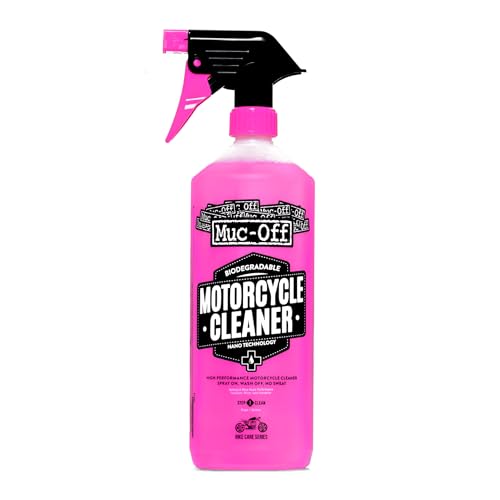
Muc-Off Nano-Tech Motorcycle Cleaner – Best All-Surface Wash
Biodegradable, safe on all motorcycle surfaces including painted panels, chrome, and anodized parts. Forum consensus on r/Harley: excellent foam dwell for road grime without attacking clearcoat. Works on gloss and matte finishes alike.
Check on Amazon
S100 Total Cycle Cleaner – Concentrated Motorcycle Wash
A longtime Harley community staple – concentrated formula, rinses clean, and is gentle enough for gloss paint while cutting through chain grease and road film. HDForums users with Touring models consistently recommend it for full-bike washes including saddlebag hardware.
Check on Amazon
Mothers Mag & Aluminum Polish – Chrome and Bare Metal
The go-to chrome polish for Harley owners across all eras – Evo, Twin Cam, and Milwaukee-Eight alike. Removes oxidation and surface rust from exhaust tips, engine cases, and wheel spokes. Apply with a clean microfiber pad, buff off in small sections. Cycle World editors have recommended it in multiple long-term tests on Harley Touring bikes.
Check on Amazon
Wizards Wipe Down – Matte and Denim Finish Safe
Explicitly labeled for flat, suede, and Denim surfaces – the exact terminology Harley-Davidson uses for its matte paint options on Street Glide and Road Glide models. No wax, no gloss agents. Spray on, wipe off. Multiple HDForums members with matte Denim Harleys use this as their primary between-wash detailer.
Check on Amazon
Lexol Leather Conditioner – Seats and Saddlebags
Harley-Davidson’s own service manuals specify using a quality leather dressing – specifically Part No. 98261-91V (HD Leather Care Dressing) – after cleaning leather with saddle soap (per 2008 VRSC Service Manual and 2004 Touring parts supplement). Lexol is the most widely available saddle-safe leather conditioner that matches that formulation intent. Apply after cleaning, allow full dry before riding.
Check on Amazon
Chemical Guys Diablo Wheel Cleaner – All Wheel Finishes
Listed as safe on all wheel and rim finishes including chrome, polished, and powder-coated. Harley’s cast wheels and laced spoked wheels both respond well. Spray, let dwell 2-3 minutes to break up brake dust, rinse thoroughly. Do not let it dry on chrome spokes – it will streak.
Check on AmazonThe Right Cleaning Order for a Harley
Order matters. Starting with the engine when the bike is hot, or applying wax before washing, creates more work and potential damage. Here is the sequence that Harley owners on HDForums and r/Harley consistently describe as the correct approach.
- Let the bike cool completely. Applying cleaner to a hot engine or exhaust causes streaking and can bake chemicals onto chrome. Minimum 30 minutes after riding.
- Rinse top to bottom with low-pressure water. Avoid pressure washers aimed at air cleaners, electrical connectors, or wheel bearings. Per the 2013 HD Dyna Service Manual (p. 1-3): clean with a rag dampened with a light cleaning agent for the drive belt area.
- Apply motorcycle wash to painted panels. Work top to bottom. Use two buckets – one with wash solution, one with rinse water – and a grit guard at the bottom to keep dirt out of your wash water.
- Clean wheels first (before they dry). Spray wheel cleaner on cool wheels, let dwell, scrub spoke gaps with a detailing brush, rinse thoroughly.
- Polish chrome after washing. Work on dry chrome only. Apply Mothers Mag with a microfiber applicator in small sections. Buff off before moving to next section.
- Apply paint protection (gloss only). Paste wax or spray sealant on gloss paint panels. Never apply to matte/Denim surfaces.
- Degrease and clean the engine last. Spray engine degreaser on cool cases, allow dwell per product instructions, rinse with low-pressure water angled away from air cleaner and connectors.
- Condition leather. After the bike is dry: clean leather with saddle soap, wipe with damp cloth, allow to dry 10 minutes, then apply leather conditioner.
Matte and Denim Finishes: The Exception to Every Rule
This is where most Harley owners make expensive mistakes. Harley-Davidson’s Denim paint (introduced on models like the Street Glide Special and Road King in the 2010s) has a deliberately textured, flat finish that wax destroys.
Multiple posts on HDForums (threads “Denim paint care 2014 FLHX” and “matte finish – how do you maintain it?”) show owners who accidentally used standard wax having to seek paint correction or respray sections. The fix is expensive. Use only matte-specific products from day one.
If you own a Milwaukee-Eight (2017+) model with a matte option, check your owner’s manual section on paint care – Harley explicitly warns against using polish or wax on Denim finishes in the owner documentation for those model years. Milwaukee-Eight models span the 107, 114, and 117 cubic inch variants across the Touring and Softail families.
Chrome Care: What Owners With 10+ Year Old Harleys Do Differently
Chrome on older Evolutions (1984-1999) and Twin Cam bikes (1999-2017) has decades of heat cycles, road salt exposure, and variable dealer prep quality behind it. The approach that works on a 2024 Street Glide’s fresh chrome may not be enough for a 2003 Road King’s exhaust pipes.
Our research found consistent advice across HDForums threads about chrome on older bikes: start with a non-abrasive cleaner first (dish soap is not the answer – use a motorcycle-specific wash) to remove loose oxidation, then progress to Mothers Mag for surface rust spots. For deeply pitted chrome with rust breakthrough, users on V-Twin Forum note that Nevr-Dull wadding polish (Amazon) can get into recesses that a standard applicator pad cannot reach. The key principle: aggressive abrasives on chrome will remove the plating layer, not just the oxidation, so start gentle and escalate only if necessary.
Heat-blued exhaust pipes are a separate category. Mothers Mag will address light blueing. For heavy heat staining on stainless or chrome exhaust, a metal polish with more cutting power like Flitz or Wenol is what experienced Harley owners on r/Harley consistently recommend – but those require more work and should be used with a light touch.
Leather Seat and Saddlebag Care: What Harley’s Own Manuals Specify
The leather care section trips up a lot of owners who default to whatever conditioner is on their shelf. Harley’s service documentation is actually specific about this.
Per the 2008 VRSC Service Manual (seat removal/installation section, p. 9-646): “Do not use ordinary soap to clean the seat. Thoroughly clean with a quality saddle soap. Once the seat is dry, it can be treated with Harley-Davidson Leather Care Dressing (Part No. 98261-91V).” The same Part No. 98261-91V reference appears in the 2004 Touring parts supplement for the FLHTCSE seat, where HD notes it “has been tested and approved for materials used in FLHTCSE seats.”
Lexol Leather Conditioner is the widely available third-party product that matches the intent of HD Part No. 98261-91V – pH-balanced, non-silicone, and designed for vegetable-tanned saddle leather. Silicone-based dressings (many “leather care” sprays at hardware stores are silicone) leave a residue that prevents the leather from breathing and can accelerate cracking in temperature extremes that motorcycle seats face.
What NOT to Use on a Harley-Davidson
Knowing what to avoid is just as important as knowing what to use. These are the most common cleaning mistakes that cost Harley owners money in repair and repainting bills.
- Dish soap (Dawn, Fairy, etc.) – strips protective wax coatings and clearcoat lubricating surfactants, accelerates corrosion on bare metal. High-alkaline pH (9-11) is too harsh for motorcycle paint systems.
- Pressure washers on high setting – forces water into bearing seals, air cleaner elements, and electrical connector boots. The 2013 HD Dyna Service Manual recommends keeping cleaning agents and water away from electrical system areas.
- WD-40 as a chrome protectant – attracts dust. WD-40 is a water displacer, not a protectant. Use dedicated chrome polish then a carnauba wax overcoat for lasting protection.
- Any wax or gloss polish on Denim/matte finishes – permanently alters the surface texture. See matte section above.
- Bleach or ammonia-based cleaners – will pit aluminum engine cases and oxidize chrome plating.
- Hot-water rinse on hot chrome – thermal shock can crack chrome plating on exhaust pipes. Always rinse with cool or room-temperature water on hot surfaces.
Harley Cleaning Linked to Maintenance Intervals
Washing your Harley is not just cosmetic – it is part of the maintenance cycle. While you are cleaning, you are in the best position to catch leaks, loose bolts, and early corrosion before they become expensive problems.
Harley-Davidson recommends a full service every 5,000 miles (Twin Cam/Milwaukee-Eight) or as specified in your model’s maintenance schedule. If you are storing your Harley for winter, cleaning before storage is part of the official pre-storage procedure – trapped salt and road grime underneath painted panels will cause corrosion through winter storage, especially in Northeastern states. For more on winterization, see our guide on how to store your Harley for winter.
After cleaning, check your oil level while the engine is warm – a clean engine makes oil seeps and weeps easy to spot. See our breakdown of best 20W-50 oils for Harley-Davidson for what to run in your model year. And before your next ride, verify tire pressure – clean wheels make it easier to spot sidewall damage or embedded debris. Our Harley-Davidson tire pressure chart has all model-specific specs in one place.
Clean wheels also make it easier to monitor tread depth and sidewall condition – our guide to how long motorcycle tires last explains the wear indicators and age rules to check at each wash.Frequently Asked Questions
These are the questions that come up most often in Harley cleaning threads on r/Harley and HDForums, answered with reference to manufacturer documentation where available.
Can I use car wash soap on my Harley-Davidson?
Some car wash soaps work but many are too alkaline for motorcycle clearcoat. Motorcycle-specific washes like S100 or Muc-Off are pH-neutral and formulated to be safe on chrome, rubber, and clearcoat. If you must use a car wash soap, choose one labeled pH-neutral and rinse thoroughly.
What do you use to clean a Harley with a matte Denim finish?
Use only a matte-rated detailer spray such as Wizards Wipe Down or Chemical Guys Meticulous Matte. Never apply wax, gloss polish, or standard spray detailers to matte/Denim finishes – the gloss agents fill the textured surface permanently.
How often should I wash my Harley-Davidson?
After every ride in rain or salted roads, and at minimum once a month during riding season. Road salt accelerates chrome corrosion and can attack clearcoat if left to dry repeatedly.
Can you pressure wash a Harley-Davidson?
Low-pressure rinsing is fine. High-pressure water aimed directly at wheel bearings, electrical connectors, air cleaner elements, or fork seals can force water past seals. The HD Dyna Service Manual notes keeping moisture away from electrical areas. Use a garden hose on medium setting or a pressure washer on its lowest setting from at least 24 inches away.
What should I use on Harley chrome exhaust pipes?
Mothers Mag & Aluminum Polish handles light oxidation and heat blueing effectively on chrome exhaust pipes. Apply with a microfiber applicator, work in sections, buff off before it hazes. For heavy heat staining on stainless exhaust, a dedicated metal polish like Flitz or Wenol provides more cutting power.
What does Harley-Davidson recommend for leather seat care?
Per the 2008 VRSC Service Manual: clean with quality saddle soap, dry, then treat with Harley-Davidson Leather Care Dressing Part No. 98261-91V. Avoid ordinary soap and silicone-based dressings. Lexol Leather Conditioner is widely regarded as a correct third-party equivalent.
Is dish soap OK to use on a Harley-Davidson?
No. Dish soap is high-alkaline (pH 9-11), strips wax coatings, and accelerates corrosion on chrome and aluminum engine cases. Use a dedicated motorcycle wash product instead.
Related reading: How to store your Harley for winter | Best 20W-50 oil for Harley-Davidson | Harley-Davidson tire pressure chart | Best seat for Heritage Softail Classic | What is the Harley-Davidson Deuce?
Disclosure: BackyardRider.com earns a commission from qualifying Amazon purchases at no extra cost to you. Our editorial selections are independent of affiliate compensation.
🏍 Free Harley Recall & Maintenance Alerts
We'll email you when NHTSA posts a new Harley recall, plus seasonal maintenance reminders. No spam, unsubscribe anytime.
By subscribing you agree to our Privacy Policy.
