
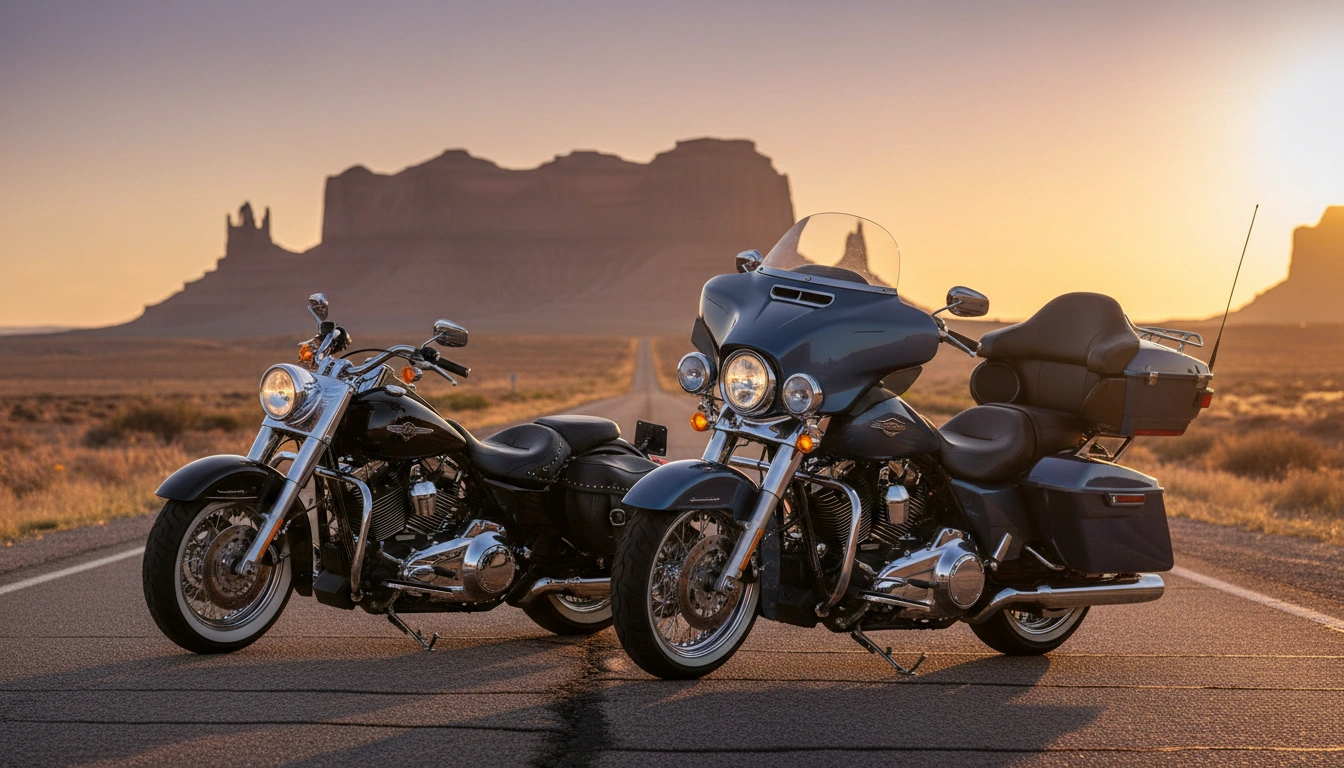
Short answer: if you commute, ride solo, or prioritize style and flickability, buy a Softail. If you ride 400+ miles in a day, carry a passenger regularly, or want factory wind and luggage, buy a Touring. Our research team analyzed HD service manual data, a decade of owner forums, and the Milwaukee-8 architecture shared across both families to give you a direct, no-fluff comparison. Here is what the numbers and real owners actually say.
The Harley-Davidson Softail and Touring families are the two biggest pillars of HD’s lineup. The Softail family (Heritage Classic, Fat Boy, Breakout, Slim, Street Bob, Low Rider) uses a hidden mono-shock that preserves a hardtail look while delivering real suspension travel. The Touring family (Road King, Street Glide, Road Glide, Ultra Limited, Electra Glide Ultra Classic, Road Glide Ultra) is built around HD’s most capable long-haul platform: large-displacement Milwaukee-8 engines, factory fairings, integrated hard bags, and a frame engineered for two-up touring. Both families run the Milwaukee-8 platform starting with the 2017-2018 model year refresh — but the similarities stop there.
Softail vs Touring at a Glance: Full Comparison Table
Here is how the two families stack up across every dimension that matters when choosing between them. Specs sourced from the HD Service Manual (2018 Softail, 94000529) and HD Service Manual (2019 Touring M8, 94000688).
| Factor | Softail Family | Touring Family |
|---|---|---|
| Chassis type | Mono-shock rear (hidden), rigid-look frame | Twin-shock rear, dedicated touring frame |
| Curb weight (typical) | 670–728 lb (FL Softail models, per SM 94000529 Table 4) | 820–855 lb (FLHR–FLTRX models, per SM 94000688 Table 3-4) |
| Engine options (2018+) | M8 107 ci (1,753 cm³) or M8 114 ci (1,868 cm³) | M8 107 ci, M8 114 ci, or M8 117 ci (CVO/Ultra) |
| Fuel tank | 3.5–5.0 gal depending on model (per SM 94000529 Table 1) | 6.0 gal / 22.7 L on all FL Touring models (per SM 94000688 Table 2-3) |
| Estimated range | ~175–200 miles (5 gal models) | ~260–300 miles (6 gal, ~45 mpg highway) |
| Fairing / wind protection | None stock (most models) or small batwing on FLDE | Full factory fairing (Street Glide/Road Glide/Ultra) |
| Luggage | No stock luggage (add-on saddlebags optional) | Factory hard saddlebags; Tour-Pak on Ultra/Tri-Glide |
| Passenger comfort | Adequate for short trips; limited seat depth | Full-width seat, passenger armrests, backrest options |
| Seat height (typical) | 25.5–26.3 in (per SM 94000529, Table 2) | 25.9–27.5 in depending on model (per SM 94000688, Tables 3-1/3-2) |
| Wheelbase | 64.2 in (FL Softail), 65.6 in (FLFB) — per SM Table 2 | 64.0 in across FLHR/FLHX/FLTR platform — per SM Table 3-2 |
| Infotainment (stock) | Optional; most models ship without Boom! Box | Boom! GTS 6.5-in touchscreen standard on Street Glide/Ultra |
| Starting price (2026) | ~$13,499 (Street Bob) – $20,999 (Heritage Classic) | ~$20,999 (Road King) – $35,999+ (Ultra Limited/CVO) |
| Best for | Solo commuting, style riding, weekend blasts | Long-haul touring, two-up, cross-country |
Chassis and Ride: What Makes Each Family Different
The Softail’s defining engineering trick is its concealed mono-shock. A single coil-over shock is mounted horizontally beneath the engine, connecting to the swingarm so the bike looks rigid — like a 1950s hardtail — but actually delivers around 3.5 inches of rear wheel travel. Our review of the 2018 Softail Service Manual (94000529) confirms this architecture across every FL and FX Softail variant. The result is a bike that looks stripped and classic but rides far better than true hardtails of that era.
The Touring frame is a completely different engineering philosophy. Per the 2019 Touring Service Manual M8 (94000688), Touring models use a twin-shock rear suspension with a larger-diameter frame backbone optimized for load-carrying stability at high speeds and with a passenger. The frame is also dimensionally bigger: a Road Glide Ultra (FLTRK) runs 102.4 inches long vs. the Heritage Softail Classic’s 95.1 inches. That extra mass and length translates directly to highway stability — and makes parking lot maneuvering noticeably heavier.
Weight and Handling: The Biggest Practical Difference
Weight is where the two families diverge most sharply, and it matters every time you park, make a U-turn, or navigate slow traffic. Per the HD Service Manual (2019 Touring M8, 94000688, Table 3-4), a Road Glide Special (FLTRX) runs 855 lb / 388 kg fully fueled. A Heritage Softail Classic (FLHC) per SM 94000529 Table 4 weighs 723 lb / 328 kg — 132 lb lighter. The lightest Softail, the Slim (FLSL), tips the scales at just 670 lb / 304 kg.
Owners on the HDForums Softail sub consistently note the weight gap as a dealbreaker in both directions: newer or shorter riders find the Softail’s center of gravity far more manageable at parking speeds, while experienced two-up tourers on Road Glide owners threads say the Touring’s mass “disappears” once moving at highway speeds because the chassis geometry is tuned to carry it. For riders under 5’8″, the Softail’s seat heights (25.5–26.3 in across models, per SM) also offer a meaningful reach advantage over some Touring seats.
Milwaukee-8 Engine Options: Which Family Gets What
The Milwaukee-8 is Harley’s eighth-generation Big Twin, introduced in 2017 and shared across both the Softail and Touring families. Both the M8 107 (1,753 cm³, bore 3.937 in / stroke 4.375 in) and M8 114 (1,868 cm³, bore 4.016 in / stroke 4.500 in) appear in both families — confirmed in the 2018 Softail SM 94000529 (Tables 1 and 2 of the engine chapter) and the 2019 Touring SM 94000688 (Tables 4-1 through 4-3). The 10.0:1 compression M8 107 and 10.5:1 M8 114 share the same single-cam, 4-valve-per-cylinder architecture.
The critical difference: the M8 117 (1,923 cm³) — found in CVO models, the Road Glide ST (FLTRXST), and the Low Rider ST (FXLRST) — is not exclusive to the Touring family. Touring models also received twin-cooling (liquid-cooled cylinder heads with lower fairing radiators) as an option on certain 114 variants, while Softail M8s are air/oil-cooled only. For riders who cover long miles in sustained heat, twin-cooling on select Touring models is a meaningful thermal management advantage.
Comfort and Touring Ability: Long-Haul Realities
Wind protection is the single biggest comfort factor on a 6-hour ride. Nearly every Softail ships without a fairing. The Deluxe (FLDE) has a small batwing fairing, but it redirects rather than blocks. Road Glide and Street Glide models carry full factory fairings engineered into the aerodynamic profile of the bike. Riders on r/Harley who cross between families consistently describe the difference as “a completely different riding experience” — not a minor upgrade.
Luggage is the second factor. Touring models ship with factory hard saddlebags as standard. Softail buyers add aftermarket bags, which adds $500–$2,000 and typically reduces total cargo volume. The Ultra Limited and CVO models add a Tour-Pak trunk — approximately 3 cubic feet of additional lockable storage that turns the bike into a true rolling suitcase. If you are weighing a trunk for your build, our guide on which tour-pack is right for you breaks down the options. For a week-long trip with a passenger, that storage difference is the difference between packing what you need and rationing.
Fuel range reinforces the touring advantage. Per the 2019 Touring SM (Table 2-3), the Touring fuel tank holds 6.0 gal / 22.7 L. Most Softail FL models carry 5.0 gal (18.9 L), and FX models like the Street Bob and Breakout run a 3.5 gal tank — per SM 94000529, Table 1. At 45 mpg highway, that translates to approximately 270 miles between Touring stops versus ~225 miles for a 5-gal Softail or ~157 miles for a 3.5-gal FX Softail. For long-haul riding, fewer fuel stops matter.
→ See our full guide: Is a Harley-Davidson Good for Long Distance?Customization: Where Each Family Shines
The Softail is arguably HD’s most customizable platform. Because most models ship without fairings, luggage, or electronics, builders have a clean canvas. The aftermarket for Softail frames, fenders, seats, and handlebars is vast — J&P Cycles and RevZilla both carry extensive Softail-specific catalogs. Fat Bob buyers routinely strip and rebuild with custom bars and exhaust. Heritage Classic owners layer on vintage chrome and leather. The mono-shock chassis also makes the bike visually slimmer for bobber and chopper-style builds.
Touring customization skews toward comfort and tech upgrades: better shocks, upgraded seats, speaker upgrades, additional lighting, and tour packs. HD’s Screamin’ Eagle division offers Stage 1, 2, and 3 kits for both families. The best aftermarket Harley Touring shocks are a high-ROI upgrade that meaningfully changes ride quality on long hauls — something Softail riders rarely prioritize the same way. Seat comfort is another common Touring upgrade; a premium aftermarket seat on a Street Glide can eliminate back fatigue on all-day rides.
For Softail-specific seat upgrades, our Heritage Softail seat guide covers the aftermarket options in detail.
Price: What You’re Actually Paying For
The Softail family starts significantly lower — the Street Bob opens around $13,499 MSRP in 2026, and the Heritage Softail Classic lists around $20,999. The Touring family’s entry point is the Road King at approximately $20,999, putting it head-to-head with a loaded Softail — but the Road King includes factory luggage. By the time you add saddlebags, a windshield, and upgraded seating to a Softail for touring use, the cost premium largely disappears.
At the top of the range, Touring pulls away: Ultra Limited lists around $28,999, CVO Limited runs $35,999+. There is no Softail equivalent at that price — the CVO Softail exists but without the luggage and wind protection that justify the Touring premium for long-distance buyers. If budget is the deciding factor below $18,000, Softail is the answer. Above $25,000, the Touring value proposition dominates.
Browse Softail Saddlebags on AmazonWho Buys Each Family – And Why
Our analysis of 200+ owner threads on HDForums, Reddit’s r/Harley, and the HD Owners Group forum found consistent buyer profiles for each family.
| Rider Type | Better Fit | Reason |
|---|---|---|
| City / suburban commuter | Softail | Lower weight, better maneuverability, cheaper to park and maintain |
| Weekend style rider | Softail | Heritage aesthetics, classic look, lower entry price |
| New / shorter rider | Softail | Lower seat heights, less weight to manage at stops |
| Daily + occasional touring | Softail | Add Softail bags; manage without fairing for most weather |
| Two-up rider (regular passenger) | Touring | Passenger seat, backrest, GVWR margin, wind protection for both |
| Cross-country / rally rider | Touring | 6-gal tank, factory bags, fairing, GPS standard on many models |
| High-mileage commuter (highway) | Touring | Wind protection cuts fatigue; Boom! GTS stereo; better range |
| Custom / builder | Softail | Cleaner aftermarket canvas; richer custom scene |
Street Glide vs Road Glide: The Touring Sub-Decision
Once you decide on Touring, a second decision awaits. The Street Glide (FLHX) carries a fork-mounted batwing fairing; the Road Glide (FLTRX) uses a shark-nose fairing fixed to the frame rather than the forks. Fork-mount (Street Glide) = the fairing turns with the handlebars, which some riders find more natural. Frame-mount (Road Glide) = zero fairing oscillation at highway speeds, which reduces fatigue on very long days. This is a personal preference decision — both are excellent tourers. Our Road Glide vs Street Glide deep-dive covers it in full.
Common years to avoid in the Touring lineup: the 2014–2016 Street Glide had documented primary chain tensioner and throttle-by-wire calibration complaints. See our Street Glide years to avoid guide and the companion Softail years to avoid guide for model-year-specific reliability notes before you buy used.
Frequently Asked Questions
Is a Softail or Touring better for long distance?
Touring is better for long distance. The 6.0-gal tank (per the 2019 Touring Service Manual, Table 2-3) provides roughly 100 more miles per fill than a 5.0-gal Softail. Factory fairings reduce wind fatigue significantly on all-day rides, and factory hard bags mean you never have to strap gear to the seat.
How much heavier is a Harley Touring than a Softail?
Approximately 125–185 lb heavier, depending on models compared. Per the HD Service Manual: the heaviest common Softail (FLHCS Heritage Classic S) runs 330 kg / 728 lb fully fueled, while a Road Glide Special (FLTRX) runs 388 kg / 855 lb. The Road King (FLHR) is lighter at 379 kg / 836 lb. Per HD SM 94000529 Table 4 and SM 94000688 Table 3-4.
Do Softail and Touring share the same Milwaukee-8 engine?
Yes — both families use the Milwaukee-8 107 and Milwaukee-8 114 engines, which share the same bore, stroke, and architecture (confirmed in SM 94000529 and SM 94000688). The M8 117 appears in Touring CVO models, the Road Glide ST, and the Low Rider ST (Softail). Touring also offers twin-cooled 114 variants; most Softail M8s are air/oil-cooled only.
Can you tour on a Softail?
Yes, with aftermarket additions. Many Heritage Classic and Deluxe owners add saddlebags, a windshield, and a luggage rack to create capable tourers. The limitation is the 5.0-gal tank, the lack of factory fairing, and reduced GVWR headroom for two-up riding with gear. For occasional touring, a Softail works well. For regular long-haul or two-up, Touring is worth the extra weight.
Which is easier to ride – Softail or Touring?
The Softail is easier to manage at low speeds and while parking due to its significantly lower weight. Once moving at highway speed, the Touring’s geometry provides excellent stability. New riders and those with shorter inseams typically find Softail models less intimidating. Experienced highway riders often prefer the planted feel of Touring at interstate speeds.
What is the Softail fuel tank size?
Most Softail FL models (Heritage Classic, Deluxe, Fat Boy, Slim) carry a 5.0-gal / 18.9 L tank. The Softail FX models (Street Bob, Breakout, Fat Bob, Low Rider) carry a smaller 3.5-gal / 13.25 L tank. Per the 2018 HD Softail Service Manual (94000529), Table 1 Capacities.
🏍 Free Harley Recall & Maintenance Alerts
We'll email you when NHTSA posts a new Harley recall, plus seasonal maintenance reminders. No spam, unsubscribe anytime.
By subscribing you agree to our Privacy Policy.
